- Animals
- ›Chordates
- ›Vertebrates
- ›Birds
- ›Swifts and Hummingbirds
- ›Hummingbirds
- ›Bee Hummingbirds, Emeralds, Mountain-gems, and Allies
- ›Mountain-gems and Allies
- ›Panterpe
On eBird ↗
Fiery-throated Hummingbird
Live sightings near you, the range map, bar charts of when it is seen, and Macaulay Library photos and recordings.
Fiery-throated Hummingbird
Panterpe insignis
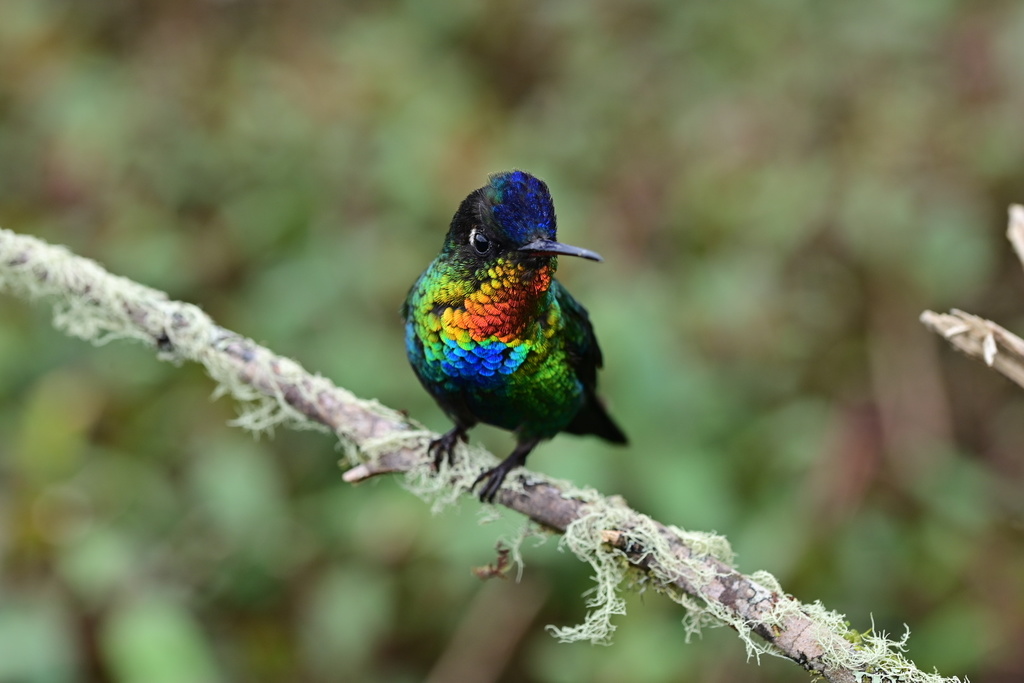
The fiery-throated hummingbird (Panterpe insignis) is a medium-sized hummingbird which breeds only in the mountains of Costa Rica and western Panama. It is the only member of the genus Panterpe.
From the article Fiery-throated hummingbird on Wikipedia (CC BY-SA), quoted section by section
Description
The fiery-throated hummingbird is 10.5 to 11 cm (4.1 to 4.3 in) long. Males weigh 5.9 to 6.2 g (0.21 to 0.22 oz) and females 4.9 to 5.2 g (0.17 to 0.18 oz). Within each subspecies the male and female are alike. All have a mostly black bill with a pink base to the mandible and a small white spot behind the eye. The nominate P. i. insignis has a glittering royal blue crown and the rest of the face and nape are black. The back is bright metallic green that becomes bluish green on the uppertail coverts. The tail is blue-black. The center of the throat is brilliant rosy coppery orange and the sides are golden green. It has a violet-blue patch on the center of the breast and the rest of the underparts are bright green to blue-green. Subspecies P. i. eisenmanni is slightly smaller than the nominate but has a much shorter bill. The black of the neck extends onto the upper back and the blue-violet of the chest extends into the belly. The uppertail coverts are mostly blue.
Range & habitat
The nominate subspecies of fiery-throated hummingbird is found from the Cordillera de Tilarán in north-central Costa Rica southeast to Bocas del Toro and Chiriquí provinces of far western Panama. P. i. eisenmanni is restricted to the Cordillera de Guanacaste in northwestern Costa Rica. The species inhabits a variety of wooded landscapes including montane forest, cloudforest and elfin forest. It also occurs in more open landscapes like the lower edge of páramo, secondary forest, and pastures with many trees. It mostly remains in the forest canopy but occurs in shrubs low down at the forest edge and in clearings. In northern and north-central Costa Rica it occurs at elevations from 1,600 m (5,250 ft) to summits at up to 2,000 m (6,560 ft); further south in higher mountains it ranges between 2,200 and 3,200 m (7,220 and 10,500 ft).
Wikipedia: “Distribution and habitat”
What it does
The fiery-throated hummingbird feeds on nectar taken from a variety of small flowers, including those of epiphytic Ericaceae, bromeliads, shrubs, and small trees. At flowers too deep for its bill it will take nectar from holes made by itself, bumblebees, and flowerpiercers. The species is aggressive and dominant over most other hummingbirds. Males defend feeding territories during the breeding season but allow females to feed; both sexes defend territories post-breeding. In addition to nectar, the species captures small arthropods on the wing and sometimes by gleaning from foliage.
Wikipedia: “Feeding”
Listen
Looking for field recordings…
Where it lives
Recorded sightings
—
geo-referenced records in GBIF, from museums, herbaria and field observers.
Drag the globe to turn it. Dots are where records exist, not a range map; darker means more records.
In the stacks
Searching the stacks…
Every page naming Panterpe insignis in the Biodiversity Heritage Library →
This page is assembled live from iNaturalist, GBIF, Wikipedia, the Source Library and the Internet Archive. It is not yet part of the hand-edited codex. iNaturalist taxon 6134.