- Animals
- ›Chordates
- ›Vertebrates
- ›Ray-finned Fishes
- ›Spiny-rayed fishes
- ›Perches, Scorpionfishes, Sticklebacks, and Allies
- ›Eelpouts and allies
- ›Monkeyfaces
- ›Cebidichthys
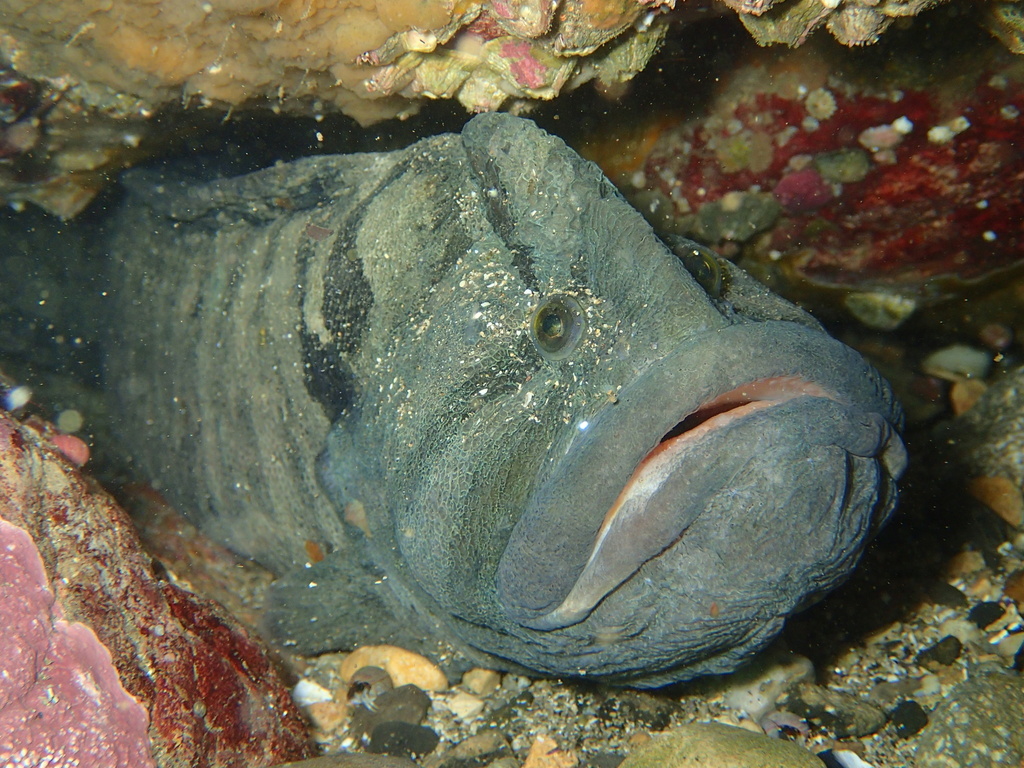
Monkey-faced Prickleback
Cebidichthys violaceus
The monkeyface prickleback (Cebidichthys violaceus), also commonly known as the monkeyface eel, is a species of prickleback native to the Pacific coast of North America. Although its shape resembles an eel due to its slender and leg-less body, the monkeyface prickleback does not belong to the order Anguilliformes, which includes true eels, instead, it is classified under either the Perciformes, along with nearly half of all bony fish, or the Scorpaeniformes, according to different authorities. Observations in nature and in the laboratory indicate that C. violaceus is a cryptic, bottom dweller and a weak, short-distance swimmer.
From the article Monkeyface prickleback on Wikipedia (CC BY-SA), quoted section by section
Description
The species reaches a maximum size of 76 cm (30 in) and may live up to 18–19 years. The heaviest monkeyface prickleback recorded to date was just over 6 lb (2.7 kg). They are slow-growing and reach sexual maturity between four and seven years of age, at a body length of approximately 36 to 45 cm. Some distinguishing characteristics of the C. violaceus include its color, which varies from black to a brownish-green. It also has two uniform dark stripes below its eyes and one or more reddish rust-colored spots on its side or belly. The coloration of both sexes is similar. This species has an anguilliform body shape, with large pectoral fins and two spines on the anal fin. Additionally, breeding males often have a large fleshy lump on the top of their heads.
Range & habitat
The monkeyface prickleback has a distribution range from southern Oregon to the northern reaches of the Mexican state of Baja California, this species is a coastal fish that inhabits rocky, intertidal areas close to shore. They are most abundant along the coast of central California. Their vertical distribution ranges from the upper intertidal zone to a depth of 24 meters. However, smaller individuals are commonly found closer to the higher intertidal zones due to reduced predation and competition, where they utilize rocks for protection during low tide. C. violaceus moves from the high intertidal to the shallow subtidal as it grows. It is considered to be a residential species, as it moves short distances from crevices or under rocks to foraging sites. This means it tends to stay in one area and does not move far from its hiding spots. This species appears to occupy a small home range of several meters and is mostly active during periods of a higher tide when it forages.
Wikipedia: “Distribution”
What it does
While young monkeyface prickleback feed on zooplankton and crustaceans, adults are primarily herbivorous, consuming red and green algae. As early juveniles, their prey includes copepods, amphipods, isopods, mysids, and polychaetas. Adults have few predators other than humans, but young fish are vulnerable to piscivorous birds and other fish, such as grass rockfish. Predation primarily affects the earlier life stages of this species; large juveniles and adult fish are most likely to evade or outgrow these predators.
Wikipedia: “Diet”
Where it lives
Recorded sightings
—
geo-referenced records in GBIF, from museums, herbaria and field observers.
Drag the globe to turn it. Dots are where records exist, not a range map; darker means more records.
In the stacks
Searching the stacks…
Every page naming Cebidichthys violaceus in the Biodiversity Heritage Library →
This page is assembled live from iNaturalist, GBIF, Wikipedia, the Source Library and the Internet Archive. It is not yet part of the hand-edited codex. iNaturalist taxon 61376.