- Animals
- ›Chordates
- ›Vertebrates
- ›Ray-finned Fishes
- ›Spiny-rayed fishes
- ›Perches, Scorpionfishes, Sticklebacks, and Allies
- ›Sticklebacks and Allies
- ›Sand Eels
- ›Hypoptychus
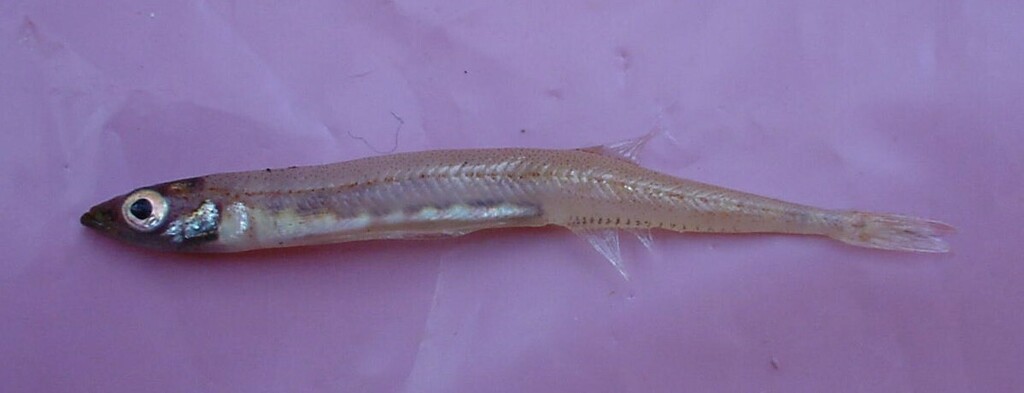
Korean sandlance
Hypoptychus dybowskii
The Korean sandlance (Hypoptychus dybowskii) is a species of marine ray-finned fish belonging to the family Hypoptychidae. The Korean sandlance is the only species in this monotypic family and genus and is found in the northwestern Pacific Ocean.
From the article Korean sandlance on Wikipedia (CC BY-SA), quoted section by section
Description
The Korean sandlance has an elongate body which has no scales, scutes or spines. Its dorsal and anal fins are placed well back on the body towards the caudal fin, and they both have around 20 fin rays. There is no pelvic girdle or pelvic fins. The pectoral fin has 9 rays and the caudal fin has 13 main rays, 11 of which are branched. There is a broken ring around the eye. In males the premaxilla has teeth but not in females. There are around 29 pairs of pleural ribs, but there are no epipleurals, the vertebrae number roughly 55 to 57. The hypural plate is split into upper and lower halves, on most other members of the suborder, the other exception being the sticklebacks in the genus Gasterosteus the hypural plate is fused. This species has a maximum published total length of 10 cm (3.9 in). The smeitransparent head and body are reddish-yellow in colour marked with small black spot, these are larger around the front of the lower jaw and on the lower gill membrane. The fins are all semi-transparent and the membranes of dorsal and anal fins have small black melanophores.
Range & habitat
The Korean sandlance is found in the northwestern Pacific Ocean where it occurs in the coastal waters off of northern Honshu and Hokkaido in Japan, Sakhalin, and the Kuril Islands. Its presence off the Korean coast has been confirmed. It is a benthopelagic species.
Wikipedia: “Distribution and habitat”
In human culture
The Korean sandlance's genus name, Hypoptychus, is a combination of hypo, which means "under", and ptychos, meaning "fold", an allusion to the long skin fin fold on the lower surface of the body in that taxon. The specific name likely honours the Polish biologist Benedykt Dybowski, who was a worker on the fauna of the Russian Far East.
Wikipedia: “Etymology”
Where it lives
Recorded sightings
—
geo-referenced records in GBIF, from museums, herbaria and field observers.
Drag the globe to turn it. Dots are where records exist, not a range map; darker means more records.
In the stacks
Searching the stacks…
Every page naming Hypoptychus dybowskii in the Biodiversity Heritage Library →
This page is assembled live from iNaturalist, GBIF, Wikipedia, the Source Library and the Internet Archive. It is not yet part of the hand-edited codex. iNaturalist taxon 615532.