- Animals
- ›Chordates
- ›Vertebrates
- ›Ray-finned Fishes
- ›Spiny-rayed fishes
- ›Perches, Scorpionfishes, Sticklebacks, and Allies
- ›Icefishes and allies
- ›Cod Icefishes
- ›Pleuragrammatinae
- ›Dissostichus
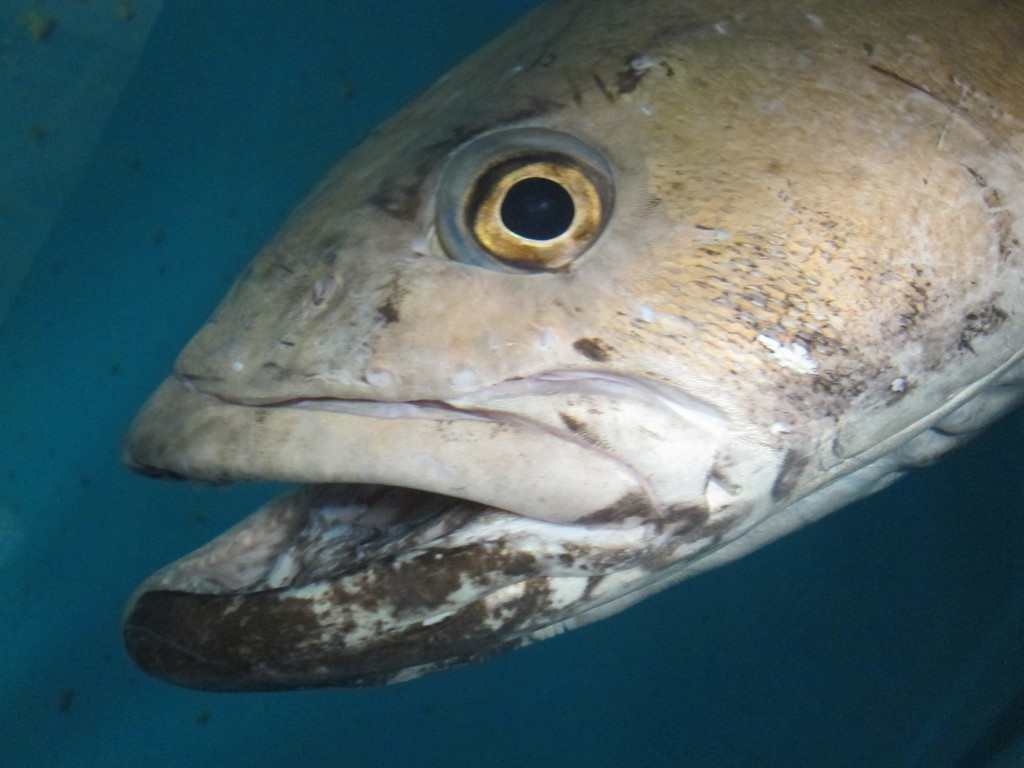
Antarctic toothfish
Dissostichus mawsoni
The Antarctic toothfish (Dissostichus mawsoni), also known as the Antarctic cod, is a large, black or brown fish found in very cold (even subzero) waters of the Southern Ocean near Antarctica. It is the largest species of bony fish in the Southern Ocean, feeding largely on smaller fishes and crustaceans, and, in turn, preyed on by orcas, other toothed whales, and seals. It is caught for food and marketed as Chilean sea bass together with its sister species, the more northerly Patagonian toothfish (D. eliginoides). Often mistakenly called "Antarctic cod", the Antarctic toothfish is a species in the (Nototheniidae), a family of fishes abundant in subantarctic waters.
From the article Antarctic toothfish on Wikipedia (CC BY-SA), quoted section by section
Description
Fully grown, antarctic toothfish, (like their warmer-water relatives, the Patagonian toothfish, D. eleginoides) may grow to more than 1.7 m (5 ft 7 in) in length and 135 kg in mass, twice as large as the next-largest Antarctic species of fishes. Being large, and consistent with the unstructured food webs of the ocean (i.e., big fish eating little fish regardless of identity, even eating their own offspring), the Antarctic toothfish has been characterized as a voracious predator. Furthermore, by being by far the largest midwater fish in the Southern Ocean, it is thought to fill the ecological role that sharks play in other oceans. As an adaptation to that role, the Antarctic toothfish is one of only five notothenioid species that, as adults, are neutrally buoyant. This buoyancy is attained at 100–120 cm in length and enables them to spend time above the bottom without wasting energy. Both bottom-dwelling and mid-water prey are, therefore, available to them. Most other notothenioid fish and the majority of all Antarctic fishes, including smaller toothfish, are confined to the bottom. Coloring is black to olive brown, sometimes lighter on the undersides, with a mottled pattern on body and fins. Small fish blend in very well among the benthic sponges and corals. …
What it does
Over the continental shelf, Antarctic toothfish feed on shrimp (Nauticaris spp.) and small fish, principally another neutrally buoyant nototheniid, the Antarctic silverfish (Pleuragramma antarcticum). This loosely schooling species is also a major prey of Adélie (Pygoscelis adeliae) and emperor penguins (Aptenodytes forsteri), Weddell seals (Leptonychotes weddellii) and Antarctic minke whales (Balaenoptera bonaerensis). Therefore, competition for prey among toothfish and these other mesopredators (middle trophic level predators) could be very important. The large Antarctic toothfish are eaten by sperm whales (Physeter macrocephalus), killer whales (Orcinus orca), Weddell seals, and possibly colossal squid (Mesonychoteuthis hamiltoni). Toothfish that are dwelling on the bottom, particularly those caught during the summer on the continental slope, eat mainly grenadiers (Macrouridae), but also feed on other smaller fish species and skates (Raja spp.). They also feed on the colossal squid. Antarctic toothfish have been caught to depths of 2200 m, though based on commercial fishing effort, few occur that deep.
Wikipedia: “Feeding ecology”
Where it lives
Recorded sightings
—
geo-referenced records in GBIF, from museums, herbaria and field observers.
Drag the globe to turn it. Dots are where records exist, not a range map; darker means more records.
In the stacks
Searching the stacks…
Every page naming Dissostichus mawsoni in the Biodiversity Heritage Library →
This page is assembled live from iNaturalist, GBIF, Wikipedia, the Source Library and the Internet Archive. It is not yet part of the hand-edited codex. iNaturalist taxon 618295.