- Animals
- ›Chordates
- ›Vertebrates
- ›Birds
- ›Swifts and Hummingbirds
- ›Hummingbirds
- ›Brilliants, Coquettes, and Allies
- ›Coquettes and Allies
- ›Heliangelus
On eBird ↗
Amethyst-throated Sunangel
Live sightings near you, the range map, bar charts of when it is seen, and Macaulay Library photos and recordings.
Amethyst-throated Sunangel
Heliangelus amethysticollis
The amethyst-throated sunangel (Heliangelus amethysticollis) is a species of hummingbird in the "coquettes", tribe Lesbiini of subfamily Lesbiinae. It is found in Bolivia, Ecuador, and Peru.
From the article Amethyst-throated sunangel on Wikipedia (CC BY-SA), quoted section by section
Description
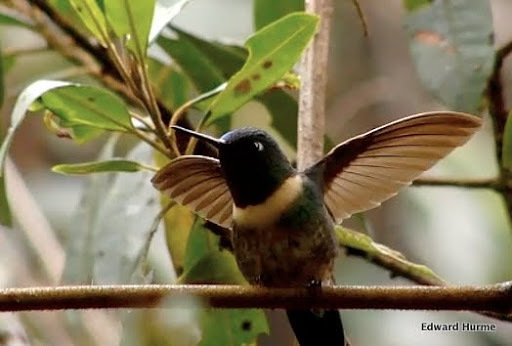
The amethyst-throated sunangel, as defined by the IOC, is about 10 cm (3.9 in) long and weighs 3.8 to 7.7 g (0.13 to 0.27 oz). The species has a straight, rather short, black bill. The adult male of nominate subspecies H. a. amethysticollis has shiny dark green upperparts with a bright green frontlet just above the bill. Its throat and upper breast gorget is rosy amethyst. That area has a narrow black border on the neck and a broader cinnamon band below it. The lower breast is glittery green and the rest of the underparts buff with green discs. The central tail feathers are bronze-green and the outer ones blue-black. The adult female is similar to the male but has a rusty throat with black flecks. Immatures are similar to the female. Subspecies H. a. laticlavius has a reddish purple gorget, a whitish breastband, and a buffy grayish belly. H. a. decolor has a paler frontlet than the nominate; its gorget is a deeper violet, its breast band whiter, and its belly grayer. H. a. apurimacensis has a turquoise-green frontlet, a whitish buff breast, and a pale buff belly.
Range & habitat
The four subspecies of amethyst-throated sunangel are found thus:
H. a. laticlavius, the Andes of southern Ecuador south to northern Department of Cajamarca in Peru H. a. decolor, the eastern slope of the Andes in central Peru from south of the Marañón River to the Department of Junín H. a. apurimacensis, the valleys of the Apurímac River and upper Urubamba River in the departments of Ayacucho and Cusco, southeastern Peru H. a. amethysticollis, the eastern slope of the Andes from southern Peru into northwestern Bolivia as far as Cochabamba Department The species inhabits wet and humid montane forest including cloudforest and elfin forest. Though it is found at forest edges and open bushy terrain, it prefers the interior of closed forest. In elevation it mostly ranges between 1,800 and 3,200 m (5,900 and 10,500 ft) but has been often recorded as high as 3,700 m (12,100 ft) in Peru.
Wikipedia: “Distribution and habitat”
What it does
The amethyst-throated sunangel feeds on nectar and also includes a high percentage of insects in its diet. It defends feeding territories that are dense with nectar sources; with its short bill it primarily feeds at flowers with shallow corollas. It typically feeds at heights up to 6 m (20 ft) and always near cover at the forest edge or interior. It captures insects by hawking from a perch.
Wikipedia: “Feeding”
Listen
Looking for field recordings…
Where it lives
Recorded sightings
—
geo-referenced records in GBIF, from museums, herbaria and field observers.
Drag the globe to turn it. Dots are where records exist, not a range map; darker means more records.
In the stacks
Searching the stacks…
Every page naming Heliangelus amethysticollis in the Biodiversity Heritage Library →
This page is assembled live from iNaturalist, GBIF, Wikipedia, the Source Library and the Internet Archive. It is not yet part of the hand-edited codex. iNaturalist taxon 6192.