- Animals
- ›Chordates
- ›Vertebrates
- ›Ray-finned Fishes
- ›Spiny-rayed fishes
- ›Rivulines, Killifishes, and Livebearers
- ›Cyprinodontoidei
- ›Live-bearers and Topminnows
- ›Typical Livebearers
- ›Poecilia
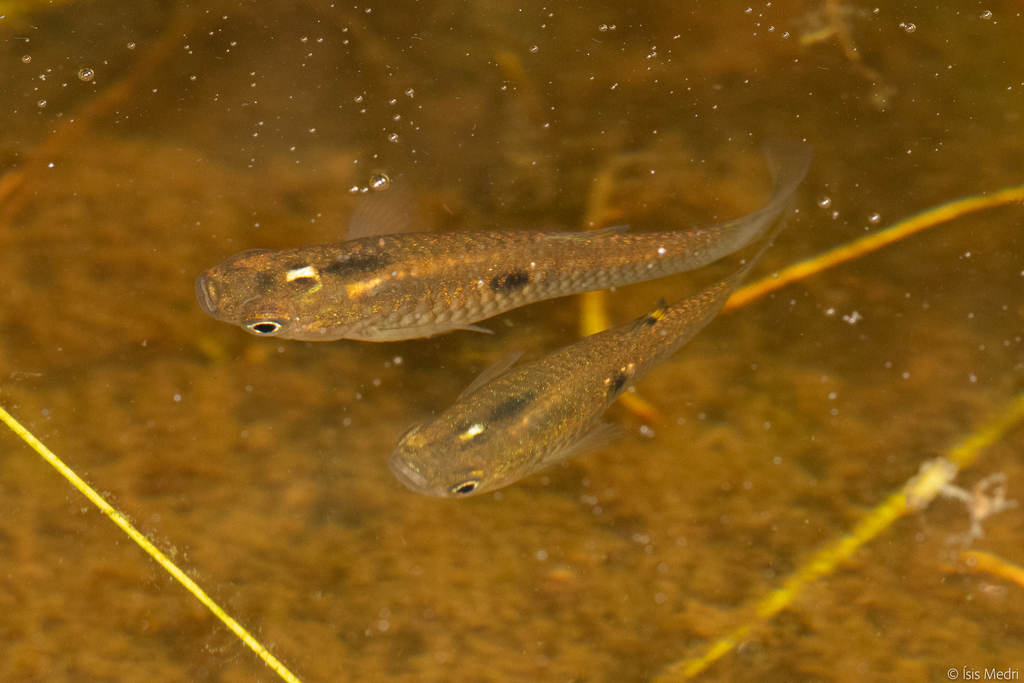
Guaru
Poecilia vivipara
Poecilia vivipara, sometimes called the southern molly, is a small euryhaline livebearer fish distributed along the Atlantic coast of South America. It is most frequently found in standing brackish water. It has been introduced outside its native range to control mosquito populations and is occasionally kept in home aquariums.
From the article Poecilia vivipara on Wikipedia (CC BY-SA), quoted section by section
Description
P. vivipara is a small poeciliid, normally growing to a size of 2–5 cm. The maximum recorded total length is 7.8 cm. Individuals from habitats with higher water salinity tend to grow faster and larger, and these differences in growth patterns are partly heritable. A factor in the size difference between freshwater populations and other populations is the high level of predation to which freshwater populations are exposed; such correlation between body size and predation pressure is usual among livebearers. Males do not exhibit bright color spots other than passing orange coloration in the throat region, which occurs more frequently in specimens from lagoon environments. Females are larger than males but the sexes do not otherwise differ as much as in the related common guppy, P. reticulata.
Range & habitat
P. vivipara was originally described from Suriname. The species is presently known to be distributed from the delta of the Orinoco River in Venezuela through Brazil to Uruguay. P. vivipara is one of the most common fish species in Brazil's lagoon ecosystems. Whether the species's range extends south to Argentina, specifically the Río de la Plata region, is contentious. P. vivipara may have been introduced to the Caribbean islands of Puerto Rico and Martinique. It is traditionally considered to have been introduced to Brazil's Fernando de Noronha archipelago to control mosquito larvae during the construction of the Second World War military bases but the species's ability to survive in saltwater makes it possible that the fish colonized the area naturally.
Wikipedia: “Distribution”
What it does
P. vivipara is omnivorous, feeding on diatoms, cyanobacteria, and invertebrates such as insect larvae. Due to preying on mosquito larvae, P. vivipara has been used to control mosquito populations in ponds and reservoirs. P. vivipara may be parasitized by the metacercariae of Pygidiopsis macrostomum, Ascocotyle pindoramensis, A. diminuta, and Acanthocollaritrema umbilicatum. In the case of A. umbilicatum, P. vivipara acts as a second intermediate host, the first being the aquatic snail Heleobia australis. Heavily infected fish are lethargic and more easily fall prey to the common snook, Centropomus undecimalis, which is the parasite's definitive host. In freshwater habitats the main predator of P. vivipara is Hoplias malabaricus; P. vivipara is one of the most common items in the latter fish's diet, especially of juveniles and subadults. Possible predators in brackish waters include cichlids Geophagus brasiliensis and Australoheros facetus, which have been observed preying on young but not adult P. vivipara in laboratory settings.
Wikipedia: “Ecology”
Where it lives
Recorded sightings
—
geo-referenced records in GBIF, from museums, herbaria and field observers.
Drag the globe to turn it. Dots are where records exist, not a range map; darker means more records.
In the stacks
Searching the stacks…
Every page naming Poecilia vivipara in the Biodiversity Heritage Library →
This page is assembled live from iNaturalist, GBIF, Wikipedia, the Source Library and the Internet Archive. It is not yet part of the hand-edited codex. iNaturalist taxon 619544.