- Animals
- ›Chordates
- ›Vertebrates
- ›Ray-finned Fishes
- ›Salmons, Pikes and Mudminnows
- ›Salmons, Trouts, and Whitefishes
- ›Salmons, Trouts, and Whitefishes
- ›Salmons and Trouts
- ›Parahucho
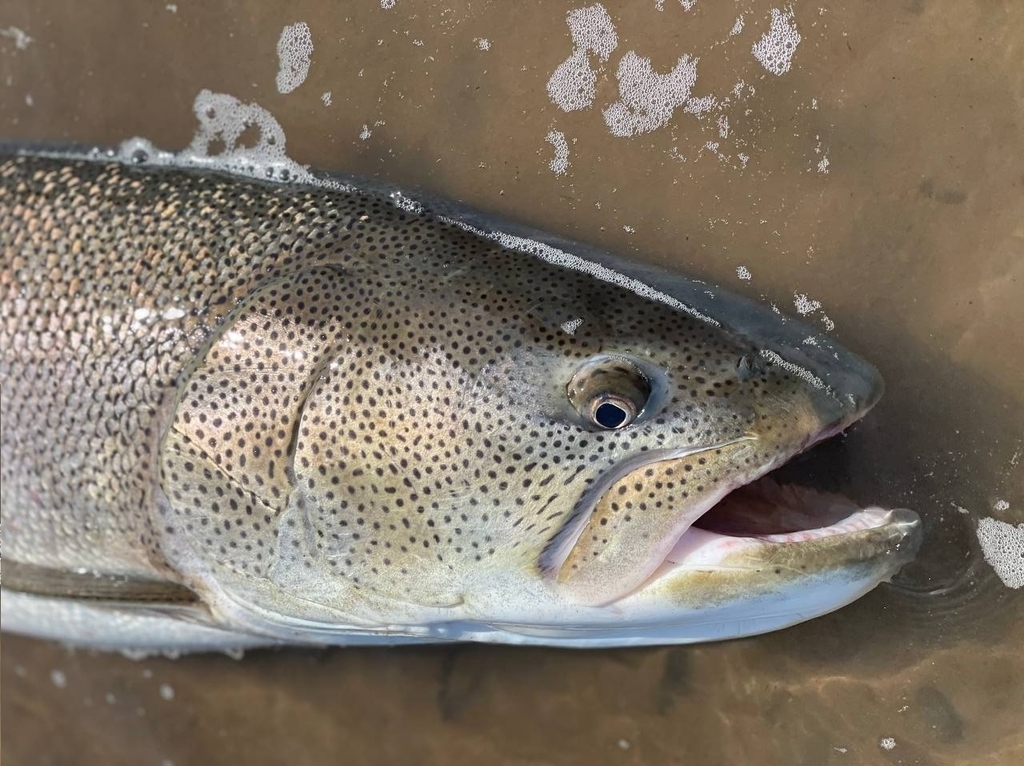
Sakhalin Taimen
Parahucho perryi
The Sakhalin taimen (Parahucho perryi, syn. Hucho perryi), also known as the Japanese huchen or stringfish (Japanese: 伊富/イトウ, romanized: itō), is a large species of salmonid freshwater fish in Northeast Asia, found in the lakes and large rivers of Primorsky, Khabarovsk, Sakhalin and Kuril Islands of Far Eastern Russia, as well as Hokkaido of Japan. Although often placed in the genus Hucho, molecular phylogenetic and other evidence has shown that it belongs in its own monotypic genus Parahucho.
The population has been in general decline for a century at least, with contributory factors including degradation of the environment by logging, oil exploration and change of land use to agriculture. The fish is caught by commercial fishing as bycatch, by recreational anglers and illegally by poaching, and present populations are estimated to be less than 5% of their historic levels. The International Union for Conservation of Nature has rated the fish as being critically endangered.
From the article Sakhalin taimen on Wikipedia (CC BY-SA), quoted section by section
Description
Parahucho perryi is one of the largest, most ancient salmon species and primarily inhabits the lower to middle reaches of lakes and rivers. Fish over 30 cm (1 ft) long are almost exclusively piscivores, while the young feed mostly on aquatic insects. Females typically lay between 2,000 and 10,000 eggs in the spring on the sandy or gravelly river bottom. The average specimens caught have weighed around 5 kg (11 lb). The largest fish caught was recorded at 15 kg (33 lb 1 oz) (IGFA world record). According to an unverified record from Japan, a fish with length of 2.1 m (6.9 ft) was captured in 1937 from the Tokachi River, Hokkaidō.
Range & habitat
Parahucho perryi are found in the Northwest Pacific: Sakhalin Island (Russia), the Island of Hokkaidō (Japan), and parts of the far eastern Russian mainland. Some populations spend all their lives in freshwater while others are anadromous. The fish take about eight years to mature and can spawn several times during their lifetime which is estimated to be about fourteen years.
Wikipedia: “Distribution”
Where it lives
Recorded sightings
—
geo-referenced records in GBIF, from museums, herbaria and field observers.
Drag the globe to turn it. Dots are where records exist, not a range map; darker means more records.
In the stacks
Searching the stacks…
Every page naming Parahucho perryi in the Biodiversity Heritage Library →
This page is assembled live from iNaturalist, GBIF, Wikipedia, the Source Library and the Internet Archive. It is not yet part of the hand-edited codex. iNaturalist taxon 620211.