- Animals
- ›Chordates
- ›Vertebrates
- ›Birds
- ›Swifts and Hummingbirds
- ›Hummingbirds
- ›Brilliants, Coquettes, and Allies
- ›Brilliants and Allies
- ›Aglaeactis
On eBird ↗
Shining Sunbeam
Live sightings near you, the range map, bar charts of when it is seen, and Macaulay Library photos and recordings.
Shining Sunbeam
Aglaeactis cupripennis
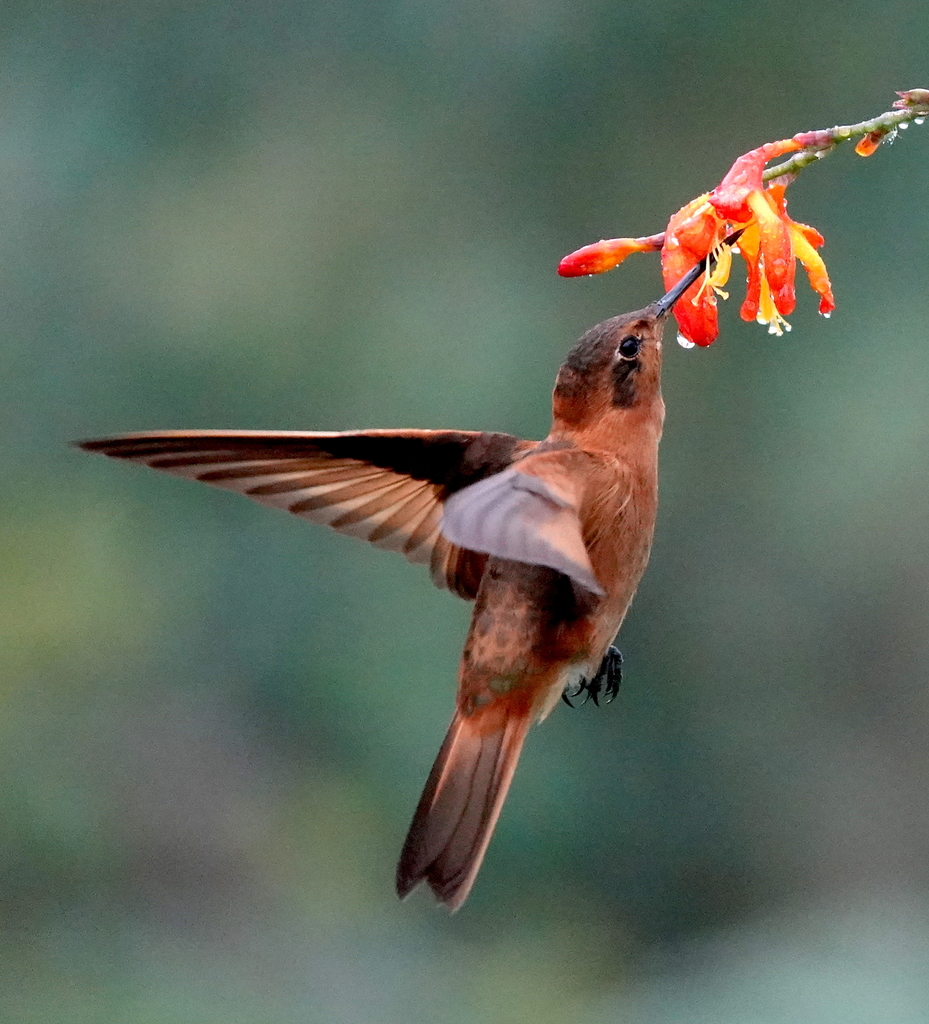
The shining sunbeam (Aglaeactis cupripennis) is a species of hummingbird in the family Trochilidae. It is found in Colombia, Ecuador, and Peru. Its natural habitats are subtropical or tropical moist montane forests and subtropical or tropical high-altitude shrubland.
From the article Shining sunbeam on Wikipedia (CC BY-SA), quoted section by section
Description
The shining sunbeam is 12 to 13 cm (4.7 to 5.1 in) long. Males weigh 7.6 to 8.1 g (0.27 to 0.29 oz) and females 6.9 to 7.5 g (0.24 to 0.26 oz). Both sexes have a short, straight, black bill. Unique among sunbeams, neither sex has any white plumage. Males of the nominate subspecies have a dark brown crown and upper back; their lower back and rump are lilac-gold becoming silvery green on the uppertail coverts. Their tail feathers are dark brown to rufous, usually with bronzy edges. Their throat is rufous dotted with dusky gray, the breast a patchy buff, and the belly reddish brown. From north to south, the male's underparts become brighter, the crown darker, and the tail redder. Females are similar to the males but the gold and green of the lower back and rump are duller or absent. A. c. caumatonota differs from the nominate with an iridescent amethyst rump and purplish amethyst uppertail coverts.
Range & habitat
The nominate subspecies of shining sunbeam is found in all three Andean ranges of Colombia and south from there through Ecuador to Peru's departments of La Libertad and Huánuco. A. c. caumatonota is found in Peru from the nominate's range south to the departments of Lima and Cuzco. The species inhabits sub-páramo to páramo, landscapes characterized by grasslands with scattered shrubs and trees. It also inhabits cloudforest and semi-arid ridges with a few trees. In elevation it ranges from 2,500 to 4,300 m (8,200 to 14,100 ft).
Wikipedia: “Distribution and habitat”
What it does
The shining sunbeam forages for nectar at all levels from the ground to treetops. It feeds at a wide variety of bromeliads, vines, and trees including Embothrium, Puya, and Fuchsia, and males defend patches of flowering plants. The species also feeds on small arthropods by hawking.
Wikipedia: “Feeding”
Listen
Looking for field recordings…
Where it lives
Recorded sightings
—
geo-referenced records in GBIF, from museums, herbaria and field observers.
Drag the globe to turn it. Dots are where records exist, not a range map; darker means more records.
In the stacks
Searching the stacks…
Every page naming Aglaeactis cupripennis in the Biodiversity Heritage Library →
This page is assembled live from iNaturalist, GBIF, Wikipedia, the Source Library and the Internet Archive. It is not yet part of the hand-edited codex. iNaturalist taxon 6210.