- Animals
- ›Chordates
- ›Vertebrates
- ›Ray-finned Fishes
- ›Spiny-rayed fishes
- ›Jacks, Flounders, Barracudas, and Allies
- ›Flatfishes
- ›True Soles
- ›Dagetichthys
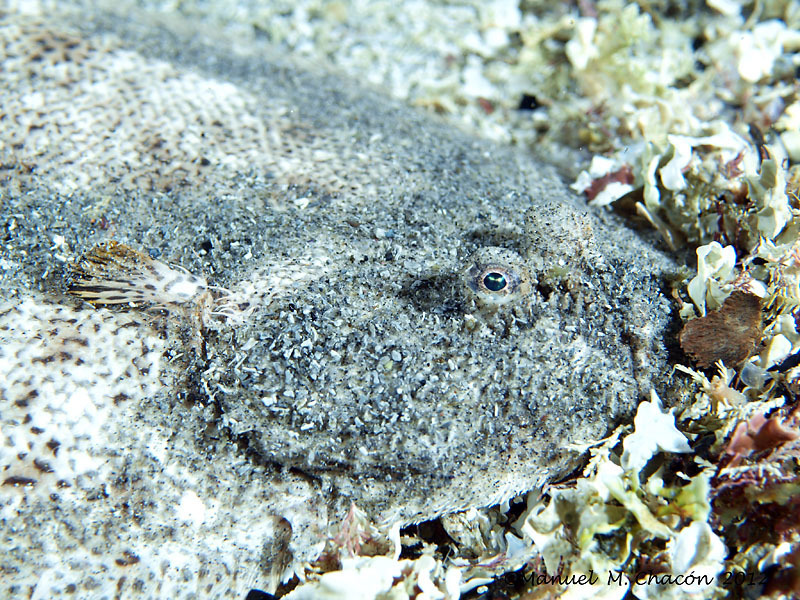
Portuguese Sole
Dagetichthys lusitanicus
Dagetichthys lusitanicus, commonly known as the Portuguese sole, is a species of flatfish native to the eastern Atlantic Ocean. Little is known of the abundance or behaviour of this fish, and the International Union for Conservation of Nature has rated its conservation status as being "data deficient".
From the article Dagetichthys lusitanicus on Wikipedia (CC BY-SA), quoted section by section
Description
The Portuguese sole grows to a standard length of about 35 cm (14 in). The general shape is oval, tapering somewhat towards the tail. Like other flatfish, the body is flattened laterally and the fish lies on its side, with both eyes on the right side; the upper eye is slightly in front of the lower one. The dorsal fin starts from the edge of the head and has 79 to 83 soft rays. The anal fin has 57 to 67 soft rays and it and the dorsal fin are continuous with the caudal fin. The upper side of the fish is greyish-brown, with black blotches, arranged in indistinct longitudinal rows. The underside of the fish is whitish.
Range & habitat
The Portuguese sole is native to the tropical and sub-tropical eastern Atlantic Ocean. Its range extends from Portugal to Angola. It is also present in the Cape Verde Islands and São Tomé and Príncipe. It was first recorded in the Mediterranean Sea in the early 1960s along the coast of Spain and has since extended its range to Libyan waters. It is a demersal fish, living on, or just above, the seabed at depths down to about 160 m (525 ft), on sandy and muddy substrates.
Wikipedia: “Distribution”
Where it lives
Recorded sightings
—
geo-referenced records in GBIF, from museums, herbaria and field observers.
Drag the globe to turn it. Dots are where records exist, not a range map; darker means more records.
In the stacks
Searching the stacks…
Every page naming Dagetichthys lusitanicus in the Biodiversity Heritage Library →
This page is assembled live from iNaturalist, GBIF, Wikipedia, the Source Library and the Internet Archive. It is not yet part of the hand-edited codex. iNaturalist taxon 621005.