- Animals
- ›Chordates
- ›Vertebrates
- ›Ray-finned Fishes
- ›Spiny-rayed fishes
- ›Perches, Scorpionfishes, Sticklebacks, and Allies
- ›Scorpionfishes and Allies
- ›Stonefishes
- ›Stingers
- ›Choridactylus
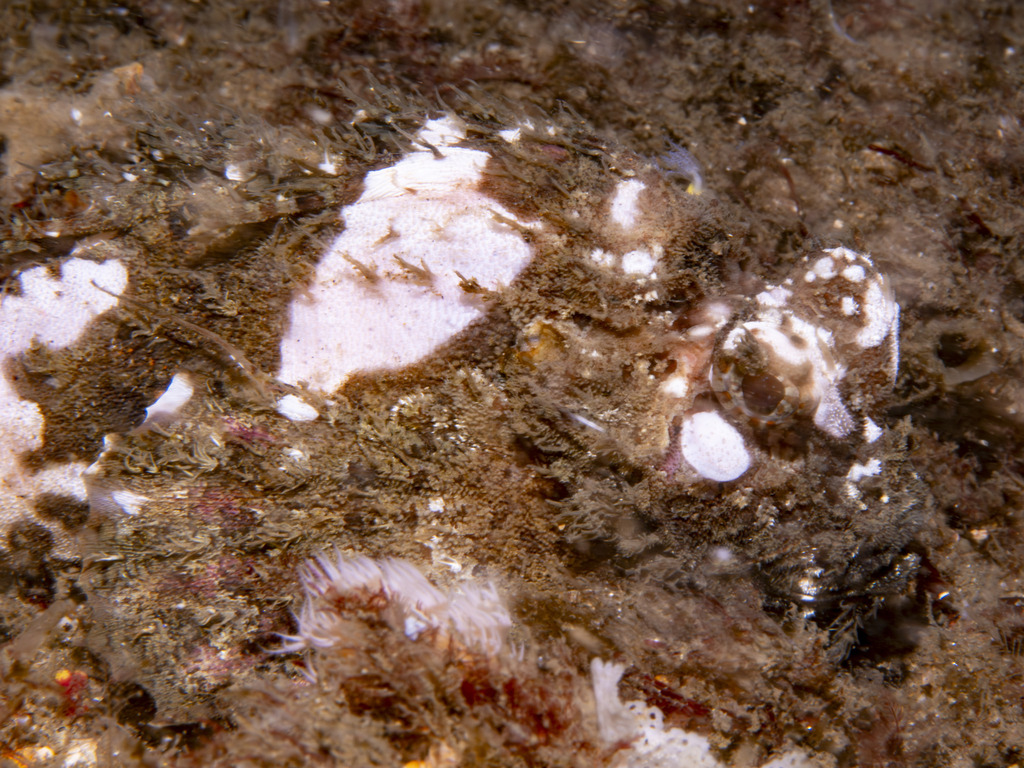
Three-Stick Stingfish
Choridactylus natalensis
Choridactylus is a genus of marine ray-finned fishes, it is one of two genera in the tribe Choridactylini, one of the three tribes which are classified within the subfamily Synanceiinae within the family Scorpaenidae, the scorpionfishes and their relatives. They are commonly known as stingfishes. They are found in the Indo-West Pacific.
From the article Choridactylus on Wikipedia (CC BY-SA), quoted section by section
Description
Choridactylus stingfishes have 12-15 spines and 8-10 soft rays in the dorsal fin with 2 spines and 8-10 soft rays in the anal fin. The pectoral fins have 12 fin rays with the 3 lower rays being separated. They have small blunt heads with bulging eyes with an occipital depression. The mouth is small and slightly oblique with villiform teeth on the jaws with no vomerine teeth or palatine teeth. The body has small tentacles or skin flaps on the lower jaw, eye, spiny dorsal fin and spiny anal fin. There are tufts on the lateral line and upper body. These fishes vary in size from a total length of 14 cm (5.5 in) in C. multibarbus and C. natalensis to 25 cm (9.8 in) in C. lineatus.
Wikipedia: “Characteristics”
Range & habitat
Choridactylus stingfishes are found in the Indian and Pacific Oceans, C. multibarbus is widespread reaching from Red Sea to the Philippines but the other three species are restricted to the western Indian Ocean. These fishes occur in shallow waters over sandy substrates.
== References ==
Wikipedia: “Distribution and habitat”
Where it lives
Recorded sightings
—
geo-referenced records in GBIF, from museums, herbaria and field observers.
Drag the globe to turn it. Dots are where records exist, not a range map; darker means more records.
In the stacks
Searching the stacks…
Every page naming Choridactylus natalensis in the Biodiversity Heritage Library →
This page is assembled live from iNaturalist, GBIF, Wikipedia, the Source Library and the Internet Archive. It is not yet part of the hand-edited codex. iNaturalist taxon 621367.