- Animals
- ›Chordates
- ›Vertebrates
- ›Ray-finned Fishes
- ›Spiny-rayed fishes
- ›Puffers and Filefishes
- ›Pufferfishes, Porcupinefishes, and Molas
- ›Pufferfishes
- ›Pao
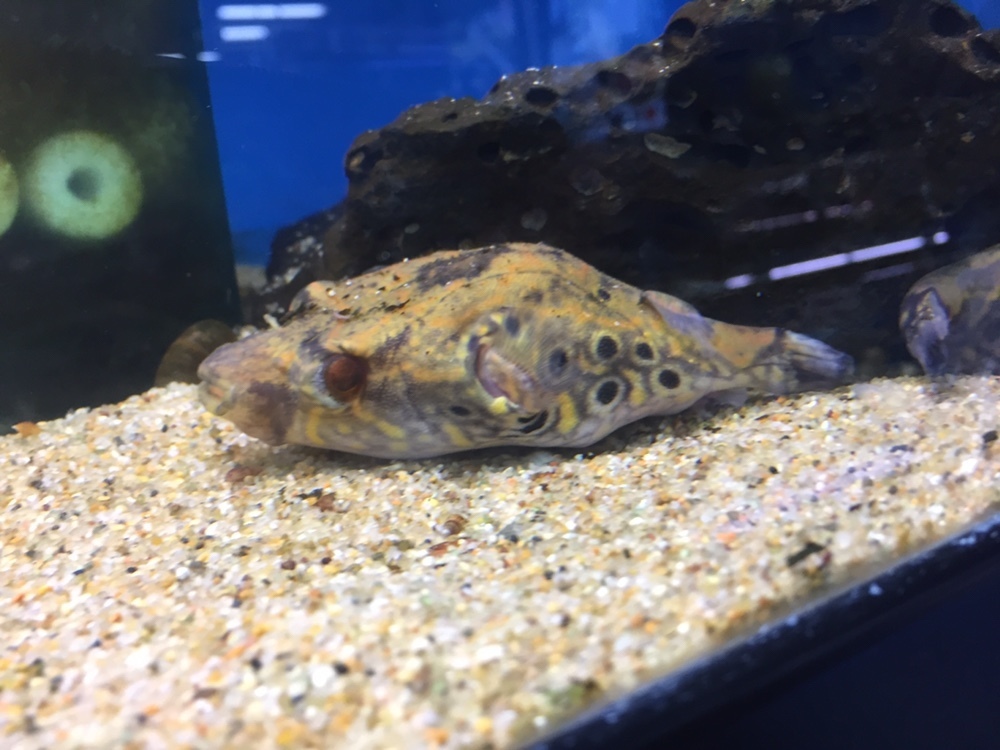
Humpback Puffer
Pao palembangensis
Pao palembangensis (formerly Tetraodon palembangensis), is a species of freshwater pufferfish native to Thailand, Laos, Malaysia and Indonesia in Southeast Asia. Its commonly called the humpback puffer or dragon puffer. It is bred for aquaria as an ornamental fish because of its beautiful skin colouration and pattern.
From the article Pao palembangensis on Wikipedia (CC BY-SA), quoted section by section
Description
Living in alkalescent, warm (24–28°), and slow-flowing rivers, Pao palembangensis grows to a length of 19.4 centimetres (7.6 in) SL. It is the largest member of its genus, and the third-largest freshwater pufferfish, only being outsized by the Fahaka and Mbu puffers. It is chocolate-brown, with a pale mottled underbelly and an elongated head. The large eyes of this fish are a distinct orange. As a pufferfish its body contains the neurotoxin tetrodotoxin (TTX), and it can swell up to three times its normal size as a defence mechanism when threatened. Females have a more pronounced "humpback", the result of a more arched spinal column. Having a small genome size (362Mb), a chromosome-scale genome assembly of P. palembangensis was sequenced as part of the Fish10K subproject of the Earth BioGenome Project.
What it does
It was previously thought to be an ambush predator but it is now believed that is not the case. P. palembangensis is an active hunter that pursues sleeping aquatic prey. It is a nocturnal fish as evidence by its large eyes, increased nightly activity, and daytime sleep..
== References ==
Wikipedia: “Behaviour”
Where it lives
Recorded sightings
—
geo-referenced records in GBIF, from museums, herbaria and field observers.
Drag the globe to turn it. Dots are where records exist, not a range map; darker means more records.
In the stacks
Searching the stacks…
Every page naming Pao palembangensis in the Biodiversity Heritage Library →
This page is assembled live from iNaturalist, GBIF, Wikipedia, the Source Library and the Internet Archive. It is not yet part of the hand-edited codex. iNaturalist taxon 621559.