- Animals
- ›Chordates
- ›Vertebrates
- ›Ray-finned Fishes
- ›Spiny-rayed fishes
- ›Cichlids and Allies
- ›Cichlids
- ›South and Central American Cichlids
- ›Mayaheros
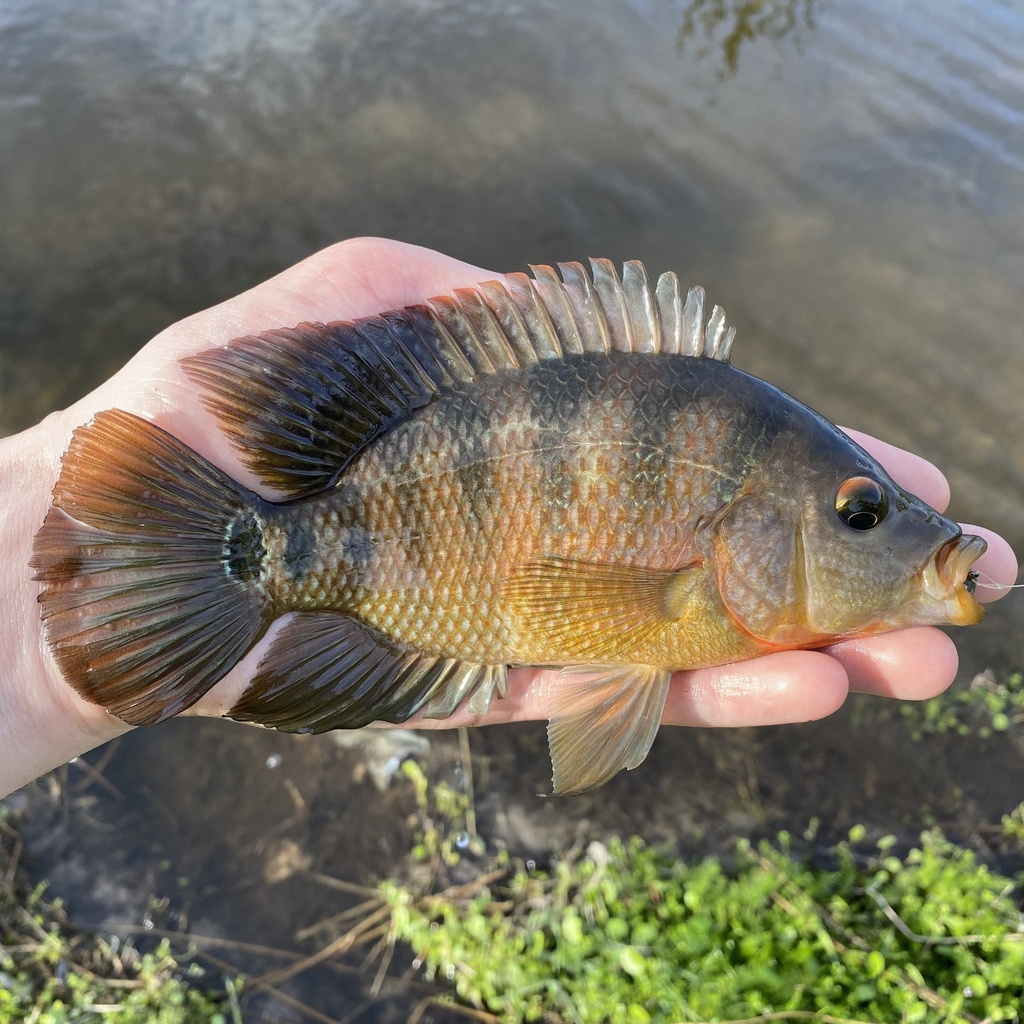
Mayan Cichlid
Mayaheros urophthalmus
Mayaheros urophthalmus, also known as the Mayan cichlid is a species of cichlid found in Middle America. It is native to the Atlantic slope of tropical Mesoamerica, ranging from eastern Mexico southward to Nicaragua. It was first recorded from Everglades National Park, Florida in 1983 and is now a common nonindigenous fish in southern Florida. It has a base color of brown to red that becomes more intense during breeding. As in many animals, the red...
From the article Mayaheros urophthalmus on Wikipedia (CC BY-SA), quoted section by section
Description
Mayaheros urophthalmus reaches a maximum length of 39.4 cm (15.5 in). This fish is one of the larger cichlids. Its body is oval and flattened on the sides and the head is tapering toward the mouth, and its fins are spiny. It has a base color of yellow-brown to gray-brown in most cases, that becomes intense red during breeding. The head and throat are reddish, especially in younger fish. The caudal fin and the soft sections of the dorsal and anal fins are usually more or less reddish. Six, wide, green-black vertical stripes run across the sides of the body between the base of the pectoral fin and the base of the caudal fin. A large black eye spot circled with blue-green is on the tail stem (hence the species scientific name urophthalmus, from oura, Greek for tail and ophthalmos, Greek for eye). Since its distribution area is relatively large, this species may occur in different colors, which may differ from the ones described above.
Range & habitat
This species can be found in Middle America. It is native to the Atlantic slope of tropical Mesoamerica, ranging from eastern Mexico southward to Nicaragua. It was first recorded from Everglades National Park, Florida, in 1983, and is now a common nonindigenous fish in South Florida.
Wikipedia: “Distribution”
What it does
Mayan cichlids are territorial and aggressive when breeding; they are highly protective of their young and have several broods per year. This species is a monogamous, biparental, substrate spawner that exhibits minimal sexual dimorphism and guards its fry for up to 6 weeks. All of these traits are greatly developed and represent an extreme in the general pattern found in the genus Mayaheros. In Mexico, the Mayan cichlid spawns for a 9-month period from March to November, particularly during the wet season from June to September. This corresponds to a period when the water temperature is at least 24 °C. Multiple broods are raised per year. The fry appear to be adapted to lotic water. They exhibit strongly positive geotactic behavior, actively swimming down to the substrate upon hatching from the egg and adhering themselves to the bottom by means of three pairs of mucous glands.
Wikipedia: “Reproduction”
Where it lives
Recorded sightings
—
geo-referenced records in GBIF, from museums, herbaria and field observers.
Drag the globe to turn it. Dots are where records exist, not a range map; darker means more records.
In the stacks
Searching the stacks…
Every page naming Mayaheros urophthalmus in the Biodiversity Heritage Library →
This page is assembled live from iNaturalist, GBIF, Wikipedia, the Source Library and the Internet Archive. It is not yet part of the hand-edited codex. iNaturalist taxon 623746.