On eBird ↗
Ancient Antwren
Live sightings near you, the range map, bar charts of when it is seen, and Macaulay Library photos and recordings.
Ancient Antwren
Herpsilochmus gentryi
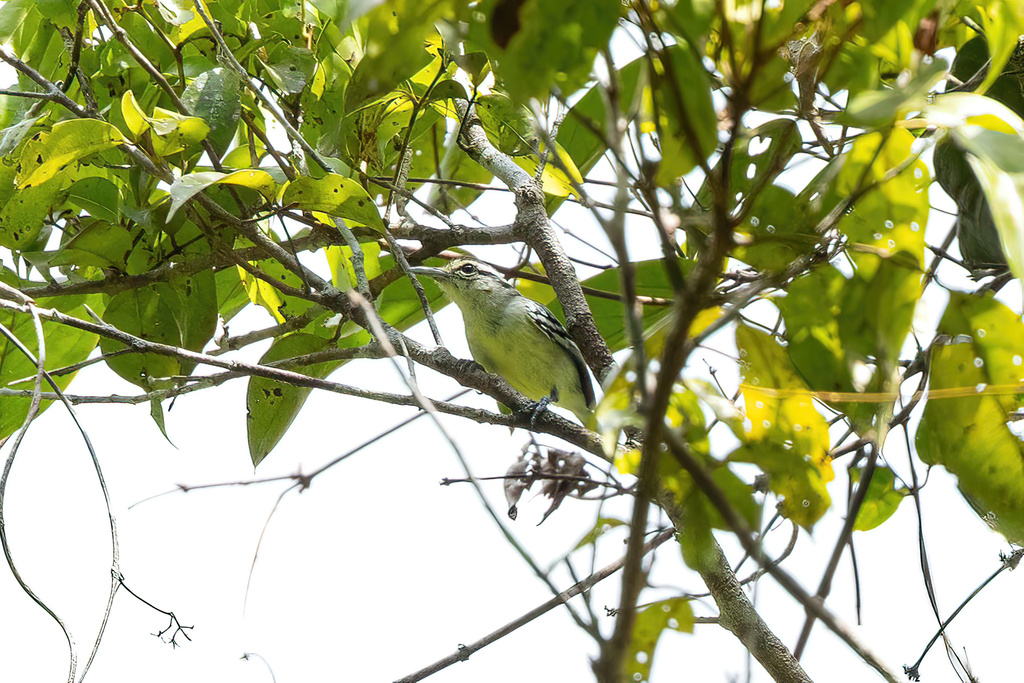
The ancient antwren (Herpsilochmus gentryi) is a species of tropical bird in the family Thamnophilidae. It is primarily found in terra firme forests of northern Peru and southeastern Ecuador. This species was described in 1998 and named after the American botanist Alwyn Gentry. Habitat loss poses the greatest threat to this species.
From the article Ancient antwren on Wikipedia (CC BY-SA), quoted section by section
Description
The ancient antwren is small passerine, with a total length of 10-11 centimeters (4 in) and weight of 10.2-11 grams. Sexual dimorphism is present in this species, but not as apparent when compared to other members of this genus. Adult males have solid black crowns with a bold yellowish supercilium, dark gray upperparts and rump, and yellowish throat and underparts. Females and subadults display whitish or yellow spots on the crown and generally have darker olive breasts and sides than adult males. The scapulars and coverts of this species are black tipped with white in all plumages, and the wings are overall short. The tail is short and graduated, with black rectrices outlined in white. Its closest relative, Todd's antwren (H. stictocephalus), does not overlap in range. It is sympatric with another member of Herpsilochmus, Dugand's antwren, but there is limited habitat overlap with this species. Ancient antwren can be distinguished from this species by its brighter yellow or olive underparts and lack of any rufous on the head or breast.
Range & habitat
This species is restricted to humid terra firme forest in north-central Peru and southeastern Ecuador within the Amazon basin. In Peru, appears to be restricted to two types of terra firme forest; varrilal, a stunted forest type characterized by white sands, and irapayal, an open-canopy forest with an understory dominated by palms. In Ecuador, it is found in terra firme forest on the highest and driest ridgetops. The ancient antwren appears to prefer patchy habitats with high-contrast edges. It is found at elevations up to 200 meters. Like others in its genus, this species occupies the canopy and sub-canopy. This species is considered a sedentary resident, with no documentation of migration or movement.
Wikipedia: “Distribution and habitat”
What it does
The ancient antwren forages high in canopy or sub-canopy, where it gleans prey from leaves and branches. Diet is poorly known, but feeds on insects, likely spiders and lepidopteran larvae. Foraging behavior has been described as active, with interspersed wing flutters and short hops. This species has been documented to forage in mixed flocks with other canopy-dwelling birds, as well as in small family groups or mated pairs.
Wikipedia: “Feeding and foraging”
Listen
Looking for field recordings…
Where it lives
Recorded sightings
—
geo-referenced records in GBIF, from museums, herbaria and field observers.
Drag the globe to turn it. Dots are where records exist, not a range map; darker means more records.
In the stacks
Searching the stacks…
Every page naming Herpsilochmus gentryi in the Biodiversity Heritage Library →
This page is assembled live from iNaturalist, GBIF, Wikipedia, the Source Library and the Internet Archive. It is not yet part of the hand-edited codex. iNaturalist taxon 62543.