On eBird ↗
Sharpe's Wren
Live sightings near you, the range map, bar charts of when it is seen, and Macaulay Library photos and recordings.
Sharpe's Wren
Cinnycerthia olivascens
The sepia-brown wren or Sharpe's wren (Cinnycerthia olivascens) is a species of bird in the Troglodytidae family. It was formerly considered a subspecies of the Peruvian wren (C. peruana), but under the common name sepia-brown wren. As presently defined, the sepia-brown wren is found in dense undergrowth of humid Andean forests in Colombia, Ecuador, and northern Peru.
From the article Sepia-brown wren on Wikipedia (CC BY-SA), quoted section by section
Description
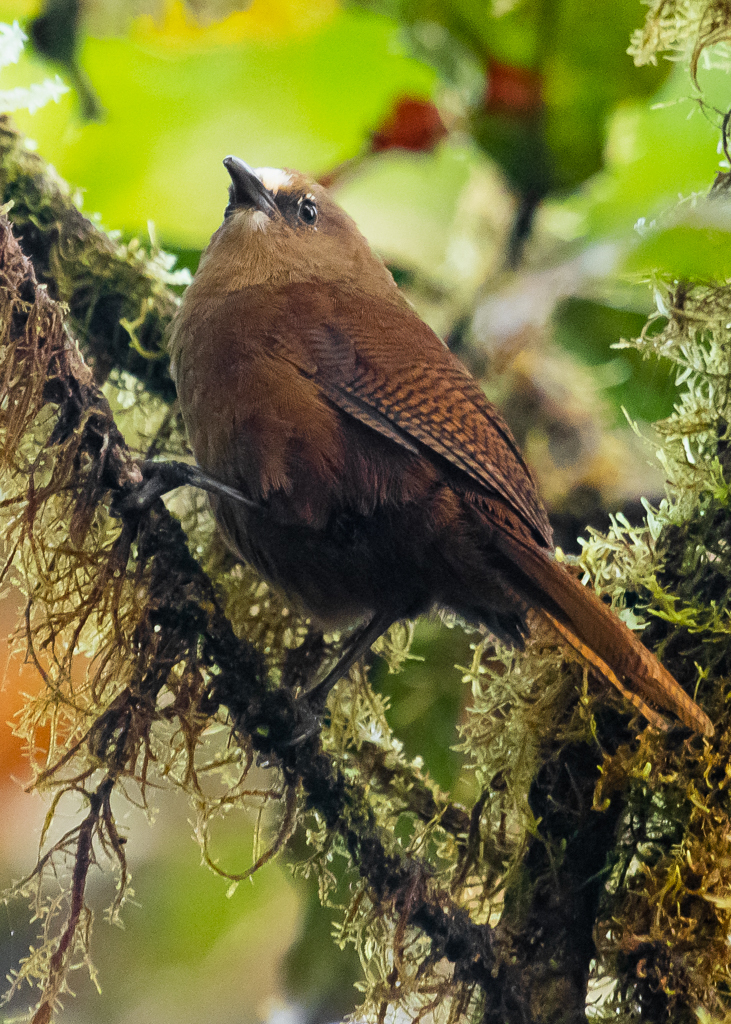
The sepia-brown wren is 16 cm (6.3 in) long; males weigh an average of 25.9 g (0.91 oz) and females weigh an average of 23 g (0.81 oz). Both subspecies are shades of brown. The nominate adult has a grayish brown crown, reddish brown back and rump, and a chesnut tail with blackish bars. It has a variable amount of white on its face. Its chin and throat are pale grayish brown darkening to dark reddish brown on the belly and vent. C. o. bogotensis is much darker overall and has no white on the face. Immatures are like the adults but with a grayish face.
Range & habitat
The nominate sepia-brown wren is found from the Central and Western Andes of Colombia south through Ecuador into extreme northern Peru. C. o. bogotensis is restricted to the western slope of Colombia's Eastern Andes. The species inhabits the interior and edges of wet mossy forest and cloudforest. In elevation it generally ranges between 1,500 and 3,100 m (4,900 and 10,200 ft) but is found as low as 900 m (3,000 ft) on the Pacific slope in Colombia.
Wikipedia: “Distribution and habitat”
What it does
The sepia-brown wren forages on and near the ground in dense vegetation, often in flocks of up to 10 individuals. Its diet is invertebrates including insects and their larva, snails, and earthworms.
Wikipedia: “Feeding”
Listen
Looking for field recordings…
Where it lives
Recorded sightings
—
geo-referenced records in GBIF, from museums, herbaria and field observers.
Drag the globe to turn it. Dots are where records exist, not a range map; darker means more records.
In the stacks
Searching the stacks…
Every page naming Cinnycerthia olivascens in the Biodiversity Heritage Library →
This page is assembled live from iNaturalist, GBIF, Wikipedia, the Source Library and the Internet Archive. It is not yet part of the hand-edited codex. iNaturalist taxon 62551.