On eBird ↗
Pale-eyed Blackbird
Live sightings near you, the range map, bar charts of when it is seen, and Macaulay Library photos and recordings.
Pale-eyed Blackbird
Agelasticus xanthophthalmus
The pale-eyed blackbird (Agelasticus xanthophthalmus) is a species of bird in the family Icteridae. It is found in Ecuador and Peru where its natural habitat is swamps. An inconspicuous bird of very local occurrence, it was first described in 1969 by American ornithologist Lester L. Short.
From the article Pale-eyed blackbird on Wikipedia (CC BY-SA), quoted section by section
Description
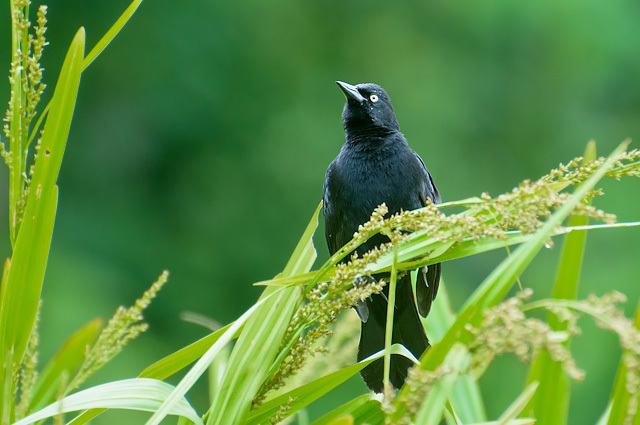
The adult pale-eyed blackbird is entirely black in both sexes. It has white or pale buff coloured irises to its eyes which are very distinctive and distinguish it from other black birds found in the area such as the velvet-fronted grackle and the shiny cowbird which have dark eyes. Juveniles and immature birds are brownish-black with underparts streaked with yellow or buff. The call is a loud metallic "tew-tew-tew-tew" similar to that of a black-capped donacobius. It is usually sung from the top of a shrub.
Range & habitat
The pale-eyed blackbird is found in a restricted area of eastern Peru and Ecuador. Its habitat is marshy areas round lagoons and oxbow lakes and the fringes of nearby grassland. Since its first discovery in 1969 it has been seen regularly in the Limoncocha National Biological Reserve near the Napo River, Ecuador and in the Tambopata National Reserve near the Madre de Dios River, Peru.
Wikipedia: “Distribution and habitat”
What it does
This blackbird is usually seen in pairs and spends most of the day in marshy places in thick undergrowth. It is most visible in the early morning when it emerges into more open areas to forage, and it at this time of day that it is most likely to be heard singing from the top of a bush.
Wikipedia: “Behaviour”
Listen
Looking for field recordings…
Where it lives
Recorded sightings
—
geo-referenced records in GBIF, from museums, herbaria and field observers.
Drag the globe to turn it. Dots are where records exist, not a range map; darker means more records.
In the stacks
Searching the stacks…
Every page naming Agelasticus xanthophthalmus in the Biodiversity Heritage Library →
This page is assembled live from iNaturalist, GBIF, Wikipedia, the Source Library and the Internet Archive. It is not yet part of the hand-edited codex. iNaturalist taxon 62561.