On eBird ↗
Orange-backed Troupial
Live sightings near you, the range map, bar charts of when it is seen, and Macaulay Library photos and recordings.
Orange-backed Troupial
Icterus croconotus
The orange-backed troupial (Icterus croconotus) is a species of bird in the family Icteridae. It is found in Guyana, Brazil, Paraguay, and eastern Ecuador, Bolivia, and Peru. It is closely related to the Venezuelan troupial (Icterus icterus) and Campo troupial (Icterus jamacaii), and at one time, all three were considered to be the same species.
From the article Orange-backed troupial on Wikipedia (CC BY-SA), quoted section by section
Description
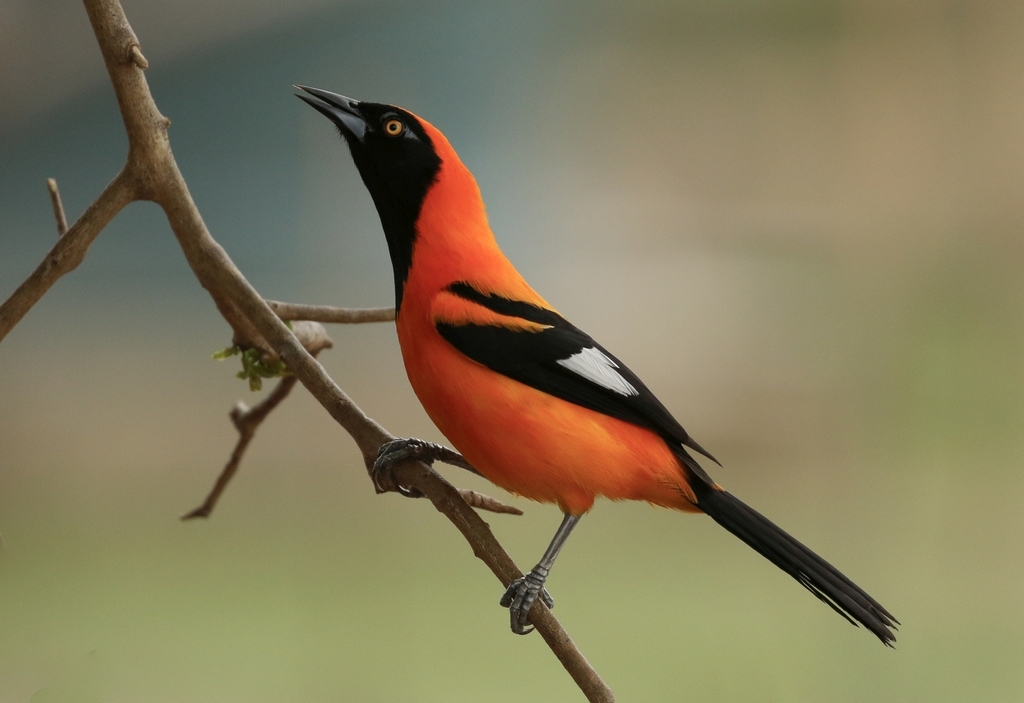
The orange-backed troupial grows to a length of about 23 cm (9 in). In colour it is bright orange apart from a black face, bib, wings and tail, and a small white patch on the secondary wing feathers. It has an orange streak on its shoulder and a small blue ring of bare skin surrounds the eye. The bib has a neat lower edge which helps to distinguish it from the Venezuelan troupial, which has a shaggy base to the bib and a much larger white streak on the wing. The song consists of a number of loud, musical phrases, mostly with two syllables.
Range & habitat
The orange-backed troupial is found in tropical South America east of the Andes where it is a non-migratory species. Its range extends from southern Guyana, southern Colombia and eastern Ecuador and Peru, through eastern and central Brazil to Bolivia and northern Paraguay. It inhabits forest edges, clearings, riparian woodland, secondary forest, and scrubby woodland at altitudes up to about 750 m (2,500 ft).
Wikipedia: “Distribution and habitat”
What it does
The orange-backed troupial often forages in pairs, feeding on fruits, insects and other arthropods found at all levels in the canopy. It also sips nectar from wild flowers, including Erythrina. It breeds in July and August in Colombia, and between November and March in Bolivia and Paraguay. It tends not to build its own nest but often pirates the nest of a yellow-rumped cacique (Cacicus cela).
Wikipedia: “Ecology”
Listen
Looking for field recordings…
Where it lives
Recorded sightings
—
geo-referenced records in GBIF, from museums, herbaria and field observers.
Drag the globe to turn it. Dots are where records exist, not a range map; darker means more records.
In the stacks
Searching the stacks…
Every page naming Icterus croconotus in the Biodiversity Heritage Library →
This page is assembled live from iNaturalist, GBIF, Wikipedia, the Source Library and the Internet Archive. It is not yet part of the hand-edited codex. iNaturalist taxon 62564.