- Animals
- ›Chordates
- ›Vertebrates
- ›Birds
- ›Swifts and Hummingbirds
- ›Hummingbirds
- ›Brilliants, Coquettes, and Allies
- ›Brilliants and Allies
- ›Haplophaedia
On eBird ↗
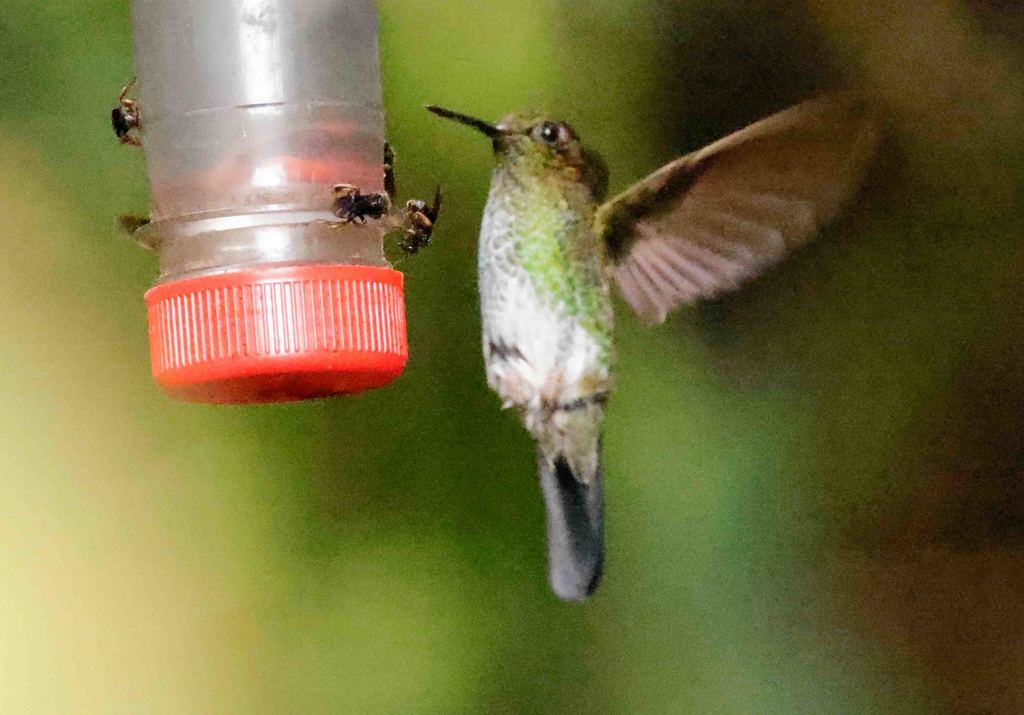
Greenish Puffleg
Live sightings near you, the range map, bar charts of when it is seen, and Macaulay Library photos and recordings.
Greenish Puffleg
Haplophaedia aureliae
The greenish puffleg (Haplophaedia aureliae) is a species of hummingbird in the family Trochilidae. It is found in Colombia, Ecuador, and Panama. Its natural habitats are subtropical or tropical moist montane forests and heavily degraded former forest. It often includes the buff-thighed puffleg as a subspecies.
From the article Greenish puffleg on Wikipedia (CC BY-SA), quoted section by section
Description
The greenish puffleg is 9 to 11.6 cm (3.5 to 4.6 in) long and weighs 4 to 6.5 g (0.14 to 0.23 oz). Males of the nominate subspecies have green upperparts with a coppery hue on the head and neck. The underparts are duller green with a grayish white scaly appearance. The leg puffs are white on the outside and buff on the inside. The slightly forked tail is blue-black. Females are similar but their underparts are more heavily scaled and their leg puffs entirely white. Juveniles resemble females. Subspecies H. a. caucensis has grass green upperparts with a more intense coppery tinge on the head and rump than the nominate, and also a white patch on the belly. Males of H. a. floccus are similar to caucensis but with paler green underparts and less of a coppery tinge on the upperparts, but in addition bright cinnamon uppertail coverts. The female's foreneck and breast have prominent white scaling. Males of H. a. galindoi are darker green above and below compared to floccus and the scaling of females' underparts is more muted. H. a. russata has a longer bill and brighter copper upperparts than the nominate and its underparts are scaled brown rather than grayish white. H. a. cutucuensis is like the nominate but with much heavier grayish white scaling on the underparts.
Range & habitat
The subspecies of the greenish puffleg are found thus:
H. a. floccus, extreme eastern Panama and adjacent northwestern Colombia H. a. galindoi, Cerro Pire in extreme eastern Panama H. a. caucensis, from southeastern Panama into the Western and Central Andes of Colombia H. a. aureliae, Colombia's Eastern Andes and possibly the eastern slope of the Central Andes H. a. russata, the eastern slope of the Ecuadorean Andes as far south as Pastaza Province H. a. cutucuensis, from the eastern slope of the southern Ecuadorean Andes into Peru to the border of Amazonas and San Martín departments The South American Classification Committee (SACC) of the American Ornithological Society and the Clements taxonomy include Peru in the species' range but the International Ornithological Committee (IOC) does not.
Wikipedia: “Distribution and habitat”
What it does
The greenish puffleg forages for nectar mostly in the lower levels of the forest but will go to the canopy to feed at flowering Inga trees. It is territorial and defends clusters of flowers. In addition to nectar, it feeds on insects that it gleans from leaves.
Wikipedia: “Feeding”
Listen
Looking for field recordings…
Where it lives
Recorded sightings
—
geo-referenced records in GBIF, from museums, herbaria and field observers.
Drag the globe to turn it. Dots are where records exist, not a range map; darker means more records.
In the stacks
Searching the stacks…
Every page naming Haplophaedia aureliae in the Biodiversity Heritage Library →
This page is assembled live from iNaturalist, GBIF, Wikipedia, the Source Library and the Internet Archive. It is not yet part of the hand-edited codex. iNaturalist taxon 6263.