- Animals
- ›Chordates
- ›Vertebrates
- ›Mammals
- ›Therians
- ›Placental Mammals
- ›Ungulates, Carnivorans, and Allies
- ›Even-toed Ungulates and Cetaceans
- ›Ruminants
- ›Bovids
- ›Bovines
- ›Cattle and Bison
- ›Bubalus
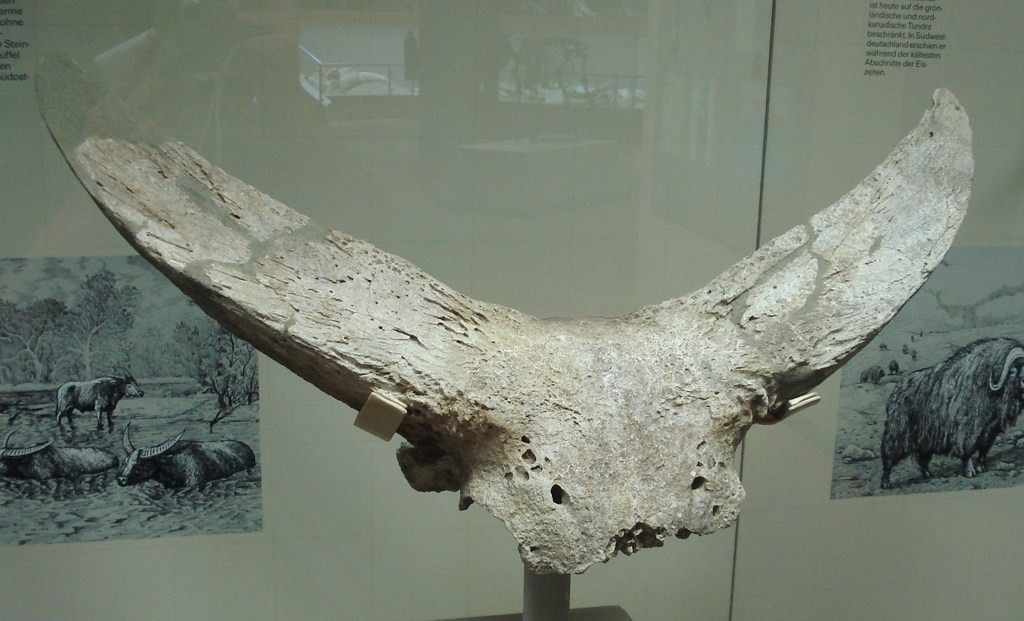
European Water Buffalo
Bubalus murrensis
Bubalus murrensis, also known as European water buffalo, is an extinct species of water buffalo in the genus Bubalus, native to Europe during the Pleistocene epoch, possibly persisting into the Holocene. Like its modern relative, it likely preferred riverine and swampy areas, and the majority of remains have been found close to rivers, including the Rhine, Elbe, and Murr, where it occurred together with other large mammals such as the European elephant (Palaeoxodon antiquus), Merck's rhinoceros (Stephanorhinus kirchbergensis) and aurochs (Bos primigenius). Its presence in Europe is usually linked to warmer interglacial periods, however, an isolated skull from the late Pleistocene of the East European Plain in Russia attests to the species' survival during the Last Ice Age, making a survival into the Holocene — as has been suggested by some — possible.
From the article Bubalus murrensis on Wikipedia (CC BY-SA), quoted section by section
Description
Bubalus murrensis is only known from skull and horn remains, as no complete skeletons have been found, and the distinction of postcrania between Bubalus and other, more abundant bovines, including aurochs (Bos primigenius) and the steppe bison (Bison priscus), is difficult. The occipital region of the skull protrudes backwards, which is a shared feature of most Bubalus, but is absent in the recent wild water buffalo (B. arnee) and its ancestor. The horn cores also protrude backwards, and, unlike modern water buffalo but similar to the recent tamaraw (Bubalus mindorensis) and extinct Chinese species of Bubalus (such as Bubalus wansjocki), they have a triangular rather than rounded cross-section, with the upper surface of the horn cores typically forming a flat plain that is continuous with the skull surface. A skull found in Rhineland-Palatinate (Germany) has a width of 107 cm.
Range & habitat
While more than 10 fossil species of Bubalus have been described from Asia, B. murrensis is the only species in Europe. Fossils of Bubalus murrensis are known from the late Middle Pleistocene (from around 400,000 years ago) onwards, typically during interglacial periods. During the Pleistocene, cold glacial and warm interglacial periods alternated, meaning that central Europe was periodically inhabited by the cold-adapted mammoth-steppe fauna (including woolly mammoth (Mammuthus primigenius), woolly rhinoceros (Coelodonta antiquitatis) and reindeer (Rangifer tarandus)) and the warm-adapted Palaeoloxodon-fauna (including the straight-tusked elephant, Merck's rhinoceros, the hippopotamus, and fallow deer (Dama dama)). B. murrensis belonged to the second group, as its presence in central Europe is strongly linked to warm interglacials, and it is considered an indicator of warm conditions. There is uncertainty over whether B. murrensis was present in central Europe only during the interglacials of the middle Pleistocene (the Holstein (MIS 11) and/or the Reinsdorf (MIS 9)), or whether it also occurred there during the Eemian (MIS 5e, c. 130-115 thousand years ago). This uncertainty is due to problems in the dating of the fossil sites and layers B. murrensis was found in. Although these stratigraphic difficulties persist, however, it is now considered more likely that B. …
Wikipedia: “Distribution and habitat”
Listen
Looking for field recordings…
Where it lives
Recorded sightings
—
geo-referenced records in GBIF, from museums, herbaria and field observers.
Drag the globe to turn it. Dots are where records exist, not a range map; darker means more records.
In the stacks
Searching the stacks…
Every page naming Bubalus murrensis in the Biodiversity Heritage Library →
This page is assembled live from iNaturalist, GBIF, Wikipedia, the Source Library and the Internet Archive. It is not yet part of the hand-edited codex. iNaturalist taxon 627091.