- Animals
- ›Chordates
- ›Vertebrates
- ›Cartilaginous Fishes
- ›Sharks and Rays
- ›Sharks
- ›Galean Sharks
- ›Mackerel Sharks
- ›Mackerel Sharks
- ›Lamna
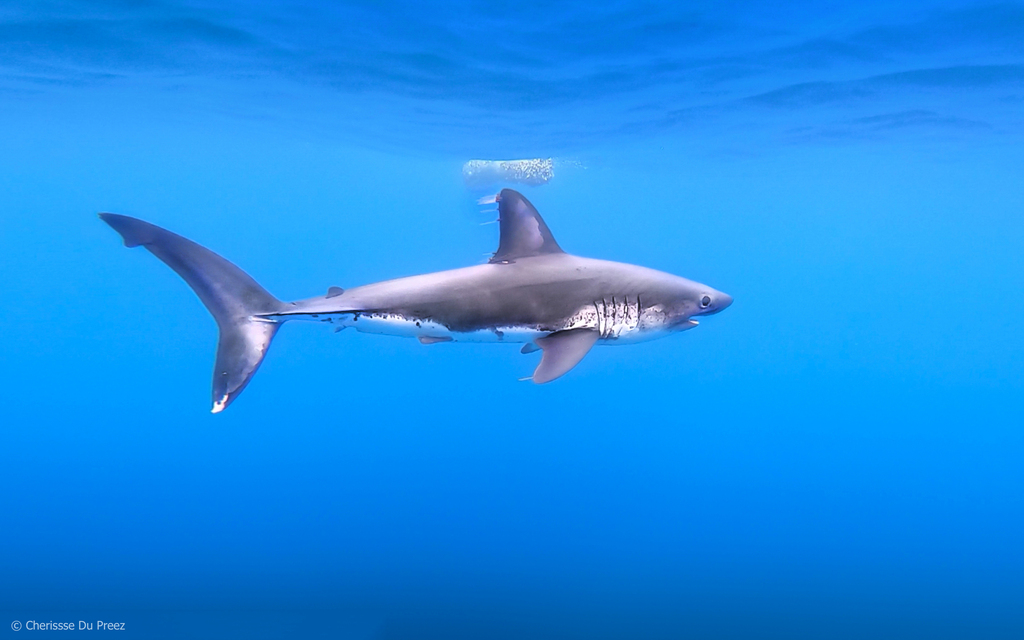
Salmon Shark
Lamna ditropis
The salmon shark (Lamna ditropis) is a species of mackerel shark found in the northern Pacific ocean. Similar to other mackerel sharks, salmon sharks have a thunniform body type. As an apex predator, the salmon shark feeds on salmon, squid, sablefish, birds, walleye pollock, and herring. Salmon sharks get their name from their diet, which primarily consists of salmon. It is known for its ability to maintain stomach temperature (homeothermy), which is unusual among fish. This shark has not been demonstrated to maintain a constant body temperature. It is also known for an unexplained variability in the sex ratio between eastern and western populations in the northern Pacific.
From the article Salmon shark on Wikipedia (CC BY-SA), quoted section by section
Description
Adult salmon sharks are medium grey to black over most of the body, with a white underside with darker blotches. Juveniles are similar in appearance, but generally lack blotches. The snout is short and cone-shaped, and the overall appearance is similar to a small great white shark. The eyes are positioned well forward, enabling binocular vision to accurately locate prey. The salmon shark generally grows to between 200 and 260 cm (6.6–8.6 ft) in length and weighs up to 220 kg (485 lb). Males appear to reach a maximum size slightly smaller than females. Unconfirmed reports exist of salmon sharks reaching as much as 4.3 m (14.2 ft); however, the largest confirmed reports indicate a maximum total length of about 3.0 m (10 ft). The claims of maximum reported weight over 450 kg (992 lb) are "unsubstantiated". Salmon sharks have a wide, double keeled tail (a second, short ridge that runs along the upper part of the lower lobe of the tail.) The only other shark with a double keeled tail is the porbeagle shark, which the salmon shark is closely related to. Salmon sharks are voracious group hunters. Groups of 30 to 40 individuals have been spotted hunting salmon in Alaska. Salmon sharks can also hunt alone, however individuals congregate in large groups in coastal waters to hunt bony fish such as salmon. …
Range & habitat
North of the equator, in the northern Pacific Ocean, the salmon shark is relatively common in continental offshore waters, where it ranges from inshore to just off the coast. Tagging has revealed a range which includes sub-Arctic to subtropical waters. The species is believed to range as far south as the Sea of Japan and as far north as 65°N in Alaska, notably appearing en masse in Prince William Sound during the annual salmon run. Individuals have been observed diving as deep as 668 m (2,192 ft), but they are believed to spend most of their time in epipelagic waters. While salmon sharks primarily travel alone, or in feeding aggregations of several individuals, sometimes they may be seen in schools. According to a study in 2008, salmon sharks have been observed to use area restricted search behaviors in both southern and northern Pacific Ocean regions. Individuals that migrate through southern high productivity regions exhibit more of these behaviors than those who travel through low productivity regions. Salmon sharks travel fast during migratory patterns. Studies conducted on said migrations put the average speed of individual sharks at 33 km. Juvenile salmon sharks stick to more coastal regions along the west coast of North America. Juveniles prefer water temperatures between 12 and 16°C. …
Wikipedia: “Range and distribution”
What it does
The salmon shark is ovoviviparous, birthing a litter of two to six pups. As with other lamniforme shark species, the salmon shark is also oophagous, with embryos feeding on the ova produced by the mother. Females reach sexual maturity from eight to ten years; males generally mature by age five. Reproductive timing is not well understood, but it is believed the sharks are on a two-year cycle, with mating occurring in the late summer to early autumn. Gestation is around nine months. Some reports indicate the sex ratio at birth may be 2.2 (males to females), but the prevalence of this is not known. Once salmon sharks are born, they are completely independent. Pups are spawned along Baja California.
Wikipedia: “Reproduction”
Where it lives
Recorded sightings
—
geo-referenced records in GBIF, from museums, herbaria and field observers.
Drag the globe to turn it. Dots are where records exist, not a range map; darker means more records.
In the stacks
Searching the stacks…
Every page naming Lamna ditropis in the Biodiversity Heritage Library →
This page is assembled live from iNaturalist, GBIF, Wikipedia, the Source Library and the Internet Archive. It is not yet part of the hand-edited codex. iNaturalist taxon 62739.