- Animals
- ›Chordates
- ›Vertebrates
- ›Mammals
- ›Therians
- ›Placental Mammals
- ›Ungulates, Carnivorans, and Allies
- ›Even-toed Ungulates and Cetaceans
- ›Ruminants
- ›Bovids
- ›Antelopes, Goats, and Sheep
- ›Goats and Sheep
- ›Myotragus
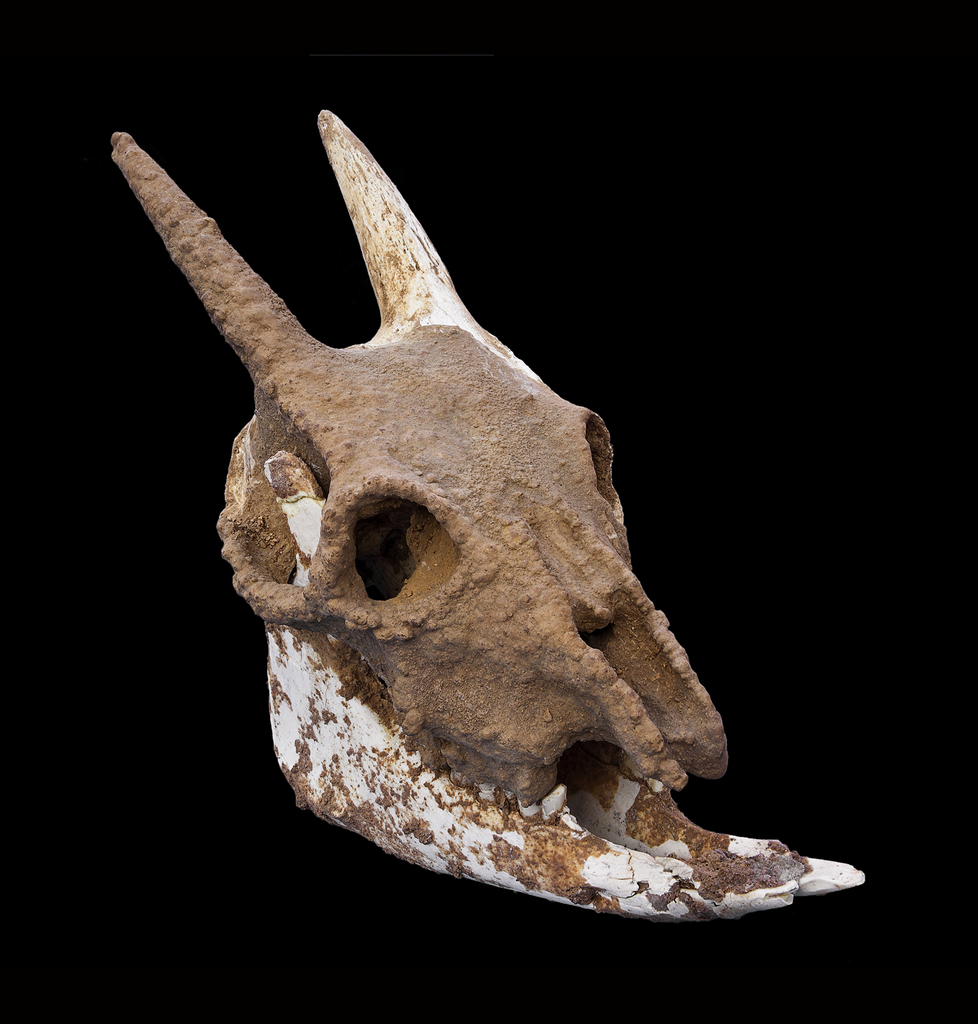
Balearic Cave Goat
Myotragus balearicus
Myotragus (Neo-Latin, derived from the Greek: μῦς, τράγος "mouse-goat") is an extinct genus of goat-antelope in the tribe Caprini which lived on the Balearic Islands of Mallorca and Menorca in the western Mediterranean until its extinction around 4,300 years ago. The fossil record of Myotragus on the Balearic Islands extends over 5 million years back to the early Pliocene on Mallorca, thought to have arrived from the European mainland after the evaporation of the Mediterranean Sea during the Messinian Salinity Crisis at the end of the Miocene epoch (around 5.96-5.33 million years ago). Following the refilling of the Mediterranean at the beginning of the Pliocene, the Balearic Islands remained strongly isolated, allowing the evolution of Myotragus to occur over the next 5.3 million years with little outside influence.
Myotragus is represented by six sequential chronospecies showing progressive morphological change, including a reduction in body size, over the course of over 5 million years of evolution in isolation on the Balearics. The youngest and best-known species, M. balearicus, is noted for a number of unusual morphological adaptations, including shortened legs with stiffened feet, forward facing eyes suggestive of binocular vision, a reduced number of teeth as well as an evergrowing lower incisor, and a relatively long lifespan, which developed in an unusual ecosystem where only a few other mammal species were present, terrestrial predators were absent, and Myotragus functioned as the only major herbivore. M.
From the article Myotragus on Wikipedia (CC BY-SA), quoted section by section
Description
The size of Myotragus varied between species, with later species on average smaller than earlier species as well as their mainland relatives, representing an example of insular dwarfism. The early species M. pepgonellae is estimated to have had a body mass of approximately 60 kilograms (130 lb), while the later M. kopperi is estimated to have been approximately 23 kilograms (51 lb). M. balearicus is estimated to have been approximately 50 centimetres (1.6 ft) tall at the shoulder on average, with a 2004 study estimating an adult body mass of around 23–32 kg (51–71 lb), with another study estimating that it was around 18% the size of its late Miocene mainland relative/possible ancestor Aragoral. However, the size of adult M. balearicus individuals varied considerably, with one adult individual recorded as being only 22 centimetres (8.7 in) tall at the shoulder. Although Waldren (1999) wrote that "both sexes of [Myotragus balearicus] are in osteological appearance unusually similar", and that there are "no clear sexual differences [between the skeletons of females and males of M. balearicus]" Bover and Alcover (1999) wrote that M. balearicus was "a highly [sexually] dimorphic species at the adult stage". Assessing the presence of sized-based sexual dimorphism in M. …
What it does
While tooth morphology and tooth texture suggests that some earlier Myotragus species may have been grazers or mixed feeders (consuming both grass and browse), coprolites (preserved feces) of M. balearicus found at Balma de Son Matge and Cova Estreta on Mallorca indicates that it was likely predominantly a browser, and heavily dependent on the native boxwood species Buxus balearica for a large part of its diet, most likely feeding on the leaves and the flowers. This plant is known for toxicity, with a high concentration of poisonous alkaloid compounds, with other boxwood species known to cause toxic effects when ingested by other bovids, suggesting that the digestive system of M. balearicus had developed the ability to effectively process and neutralise the toxins without ill effect. The smoothness of the coprolites suggests that digestion was highly efficient. The progressively more high-crowned teeth of Myotragus over the course of its evolution likely represents at least in part an adaptation to the increased consumption of abrasive food. M. balearicus may have used the evergrowing lower incisor for stripping bark, excavating roots, and feeding on low-growing vegetation. The shortened face of later Myotragus species is suggested to have enhanced chewing efficiency.
Wikipedia: “Diet”
In human culture
The first remains of Myotragus were described by Dorothea Bate in 1909. Bate had been sent a letter by Robert Ashington Bullen, who informed her about a bone-bearing breccia deposit on the east of Mallorca, which prompted her to survey the island for Pleistocene aged cave deposits. Three such deposits were found, which yielded fragmentary remains of Myotragus, including a mostly complete skull, associated with a mandible and atlas vertebra, which was designated the type specimen of the new species and genus Myotragus balearicus. In 1915, Charles William Andrews described more material discovered in the intervening years, including material that had been discovered on Menorca.
Species. Six sequential chronospecies of Myotragus have been named, representing 5 million years of gradual accumulated morphological change, including a reduction in body size and changes to the locomotor system, the teeth and the visual system.
M. palomboi Bover, Quintana & Alcover, 2010 Early Pliocene, Mallorca M. pepgonellae Moyà-Solà & Pons-Moyà, 1982 Middle Pliocene, Mallorca M. antiquus Pons-Moyà, 1977 Late Pliocene (c. 3.6-2.6 Ma), Mallorca M. kopperi Moya & Pons, 1980 Early Pleistocene, Mallorca M. batei Crusafont & Angel, 1966 Middle Pleistocene, Mallorca, Menorca M. balearicus Bate, 1909 Late Pleistocene-Holocene, Mallorca, Menorca The species M. …
Wikipedia: “History of discovery and taxonomy”
Listen
Looking for field recordings…
Where it lives
Recorded sightings
—
geo-referenced records in GBIF, from museums, herbaria and field observers.
Drag the globe to turn it. Dots are where records exist, not a range map; darker means more records.
In the stacks
Searching the stacks…
Every page naming Myotragus balearicus in the Biodiversity Heritage Library →
This page is assembled live from iNaturalist, GBIF, Wikipedia, the Source Library and the Internet Archive. It is not yet part of the hand-edited codex. iNaturalist taxon 631748.