- Animals
- ›Chordates
- ›Vertebrates
- ›Birds
- ›Swifts and Hummingbirds
- ›Hummingbirds
- ›Brilliants, Coquettes, and Allies
- ›Brilliants and Allies
- ›Loddigesia
On eBird ↗
Marvelous Spatuletail
Live sightings near you, the range map, bar charts of when it is seen, and Macaulay Library photos and recordings.
Marvelous Spatuletail
Loddigesia mirabilis
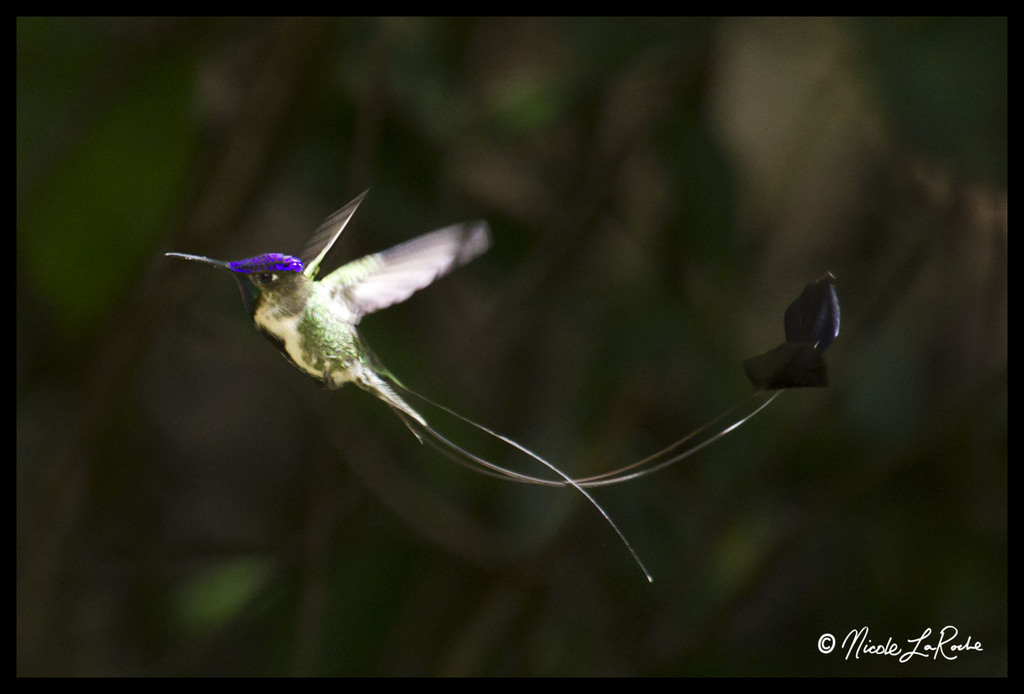
The marvellous spatuletail (Loddigesia mirabilis) is a medium-sized (up to 15 cm long) white, green and bronze hummingbird adorned with blue crest feathers, a brilliant turquoise gorget, and a black line on its white underparts. It is the only member of the monotypic genus Loddigesia. It is sexually dimorphic.
From the article Marvelous spatuletail on Wikipedia (CC BY-SA), quoted section by section
Description
The male marvelous spatuletail is 15 to 17 cm (5.9 to 6.7 in) long including its 11 to 13 cm (4.3 to 5.1 in) tail. Females are 9 to 10 cm (3.5 to 3.9 in) long with a 5 to 7 cm (2.0 to 2.8 in) tail. The male's signature feature is its two outer tail feathers with bare shafts that cross each other and end in large purplish black racquets or "spatules". The remaining tail feathers are very short and are supported by two long undertail coverts. The female's outer tail feathers are also long, but shorter than the male's, and do not have the racquets. Both sexes have a slightly decurved black bill and a white spot behind the eye. Males have mostly green upperparts with a blue crest and a brownish hindneck. Their gorget is glossy blue-green and the rest of the underparts are white with a black line down the center. Females are also green above but do not have a crest or gorget. Their underparts are white without the male's black central line.
Range & habitat
The marvelous spatuletail is found only in a small area in the Andes of northern Peru. Most records are from the valley of the Utcubamba River in Amazonas Department with a few further east in the Department of San Martín. It inhabits the edges of mature forest, secondary forest, and montane scrublands. It is partial to thickets of thorny Rubus with alder (Alnus). In elevation it ranges between 2,100 and 2,900 m (6,900 and 9,500 ft) though there are unconfirmed reports both higher and lower.
Wikipedia: “Distribution and habitat”
What it does
The marvelous spatuletail forages by trap-lining, visiting a circuit of flowering plants where it perches to feed. It is most often seen feeding at a red-flowered lily (Bomarea formosissima) but has been observed feeding in at least five other species of flowering plants. It is dominated by other hummingbird species that share its range.
Wikipedia: “Feeding”
Listen
Looking for field recordings…
Where it lives
Recorded sightings
—
geo-referenced records in GBIF, from museums, herbaria and field observers.
Drag the globe to turn it. Dots are where records exist, not a range map; darker means more records.
In the stacks
Searching the stacks…
Every page naming Loddigesia mirabilis in the Biodiversity Heritage Library →
This page is assembled live from iNaturalist, GBIF, Wikipedia, the Source Library and the Internet Archive. It is not yet part of the hand-edited codex. iNaturalist taxon 6335.