- Animals
- ›Chordates
- ›Vertebrates
- ›Ray-finned Fishes
- ›Spiny-rayed fishes
- ›Blennies, Damselfishes and Allies
- ›Blennies
- ›Combtooth Blennies
- ›Salariin Blennies
- ›Ophioblennius
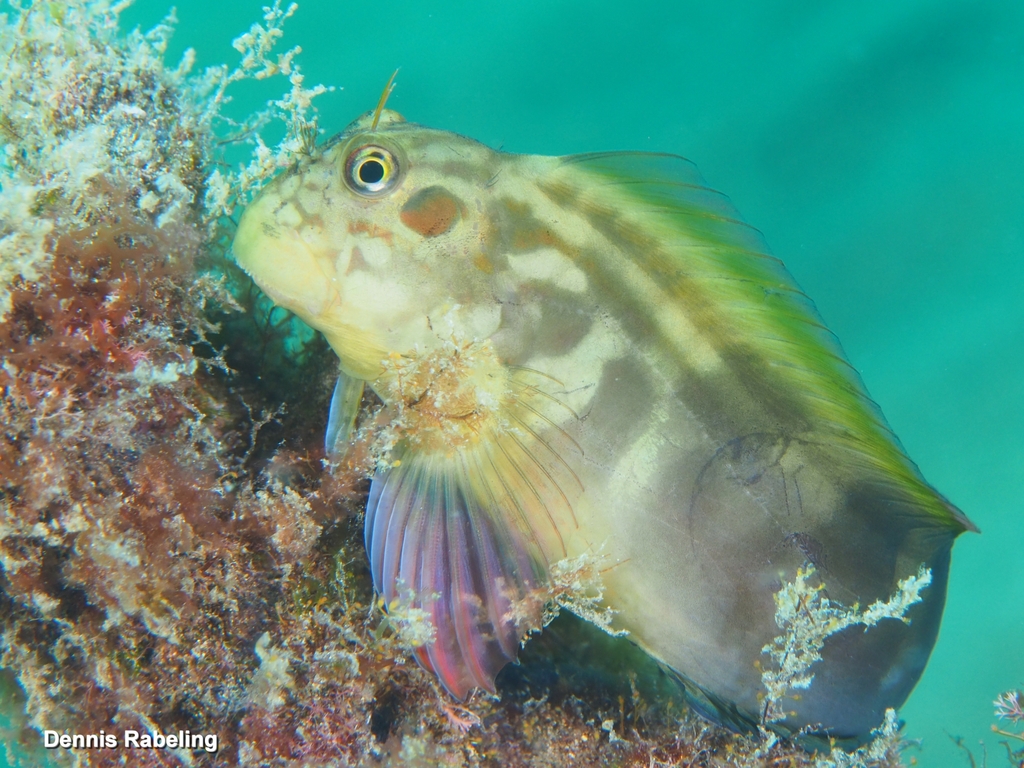
East Atlantic Redlip Blenny
Ophioblennius atlanticus
Ophioblennius atlanticus, also known as the redlip blenny and the horseface blenny, is a species of combtooth blenny, family Blenniidae, found primarily in the western central Atlantic ocean. Redlip blennies can be found in coral crests and shallow fringing reefs. They are highly territorial and attack intruders with two long, sharp canine teeth. The adults are found at depths of 10 to 20 meters, and the eggs are benthic. The adults may reach up to four inches in length when fully grown, and they have large reddish lips, from which they attained their names. Redlip blennies largely feed on algae.
From the article Ophioblennius atlanticus on Wikipedia (CC BY-SA), quoted section by section
Description
Adult redlip blennies can reach two to four inches in length. They are chocolate brown in appearance with some yellow markings, and possess blunt heads featuring four branching horns, and large reddish lips. A variation on the species is a paler form, having a shell-white body and reddish brown head.
Range & habitat
Ophioblennius atlanticus is native to the tropical marine environments of the central Atlantic Ocean. Its range extends to the eastern Atlantic from Senegal to Angola, including offshore islands, in the northeastern Atlantic it is confined to the Macaronesian archipelagos of the Canary Islands, Madeira and the Azores. In the western Atlantic it is found off Bermuda and off the shores of North Carolina south through the West Indies to Brazil. It has been reporded twice in the central Mediterranean Sea. Ophioblennius atlanticus mostly inhabits shallow, clear waters with coral reefs and rock bottoms. Ophioblennius atlanticus adults are mostly found at depths of 10 to 20 meters, while their eggs are benthic.
Wikipedia: “Distribution and habitat”
What it does
Redlip blennies reproduce year-round in the ten days before and four days after the full moon in each month. The male and female pair up in the first three hours of daylight, and the female moves to the male territory. The male has to prepare a nest for depositing eggs. In order to prepare a nest, the male makes a "small box-like" space in its territory and removes coral rubble and dead algae crusts from the space. One male redlip blenny usually has five nests, and the amount of time he spends at each nest is determined by how much the nest is favored by females. Usually the most favored nest has a larger inner surface area and volume than the less favored ones. When a female redlip blenny enters a male's nest, the female chooses whether or not to mate with the male. Larger males with larger nests have better chance of successful mating than smaller males with smaller nests. During spawning seasons, males reduce their feeding. The eggs are deposited in a single layer, and the male guards and cares for the eggs by blowing air onto them until they hatch as planktonic larvae. The egg batches in one nest may be at different developmental stages because the male redlip blenny is polygynous, mating with multiple females. In other words, the eggs have different mothers. …
Wikipedia: “Reproduction”
In human culture
These fish occasionally make their way into the pet trade. They require a minimum of 30 gallons, and being generally peaceful are suitable for community tanks, as long as no other fish have a similar body shape. However they do well in mated pairs. They should be kept at temperatures of 22–26 °C (72–78 °F), with a PH level of 8.1–8.4. They have a jumping ability which allows them to jump from tide pool to tide pool in the wild. This means that if they are to be housed in an aquarium a lid is necessary. The horseface blenny feeds primarily on algae, but also consumes zooplankton and other invertebrates. They possess two razor-sharp canine teeth, which has earned them the nickname of "devil fish" in some countries.
Wikipedia: “Aquaculture”
Where it lives
Recorded sightings
—
geo-referenced records in GBIF, from museums, herbaria and field observers.
Drag the globe to turn it. Dots are where records exist, not a range map; darker means more records.
In the stacks
Searching the stacks…
Every page naming Ophioblennius atlanticus in the Biodiversity Heritage Library →
This page is assembled live from iNaturalist, GBIF, Wikipedia, the Source Library and the Internet Archive. It is not yet part of the hand-edited codex. iNaturalist taxon 63412.