- Animals
- ›Chordates
- ›Vertebrates
- ›Cartilaginous Fishes
- ›Sharks and Rays
- ›Sharks
- ›Galean Sharks
- ›Mackerel Sharks
- ›Mackerel Sharks
- ›Lamna
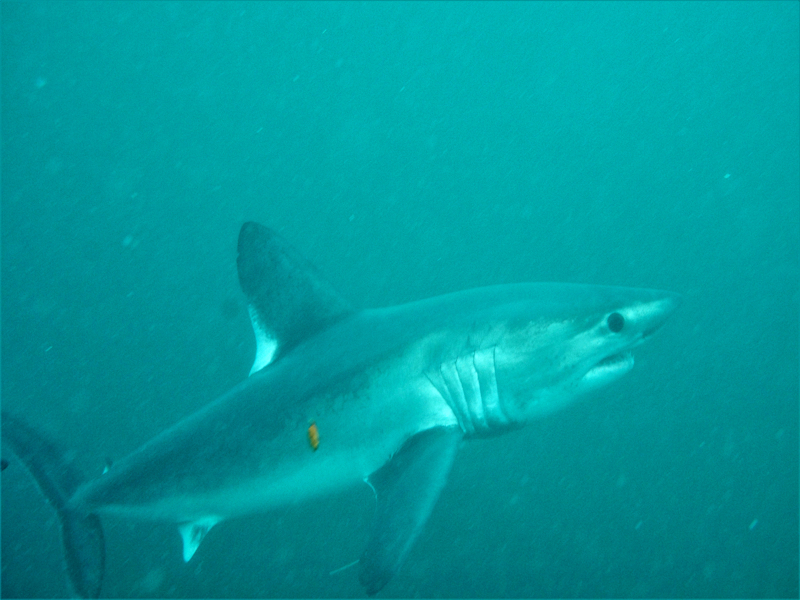
Porbeagle
Lamna nasus
The porbeagle or porbeagle shark (Lamna nasus) is a species of mackerel shark in the family Lamnidae, distributed widely in the cold and temperate marine waters of the North Atlantic and Southern Hemisphere. In the North Pacific, its ecological equivalent is the closely related salmon shark (L. ditropis). It typically reaches 2.5 m (8.2 ft) in length and a weight of 135 kg (298 lb); North Atlantic sharks grow larger than Southern Hemisphere sharks and differ in coloration and aspects of life history. Grey above and white below, the porbeagle has a very stout midsection that tapers towards the long, pointed snout and the narrow base of the tail. It has large pectoral and first dorsal fins, tiny pelvic, second dorsal, and anal fins, and a crescent-shaped caudal fin. The most distinctive features of this species are its three-cusped teeth, the white blotch at the aft base of its first dorsal fin, and the two pairs of lateral keels on its tail.
The porbeagle is an opportunistic hunter that preys mainly on bony fishes and cephalopods throughout the water column, including the bottom. Most commonly found over food-rich banks on the outer continental shelf, it makes occasional forays both close to shore and into the open ocean to a depth of 1,360 m (4,460 ft). It also conducts long-distance seasonal migrations, generally shifting between shallower and deeper water. The porbeagle is fast and highly active, with physiological adaptations that enable it to maintain a higher body temperature than the surrounding water.
From the article Porbeagle on Wikipedia (CC BY-SA), quoted section by section
Description
The porbeagle is a very stout-bodied shark with a fusiform (spindle-like) shape. The long, conical snout tapers to a sharp point, and is supported by enlarged, highly calcified rostral cartilages. The eyes are large and black, without nictitating membranes (protective third eyelids). The small, S-shaped nostrils are positioned in front of and below the level of the eyes. The mouth is large and strongly curved, with moderately protrusible jaws. North Atlantic sharks have 28–29 upper tooth rows and 26–27 lower tooth rows, while Southern Hemisphere sharks have 30–31 upper tooth rows and 27–29 lower tooth rows. Each tooth has a strongly arched base and a nearly straight, awl-like central cusp, which is flanked by a pair of smaller cusplets in all but the smallest individuals. The five pairs of gill slits are long and precede the pectoral fin bases. The pectoral fins are long and narrow. The first dorsal fin is large and high, with a rounded apex, and originating just behind the pectoral fin bases. The pelvic fins are much smaller than the first dorsal fin. The second dorsal and anal fins are smaller still, and placed about even with each other on narrow bases that allow pivoting from side to side. The sides of the caudal peduncle are expanded into prominent lateral keels. A second, shorter pair of keels are present below the main keels. …
Range & habitat
The porbeagle has an almost global amphitemperate distribution, i.e., it is absent from the tropics; in the North Pacific, where its ecological niche is assumed by the salmon shark. It is found mostly within 30–70°N and 30–50°S latitudes. In the North Atlantic, the northern limit of its range extends from the Newfoundland Grand Banks off Canada, through southern Greenland, to Scandinavia and Russia; the southern limit of its range extends from New Jersey and Bermuda, through the Azores and Madeira, to Morocco. It is found in the Mediterranean Sea, but not the Black Sea. Normally, North Atlantic sharks only stray as far south as South Carolina and the Gulf of Guinea, but pregnant females from the western North Atlantic population are known to range into the Sargasso Sea, almost as far as Hispaniola, to give birth. In the Southern Hemisphere, the porbeagle apparently occupies a continuous band bound in the south by the Antarctic Convergence, and extending as far north as Chile and Brazil, the Western Cape province of South Africa, Australia to southern Western Australia and southern Queensland, and New Zealand. In New Zealand it is most common south of the Cook Strait. …
Wikipedia: “Distribution and habitat”
What it does
Fast and energetic, the porbeagle can be found singly or in groups. Its fusiform body, narrow caudal peduncle with lateral keels, and crescent-shaped tail are adaptations for efficiently sustaining speed, which have also been independently evolved by tunas, billfishes, and several other groups of active fishes. The salmon shark and it are the thickest-bodied members of their family (length-depth ratio approaching 4.5), and consequently have the stiffest swimming style; they oscillate their tails while holding their bodies mostly rigid, which confers propulsive power with high energy efficiency, but at the cost of maneuverability. The large gill surface area of the porbeagle allows more oxygen to be delivered to its tissues. It also has a short band of aerobic "red muscle" along each side, which can contract independently of the regular "white muscle" at a lower energy cost, enhancing the shark's stamina. Porbeagles are among the few fishes that exhibit apparent play behavior. Reports, principally off the Cornish coast, have this species rolling and repeatedly wrapping themselves in long kelp fronds near the surface; this activity may have an exploratory or self-stimulatory purpose, though alternately, the sharks may be attempting to feed on small kelp organisms or scrape off parasites. …
Wikipedia: “Biology and ecology”
Where it lives
Recorded sightings
—
geo-referenced records in GBIF, from museums, herbaria and field observers.
Drag the globe to turn it. Dots are where records exist, not a range map; darker means more records.
In the stacks
Searching the stacks…
Every page naming Lamna nasus in the Biodiversity Heritage Library →
This page is assembled live from iNaturalist, GBIF, Wikipedia, the Source Library and the Internet Archive. It is not yet part of the hand-edited codex. iNaturalist taxon 63508.