- Animals
- ›Chordates
- ›Vertebrates
- ›Ray-finned Fishes
- ›Spiny-rayed fishes
- ›Wrasses and allies
- ›False scorpionfishes, wrasses, and parrotfishes
- ›Wrasses and Parrotfishes
- ›Razorfishes and Allies
- ›Novaculichthys
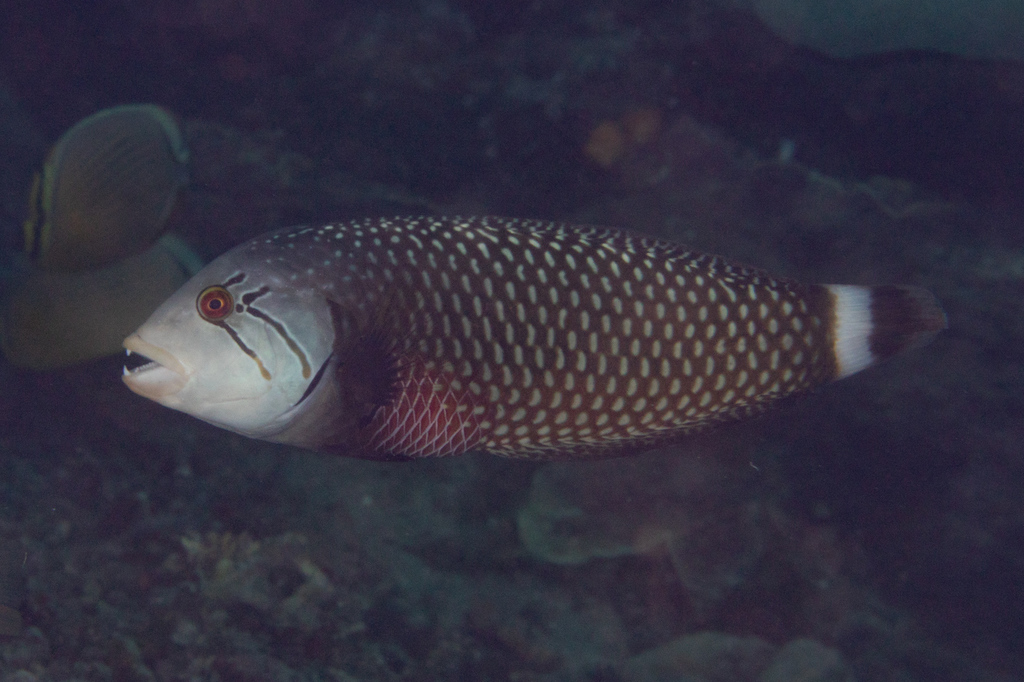
Rockmover Wrasse
Novaculichthys taeniourus
Novaculichthys taeniourus, also known as the rockmover wrasse, carpet wrasse, dragon wrasse, bar-cheeked wrasse, olive-scribbled wrasse or reindeer wrasse, is a species of wrasse mainly found in coral reefs and lagoons in the Indo-Pacific region. These include habitats in the Gulf of California to Panama; tropical Pacific Ocean islands including Hawaii; the Philippines, Indonesia and Australia; and the Indian Ocean to the east coast of Africa. The common name, "rockmover wrasse", comes from their behavior of upending small stones and reef fragments in search of prey. This species is the only known member of its genus.
From the article Novaculichthys on Wikipedia (CC BY-SA), quoted section by section
Description
The rockmover wrasse is a colorful fish, 27–30 cm (11–12 in) in length. It has an oblong, laterally compressed body and a wedge-shaped head. Its head is scaleless except for two scales on the upper part of the gill coverings and an almost vertical row of small scales behind each eye. Juveniles and adults have markedly different appearances. In juveniles, the first two dorsal fin spines are long and extended, drooping over the fish's forehead to form a "cowlick". As the fish matures, the elongated rays are lost. The adult fish has a dark greenish-brown body with an elongated white spot on each scale. Its head is gray-blue with brown lines radiated from the eyes. Two black spots occur in front of the dorsal fin and a wide vertical white bar is found on the base of the caudal fin. The posterior part of the caudal fin and the pelvic fins are black. Juveniles found in Hawaii are usually green and those in the western Pacific are burgundy to brownish. Both are spotted in white.
The difference in appearance between juvenile and adult N. taeniourus is so striking, the common name "rockmover wrasse" is used for adults and "dragon wrasse" is used for juveniles.
Range & habitat
They are widely distributed in tropical Indian Ocean and Pacific Ocean reefs and lagoons.
Wikipedia: “Distribution”
What it does
Although little is known about reproduction of these fish, like other wrasses, they probably are able to change sex and are pelagic spawners, broadcasting eggs and sperm into the water column.
Wikipedia: “Reproduction”
In human culture
The genus "Novaculichthys", in Latin Novacula means razor, and ikhthús in Greek, means fish., while the specific name "taeniourus" from Greek tainía means ribbon, and oura means tail.
Wikipedia: “Etymology”
Where it lives
Recorded sightings
—
geo-referenced records in GBIF, from museums, herbaria and field observers.
Drag the globe to turn it. Dots are where records exist, not a range map; darker means more records.
In the stacks
Searching the stacks…
Every page naming Novaculichthys taeniourus in the Biodiversity Heritage Library →
This page is assembled live from iNaturalist, GBIF, Wikipedia, the Source Library and the Internet Archive. It is not yet part of the hand-edited codex. iNaturalist taxon 63597.