- Animals
- ›Chordates
- ›Vertebrates
- ›Ray-finned Fishes
- ›Spiny-rayed fishes
- ›Perches, Scorpionfishes, Sticklebacks, and Allies
- ›Scorpionfishes and Allies
- ›Scorpionfishes
- ›Rockfishes
- ›Sebastes
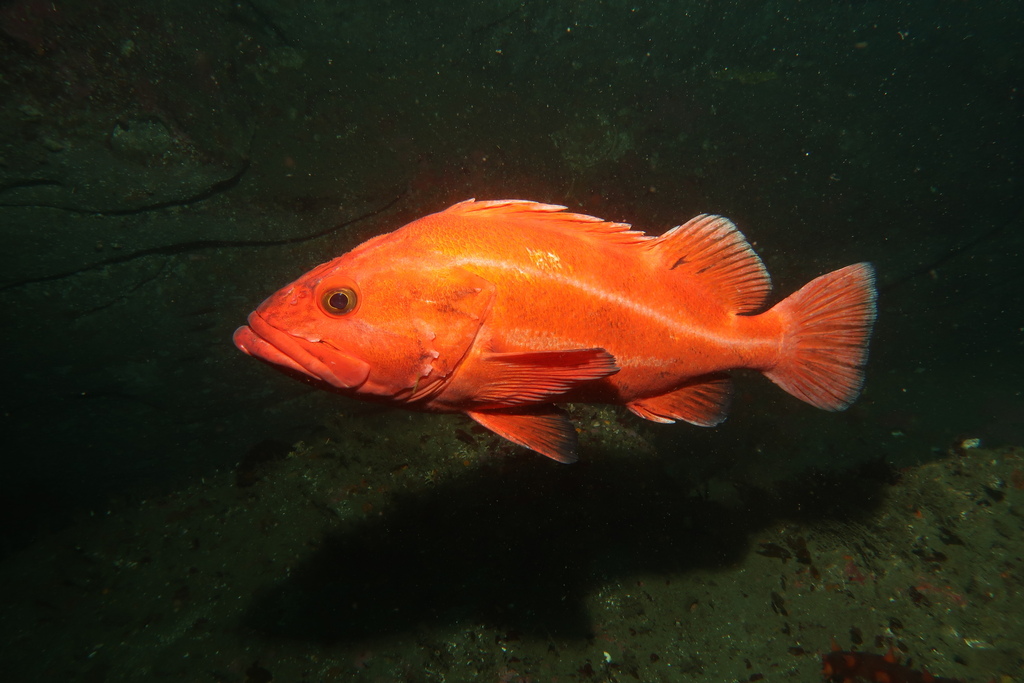
Yelloweye Rockfish
Sebastes ruberrimus
The yelloweye rockfish (Sebastes ruberrimus) is a species of marine ray-finned fish belonging to the subfamily Sebastinae, the rockfishes, part of the family Scorpaenidae and one of the biggest members of the genus Sebastes. Its name derives from its coloration. It is also locally known as "red snapper," not to be confused with the warm-water Atlantic species Lutjanus campechanus that formally carries the name red snapper. The yelloweye is one of the world's longest-lived fish species, and is cited to live to a maximum of 114 to 120 years of age. As they grow older, they change in color, from reddish in youth, to bright orange in adulthood, to pale yellow in old age. Yelloweye live in rocky areas and feed on small fish and other rockfish. They reside in the East Pacific and range from Baja California to Dutch Harbor in Alaska.
Yelloweye rockfish are prized for their meat, and were declared overfished in 2002, at which time a survey determined that their population, which had been in decline since the 1980s, was just 7–13% of numbers before commercial fishing of the species began. Because of the slow reproductive age of the species, recovery of the species is difficult, and liable to last decades, even with the harshest restrictions; Washington state, for example, maintains a quota of under 1000 individuals per year. The stock in inside waters is listed as "threatened" while the outside stock was declared overfished and is subject to a rebuilding plan.
From the article Yelloweye rockfish on Wikipedia (CC BY-SA), quoted section by section
Description
The yelloweye rockfish is colored red on its back, orange to yellow on the sides, and black on the fin tips. Its young are typically under 28 cm (11 in) in length, and differ from the adults in that they have two reddish-white stripes along their belly, and are often red. Because of the distinct difference in coloration between juveniles and adults, they were considered separate species for a long time. Its head spines are exceptionally strong. They grow to a maximum length of 36 in (0.9 m) and a weight of 17.5 kg (39 lb).
Range & habitat
The yelloweye rockfish has been recorded all along the East Pacific, from Umnak Island and Prince William Sound, Alaska, to Ensenada, Baja California. They are typically found in deeper, rocky-bottomed areas; in fact, they often spend their entire lifetime on a single rock pile. They are typically found in the 28-to-215-fathom (51-to-393 m) range, although specimen have been reported up to a maximum depth of 260 fathoms (475 m).
Wikipedia: “Distribution and habitat”
What it does
Larval yelloweye feed on diatoms, dinoflagellates, crustaceans, tintinnids, and cladocerans, and juveniles consume copepods and krill of all life stages. Adults eat demersal invertebrates and small fishes, including other species of rockfish.
Wikipedia: “Diet”
Where it lives
Recorded sightings
—
geo-referenced records in GBIF, from museums, herbaria and field observers.
Drag the globe to turn it. Dots are where records exist, not a range map; darker means more records.
In the stacks
Searching the stacks…
Every page naming Sebastes ruberrimus in the Biodiversity Heritage Library →
This page is assembled live from iNaturalist, GBIF, Wikipedia, the Source Library and the Internet Archive. It is not yet part of the hand-edited codex. iNaturalist taxon 63695.