- Animals
- ›Chordates
- ›Vertebrates
- ›Birds
- ›Swifts and Hummingbirds
- ›Hummingbirds
- ›Brilliants, Coquettes, and Allies
- ›Coquettes and Allies
- ›Discosura
On eBird ↗
Black-bellied Thorntail
Live sightings near you, the range map, bar charts of when it is seen, and Macaulay Library photos and recordings.
Black-bellied Thorntail
Discosura langsdorffi
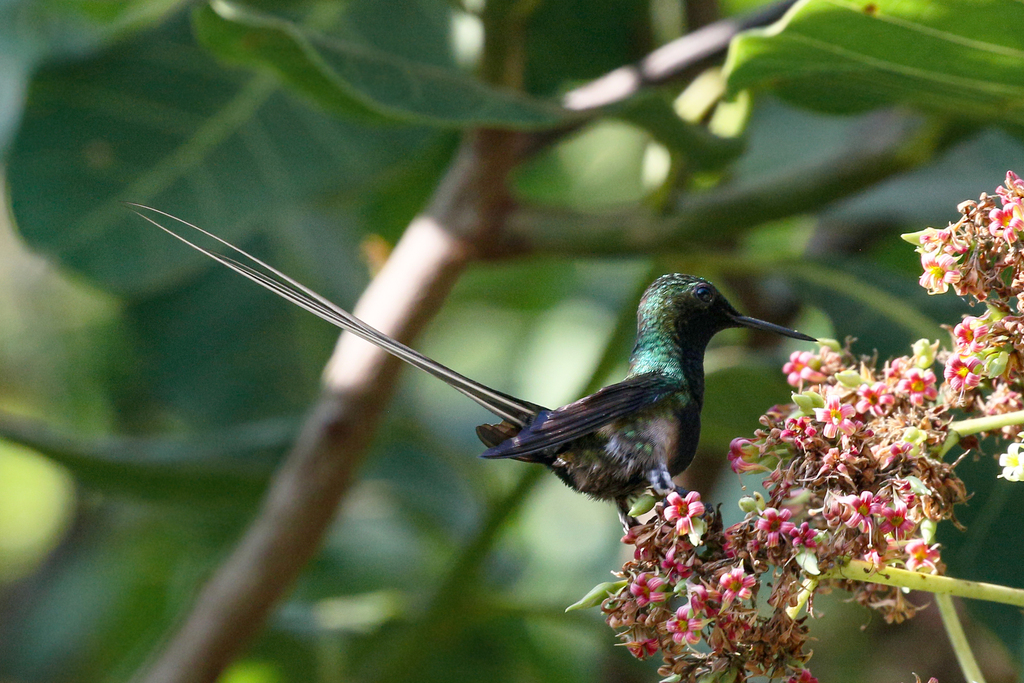
The black-bellied thorntail (Discosura langsdorffi) is a species of hummingbird in the family Trochilidae. It is found in Bolivia, Brazil, Colombia, Ecuador, Peru, and Venezuela. Its natural habitats are subtropical or tropical moist lowland forest and heavily degraded former forest.
From the article Black-bellied thorntail on Wikipedia (CC BY-SA), quoted section by section
Description
The black-bellied thorntail weighs about 3.2 g (0.11 oz). Males are 12 to 13.7 cm (4.7 to 5.4 in) long and females 7.4 to 7.6 cm (2.9 to 3.0 in). Adults of both sexes of the nominate subspecies have an iridescent emerald green crown and coppery green upperparts with a white band across the rump. The male's gorget is iridescent emerald green with a golden coppery band below it. Its flanks are bronzy green and the rest of the underparts black. The tail inner feathers of the tail are steely blue and the outer three pairs gray; all have white shafts. The tail is deeply forked, and the outer feathers are very narrow which give the species its common name. The female's throat is white with green and black spangles and it has a thin white streak on the cheek. Its breast is spangled green with a coppery lower border; the belly is black with a white patch on the flank. Its tail is short, only slightly forked, and steely blue with bronze at the base and white tips. Juveniles are similar to the adult female. Subspecies D. l. melanosternon is slightly smaller than the nominate; its crown is grass green, the breast more golden, and the rest of the underparts darker.
Range & habitat
The nominate subspecies of black-bellied thorntail is restricted to coastal eastern Brazil from southeastern Bahia south through Espírito Santo into eastern Rio de Janeiro. D. l. melanosternon is found in Amazonia of southern Venezuela, southeastern Colombia, eastern Ecuador and Peru, far northern Bolivia, and western Brazil. It inhabits the edges and interior of humid lowland forest generally at elevations between 100 and 300 m (330 and 980 ft). In Amazonia it is mostly found in terra firme forest but also occurs in the transition zone between terra firme and várzea.
Wikipedia: “Distribution and habitat”
What it does
The black-bellied thorntail feeds on the nectar of a wide variety of flowering trees and other plants. It mostly forages from the middle level of the forest to the canopy. It also feeds on arthropods, and a female has been observed apparently picking insects from a spider web.
Wikipedia: “Feeding”
Listen
Looking for field recordings…
Where it lives
Recorded sightings
—
geo-referenced records in GBIF, from museums, herbaria and field observers.
Drag the globe to turn it. Dots are where records exist, not a range map; darker means more records.
In the stacks
Searching the stacks…
Every page naming Discosura langsdorffi in the Biodiversity Heritage Library →
This page is assembled live from iNaturalist, GBIF, Wikipedia, the Source Library and the Internet Archive. It is not yet part of the hand-edited codex. iNaturalist taxon 6399.