- Animals
- ›Chordates
- ›Vertebrates
- ›Birds
- ›Swifts and Hummingbirds
- ›Hummingbirds
- ›Brilliants, Coquettes, and Allies
- ›Brilliants and Allies
- ›Sternoclyta
On eBird ↗
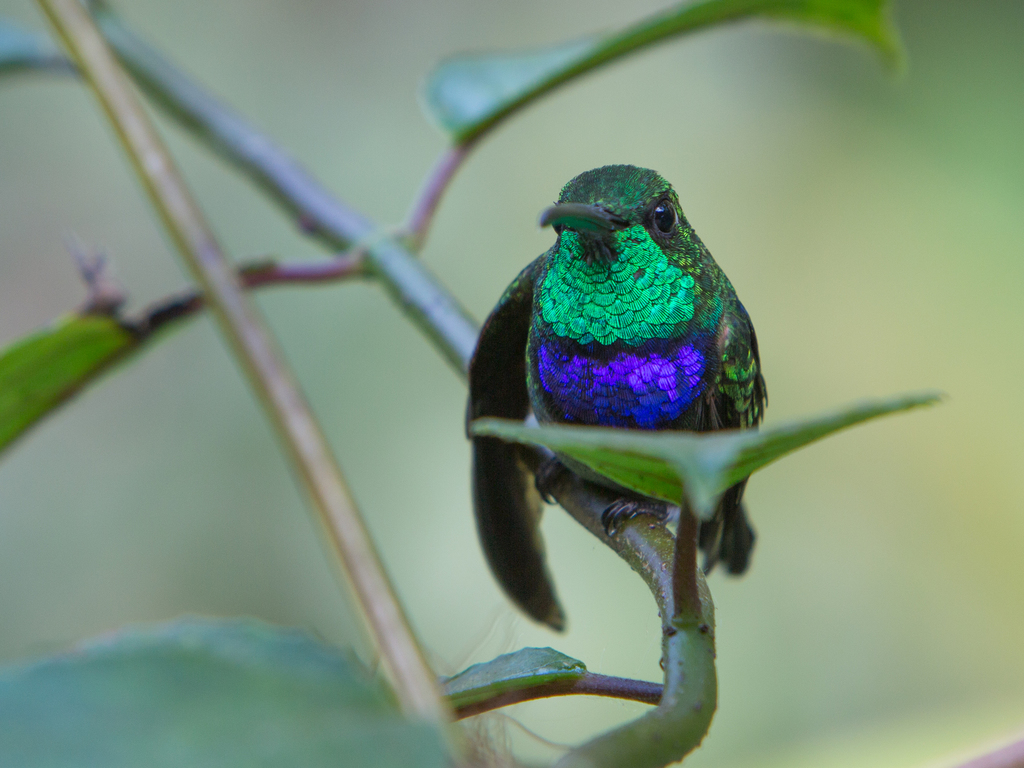
Violet-chested Hummingbird
Live sightings near you, the range map, bar charts of when it is seen, and Macaulay Library photos and recordings.
Violet-chested Hummingbird
Sternoclyta cyanopectus
The violet-chested hummingbird (Sternoclyta cyanopectus) is a species of hummingbird. It has a large global range and is not globally threatened. It is found in Venezuela and adjacent Colombia. It belongs to the monotypical genus Sternoclyta.
From the article Violet-chested hummingbird on Wikipedia (CC BY-SA), quoted section by section
Description
The violet-chested hummingbird is 11.4 to 13 cm (4.5 to 5.1 in) long. Males weigh 7 to 9.4 g (0.25 to 0.33 oz) and females 4.0 to 10.3 g (0.14 to 0.36 oz). Both sexes have a decurved black bill, with the male's being longer, and a small white spot behind the eye. Adult males have shining grass green upperparts. Their gorget is glittering emerald green with a patch of glittering violet blue below it on the breast. The rest of the underparts are grayish buff with golden-green spots on the flanks. The tail is bronze with small white tips on the outer feathers. Adult females are also shining grass green above. Their underparts are mostly grayish with green spots on the chest; the center of the belly is rufescent. Young juveniles resemble the adult female.
Range & habitat
The largest part of the violet-chested hummingbird's range is in northern and western Venezuela. It is found in the Coastal Range as far east as Miranda state and from there southwest in the Andes of Lara, Mérida, and Táchira states and slightly into Colombia's Norte de Santander Department. It primarily inhabits humid subtropical forest and woodlands and is partial to openings created by landslides and treefall. It also occurs in mature secondary forest and coffee plantations. In elevation it ranges from sea level to 2,000 m (6,600 ft) though it is seldom found below 700 m (2,300 ft).
Wikipedia: “Distribution and habitat”
What it does
The violet-chested hummingbird usually forages for nectar deep in the forest, typically in dense understory and often in damp ravines and Heliconia thickets. It defends flower patches and never gathers with other hummingbirds at large flowering events.
Wikipedia: “Feeding”
Listen
Looking for field recordings…
Where it lives
Recorded sightings
—
geo-referenced records in GBIF, from museums, herbaria and field observers.
Drag the globe to turn it. Dots are where records exist, not a range map; darker means more records.
In the stacks
Searching the stacks…
Every page naming Sternoclyta cyanopectus in the Biodiversity Heritage Library →
This page is assembled live from iNaturalist, GBIF, Wikipedia, the Source Library and the Internet Archive. It is not yet part of the hand-edited codex. iNaturalist taxon 6405.