- Animals
- ›Chordates
- ›Vertebrates
- ›Birds
- ›Swifts and Hummingbirds
- ›Hummingbirds
- ›Brilliants, Coquettes, and Allies
- ›Coquettes and Allies
- ›Sephanoides
On eBird ↗
Juan Fernandez Firecrown
Live sightings near you, the range map, bar charts of when it is seen, and Macaulay Library photos and recordings.
Juan Fernández Firecrown
Sephanoides fernandensis
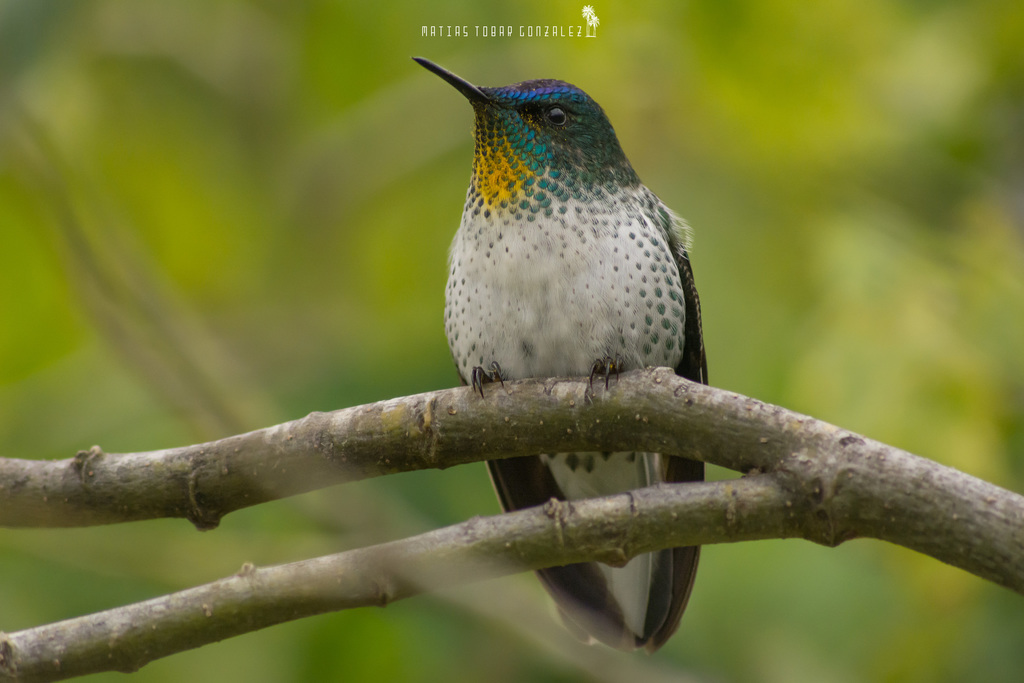
The Juan Fernández firecrown (Sephanoides fernandensis) is a hummingbird found today solely on Isla Róbinson Crusoe, one of a three-island archipelago belonging to Chile. It is non-migratory and shares the island with its smaller relative the green-backed firecrown (S. sephaniodes), which seasonally migrates to the mainland.
From the article Juan Fernández firecrown on Wikipedia (CC BY-SA), quoted section by section
Description
The Juan Fernández firecrown is among the most radically sexually dimorphic hummingbirds. The male and female plumages are so different, and even the female has a male-like iridescent crown, that in the 19th century they were thought to be different species until a nest was discovered with one of each sex. Males are 11.5 to 12 cm (4.5 to 4.7 in) long and weigh about 10.9 g (0.38 oz). Females are about 10.5 cm (4.1 in) long and weigh about 6.8 g (0.24 oz). Both sexes have a straight black bill. The male is almost entirely cinnamon-orange. Its forehead and crown are iridescent fiery reddish yellow and the wings a dark coppery gray. The female's upperparts are bluish green with an iridescent bluish purple crown. Its underparts are pure white with black and green disks and the wings slaty green. The central tail feathers and the inner webs of the others are blue-green and the outer webs white.
Range & habitat
The nominate subspecies of Juan Fernández firecrown is found only on Isla Róbinson Crusoe in the Juan Fernández Islands of Chile. The putative extinct subspecies S. f. leyboldi is attributed to Alejandro Selkirk Island. The species inhabits forests, thickets, and gardens, favoring shady areas. In summer, males are frequently seen in the island's only town, San Juan Bautista, feeding on the flowers of trees in Sonchus subgenus Dendroseris which are endemic to the island chain, and many of which are themselves critically endangered species. All of the breeding records are at elevations between 120 and 660 m (390 and 2,200 ft).
Wikipedia: “Distribution and habitat”
What it does
The Juan Fernández firecrown forages for nectar at the flowers of native plants, especially Rhaphithamnus venustus and Sonchus brassicifolius. It may also feed on introduced Eucalyptus and Abutilon during autumn and winter when most of the native plants are not flowering. It feeds by clinging to the flowers, and favors shaded blossoms well above the ground. Both sexes defend foraging territories, with males holding the more productive sites. In addition to nectar, the species feeds on small insects taken in flight or gleaned from leaves.
Wikipedia: “Feeding”
Listen
Looking for field recordings…
Where it lives
Recorded sightings
—
geo-referenced records in GBIF, from museums, herbaria and field observers.
Drag the globe to turn it. Dots are where records exist, not a range map; darker means more records.
In the stacks
Searching the stacks…
Every page naming Sephanoides fernandensis in the Biodiversity Heritage Library →
This page is assembled live from iNaturalist, GBIF, Wikipedia, the Source Library and the Internet Archive. It is not yet part of the hand-edited codex. iNaturalist taxon 6410.