- Animals
- ›Chordates
- ›Vertebrates
- ›Ray-finned Fishes
- ›Spiny-rayed fishes
- ›Anglerfishes
- ›Pelagic Anglerfishes
- ›Warty Seadevils
- ›Ceratias
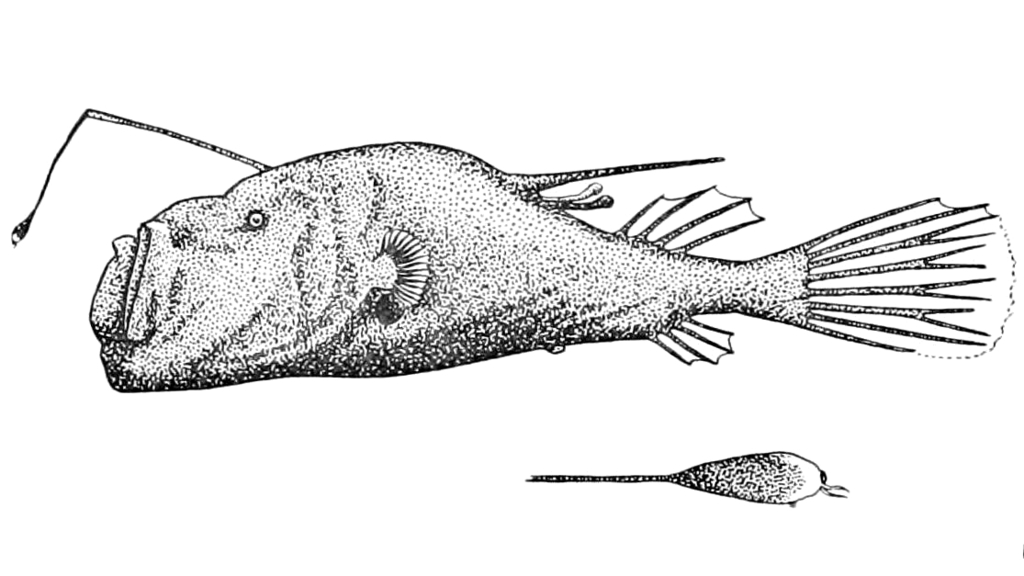
Southern Seadevil
Ceratias tentaculatus
Ceratias tentaculatus, the southern seadevil, is a species of marine ray-finned fish belonging to the family Ceratiidae, the warty seadevils. This is bathydemersal species which can be found at depths ranging from 100 to 2,900 metres (330 to 9,510 ft). It is restricted to the Southern Hemisphere.
From the article Ceratias tentaculatus on Wikipedia (CC BY-SA), quoted section by section
Description
Ceratias tentaculatus is sexually dimorphic and the metamorphosed females can be distinguished from the metamorphosed females of other species in the genus Ceratias by the morphology of its dark coloured esca which has two appendages at the tip of its bulb, these appendages are almost always forked or branched. The esca is on an illicium which has a length equivalent to 19.1% to 28.5% of the standard length of the fish. The pore of the esca is located at the apex of its bulb, and is slightly elecated on a pigmented papilla in all specimens with a standard length in excess of 75 mm (3.0 in). There are teeth on the vomer of all known specimens. This species has a maximum published total length of 88 cm (35 in).
Range & habitat
Ceratias tentaculatus has a circumglobal distribution in the Southern Ocean, where most of the specimens were taken between 35° and 68° S. Smaller specimens have also been collected from Saldanha Bay on the Atlantic Coast of the Western Cape of South Africa north to Delagoa Bay in Mozambique, in the Indian Ocean. It has been collected from depths between 100 and 2,900 m (330 and 9,510 ft), but it typically is found between 650 and 1,500 m (2,130 and 4,920 ft).
== References ==
Wikipedia: “Distribution and habitat”
In human culture
Ceratias tentaculatus belongs to the genus Ceratias, this name means "horn bearer", an allusion to the esca sticking up from the snout. The specific name tentaculatus means "tentacule", i.e. a small tentacle, this is assumed to be an allusion to the two small tentacles on the escal bulb that Norman described as "small and almost transparent".
Wikipedia: “Etymology”
Where it lives
Recorded sightings
—
geo-referenced records in GBIF, from museums, herbaria and field observers.
Drag the globe to turn it. Dots are where records exist, not a range map; darker means more records.
In the stacks
Searching the stacks…
Every page naming Ceratias tentaculatus in the Biodiversity Heritage Library →
This page is assembled live from iNaturalist, GBIF, Wikipedia, the Source Library and the Internet Archive. It is not yet part of the hand-edited codex. iNaturalist taxon 64217.