- Animals
- ›Chordates
- ›Vertebrates
- ›Birds
- ›Swifts and Hummingbirds
- ›Hummingbirds
- ›Mango Hummingbirds and Allies
- ›Augastes
On eBird ↗
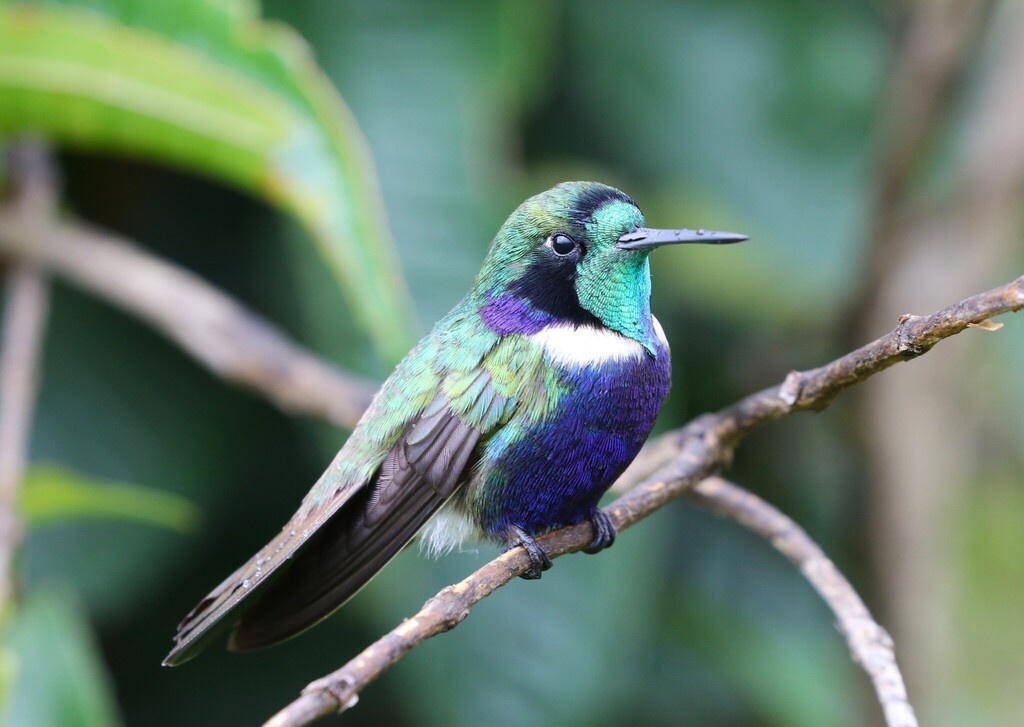
Hyacinth Visorbearer
Live sightings near you, the range map, bar charts of when it is seen, and Macaulay Library photos and recordings.
Hyacinth Visorbearer
Augastes scutatus
The hyacinth visorbearer (Augastes scutatus) is a species of hummingbird in the family Trochilidae. It is endemic to Brazil.
From the article Hyacinth visorbearer on Wikipedia (CC BY-SA), quoted section by section
Description
Hyacinth visorbearer males are 8.1 to 9.9 cm (3.2 to 3.9 in) long and weigh 3 to 4 g (0.11 to 0.14 oz). Females are 8 to 9.7 cm (3.1 to 3.8 in) long and weigh 2.7 to 3.8 g (0.10 to 0.13 oz). In addition to being longer overall and heavier than females, males also have longer wings and tail. Both sexes have a short bill, but that of the male is longer. Males of the nominate subspecies have a shiny golden green forehead; the rest of the upperparts and the tail are bronze-green. The throat is also shiny golden green with a black edge and the belly is deep blue; between them is a creamy white to pink band across the chest. The sides of the neck have a purplish blue "ruff". The female lacks the black edge to the green throat, the blue belly is mottled with gray and blue-green, and the outer tail feathers are tipped with gray. A. s. ilseae has dark violet ruffs, a violet-blue belly, and bluish green on the underside of the tail. A. s. soaresi is the largest subspecies; in plumage it differs from the nominate only by having a blue line between the violet and green areas of the head.
Range & habitat
The hyacinth visorbearer is found only in the Brazilian state of Minas Gerais. The nominate subspecies is found at elevations from about 1,000 to 2,000 m (3,300 to 6,600 ft) in the central and eastern parts of the state. It typically inhabits dry rocky areas with low vegetation (campos rupestres). A. s. ilseae has essentially the same range but at elevations between about 900 and 1,200 m (3,000 and 3,900 ft). It is usually found in gallery forest and bushy areas. A. s. soaresi is limited to the upper reaches of the Piracicaba River basin in south-central Minas Gerais. It inhabits ravines in montane forest at elevations between about 1,000 to 1,600 m (3,300 to 5,200 ft).
Wikipedia: “Distribution and habitat”
What it does
The hyacinth visorbearer typically forages 2 to 3 m (6.6 to 9.8 ft) above ground, taking nectar from a wide variety of flowering plants including terrestrial bromeliads and cacti. It also takes small insects by flying out from a perch and returning to it, and sometimes gleans them while perched as well. Males defend feeding territories, especially those with groups of flowering plants; females tend to feed in more sparsely flowered areas and do not defend them.
Wikipedia: “Feeding”
Listen
Looking for field recordings…
Where it lives
Recorded sightings
—
geo-referenced records in GBIF, from museums, herbaria and field observers.
Drag the globe to turn it. Dots are where records exist, not a range map; darker means more records.
In the stacks
Searching the stacks…
Every page naming Augastes scutatus in the Biodiversity Heritage Library →
This page is assembled live from iNaturalist, GBIF, Wikipedia, the Source Library and the Internet Archive. It is not yet part of the hand-edited codex. iNaturalist taxon 6440.