- Animals
- ›Chordates
- ›Vertebrates
- ›Birds
- ›Swifts and Hummingbirds
- ›Hummingbirds
- ›Brilliants, Coquettes, and Allies
- ›Brilliants and Allies
- ›Boissonneaua
On eBird ↗
Chestnut-breasted Coronet
Live sightings near you, the range map, bar charts of when it is seen, and Macaulay Library photos and recordings.
Chestnut-breasted Coronet
Boissonneaua matthewsii
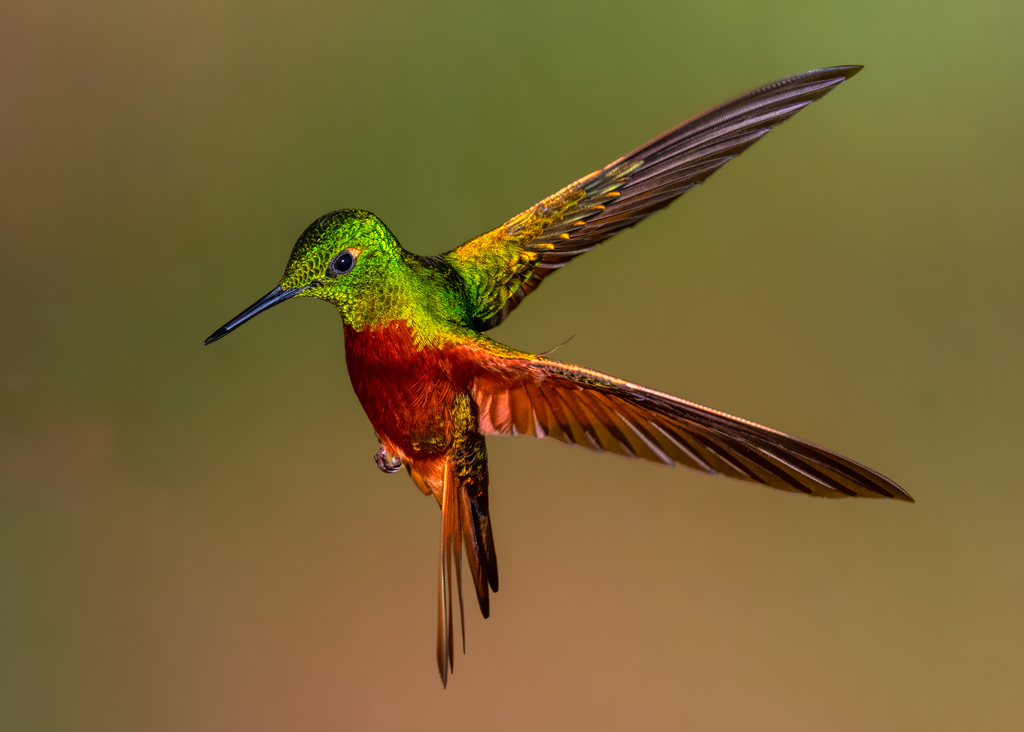
The chestnut-breasted coronet (Boissonneaua matthewsii) is a species of hummingbird in the family Trochilidae. It is found in humid montane Andean forests in Colombia, Ecuador, and Peru. It is generally easily recognized by its contrasting rufous underparts.
From the article Chestnut-breasted coronet on Wikipedia (CC BY-SA), quoted section by section
Description
The chestnut-breasted coronet is 10.5 to 13 cm (4.1 to 5.1 in) long and weighs about 6.5 to 8.3 g (0.23 to 0.29 oz). Both sexes have a short, straight, black bill, a white spot behind the eye, and a notched tail. Males have metallic green upperparts. Their throat has yellowish green speckles on a buff base and the rest of the underparts are reddish chestnut with some green speckles on the flanks. The central tail feathers are bronzy and the rest reddish chestnut with bronzy tips. The female's plumage is almost identical, but with somewhat paler underparts and less speckling on the throat.
Range & habitat
The chestnut-breasted coronet is found from extreme southeastern Colombia south along the east slope of the Andes through Ecuador and Peru as far as Cuzco Department. It also occurs on the west slope of the Andes from central Ecuador into northwestern Peru. It inhabits the interior and edges of humid montane forest and also gardens near the forest. In elevation it ranges between 1,600 and 3,300 m (5,250 and 10,830 ft) in Ecuador, though is most numerous between 1,900 and 2,700 m (6,230 and 8,860 ft). In Peru it occurs between 1,500 and 3,300 m (4,920 and 10,830 ft).
Wikipedia: “Distribution and habitat”
What it does
The chestnut-breasted coronet is highly territorial and defends clusters of flowers from other nectar-feeding birds. It typically forages from the mid-story to the canopy. It feeds by clinging to the flower, holding its wings open for a second or two after landing. In addition to feeding on nectar it captures small insects by hawking from a perch.
Wikipedia: “Feeding”
Listen
Looking for field recordings…
Where it lives
Recorded sightings
—
geo-referenced records in GBIF, from museums, herbaria and field observers.
Drag the globe to turn it. Dots are where records exist, not a range map; darker means more records.
In the stacks
Searching the stacks…
Every page naming Boissonneaua matthewsii in the Biodiversity Heritage Library →
This page is assembled live from iNaturalist, GBIF, Wikipedia, the Source Library and the Internet Archive. It is not yet part of the hand-edited codex. iNaturalist taxon 6445.