- Animals
- ›Chordates
- ›Vertebrates
- ›Birds
- ›Swifts and Hummingbirds
- ›Hummingbirds
- ›Brilliants, Coquettes, and Allies
- ›Brilliants and Allies
- ›Boissonneaua
On eBird ↗
Velvet-purple Coronet
Live sightings near you, the range map, bar charts of when it is seen, and Macaulay Library photos and recordings.
Velvet-purple Coronet
Boissonneaua jardini
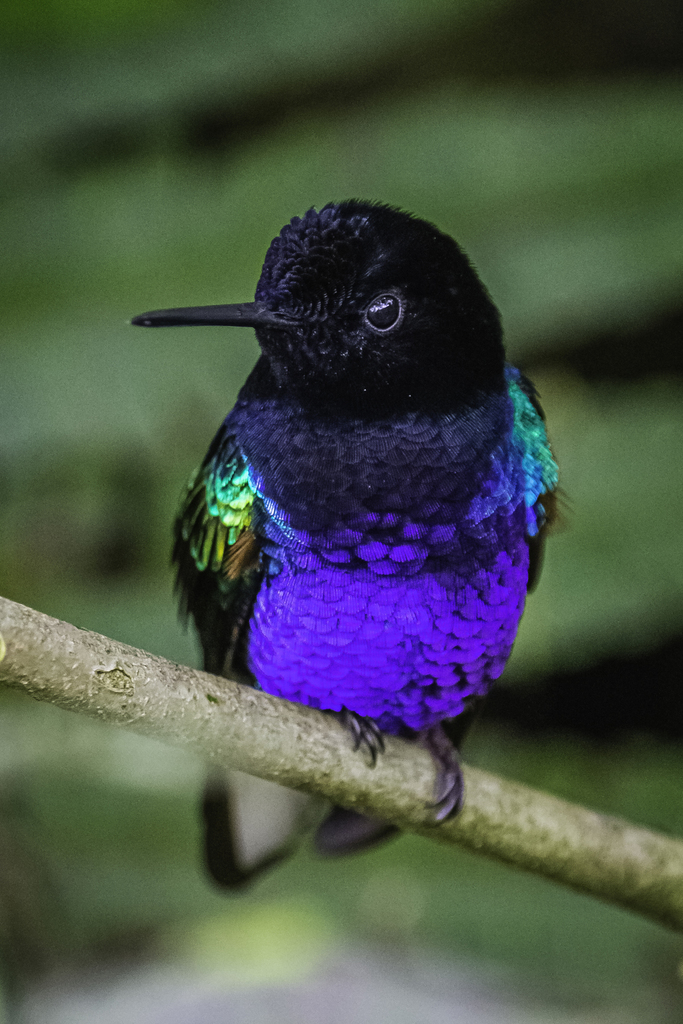
The velvet-purple coronet (Boissonneaua jardini) is a species of hummingbird in the Trochilidae family. It is found in humid foothill forest on the West Andean slope in western Colombia and north-western Ecuador.
From the article Velvet-purple coronet on Wikipedia (CC BY-SA), quoted section by section
Description
The velvet-purple coronet is 11 to 12.7 cm (4.3 to 5.0 in) long and weighs 8.0 to 8.5 g (0.28 to 0.30 oz). Both sexes have a short, straight, black bill and a white spot behind the eye. Both have a notched tail, though the female's is less deeply indented than the male's, and both have small white puffs on the legs. Males have a velvety black head with a glittering purplish blue crown; the rest of the upperparts are shining bluish green. The throat is velvety black and the breast and belly glittering purplish blue. The underwing coverts are cinnamon and show in flight. The central tail feathers are black and the rest white with black tips and edges. Females are similar to males but duller overall, and the breast and belly feathers have buff to grayish brown fringes.
Range & habitat
The velvet-purple coronet is found along the Pacific slope of the Andes from southwestern Colombia's Chocó Department to northwestern Ecuador's Pichincha Province. It mostly inhabits the interior and edges of wet mossy primary and secondary forest, but also occurs in shrubby landscapes. It has been recorded between 800 and 1,700 m (2,600 and 5,600 ft) in Ecuador and between 350 and 2,200 m (1,150 and 7,220 ft) in Colombia, but is most common above 1,200 m (3,900 ft).
Wikipedia: “Distribution and habitat”
What it does
The velvet-purple coronet is territorial and defends clusters of flowers from other nectar-feeding birds. It forages at any forest level from the lower strata to the canopy. It feeds by clinging to the flower, holding its wings open for a second or two after landing. In addition to feeding on nectar it captures small insects by hawking from a perch.
Wikipedia: “Feeding”
Listen
Looking for field recordings…
Where it lives
Recorded sightings
—
geo-referenced records in GBIF, from museums, herbaria and field observers.
Drag the globe to turn it. Dots are where records exist, not a range map; darker means more records.
In the stacks
Searching the stacks…
Every page naming Boissonneaua jardini in the Biodiversity Heritage Library →
This page is assembled live from iNaturalist, GBIF, Wikipedia, the Source Library and the Internet Archive. It is not yet part of the hand-edited codex. iNaturalist taxon 6446.