- Animals
- ›Chordates
- ›Vertebrates
- ›Ray-finned Fishes
- ›Spiny-rayed fishes
- ›Perches, Scorpionfishes, Sticklebacks, and Allies
- ›Scorpionfishes and Allies
- ›Scorpionfishes
- ›Rockfishes
- ›Sebastes
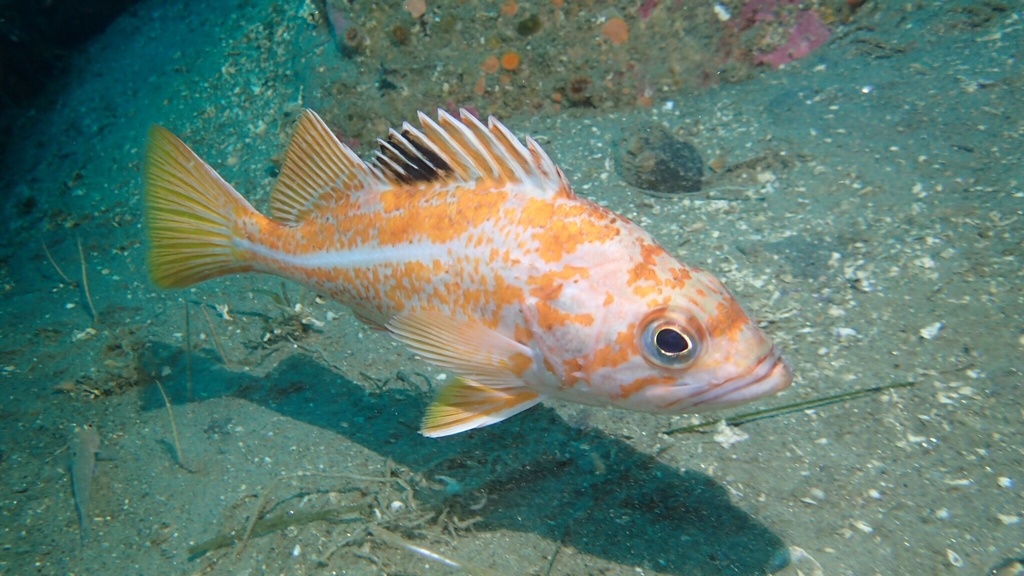
Canary Rockfish
Sebastes pinniger
The canary rockfish (Sebastes pinniger), also known as the orange rockfish, is a species of marine ray-finned fish belonging to the subfamily Sebastinae, the rockfishes, part of the family Scorpaenidae. It is native to the waters of the Pacific Ocean off western North America.
From the article Canary rockfish on Wikipedia (CC BY-SA), quoted section by section
Description
As the name suggests, this rockfish is notable for a general orange-yellow appearance, consisting of a blotchy orange pattern over a whitish or light gray background. The head has three stripes angling downwards and back, the middle one generally running across the eye, and the other two on each side of the eye. The lateral line is within a narrow stripe clear of blotches. The fins are orange, with the pectoral, pelvic, and anal fins somewhat pointed and larger (thus the species epithet pinniger, meaning "I bear a large fin"). Some individuals have dark blotches on the body or dorsal fin. Maximum recorded length is 76 cm (29.6 in).
What it does
Young canaries live in relatively shallow water, moving to deeper water as they mature. Adults are mostly found at depths of 80–200 meters (with two recorded at 838 meters), tending to collect in groups around pinnacles and similar high-relief rock formations, especially where the current is strong. Some off Oregon have been reported living over flat rock and mud-boulder bottoms. They may move considerable distances; one individual covered 700 km in four years after being tagged and released. Juveniles feed on small crustacea such as krill larvae (and eggs), copepods and amphipods, while adults eat krill and small fishes.
Wikipedia: “Ecology”
Where it lives
Recorded sightings
—
geo-referenced records in GBIF, from museums, herbaria and field observers.
Drag the globe to turn it. Dots are where records exist, not a range map; darker means more records.
In the stacks
Searching the stacks…
Every page naming Sebastes pinniger in the Biodiversity Heritage Library →
This page is assembled live from iNaturalist, GBIF, Wikipedia, the Source Library and the Internet Archive. It is not yet part of the hand-edited codex. iNaturalist taxon 64465.