- Animals
- ›Chordates
- ›Vertebrates
- ›Ray-finned Fishes
- ›Spiny-rayed fishes
- ›Perches, Scorpionfishes, Sticklebacks, and Allies
- ›Perches, groupers and allies
- ›Groupers
- ›Mycteroperca
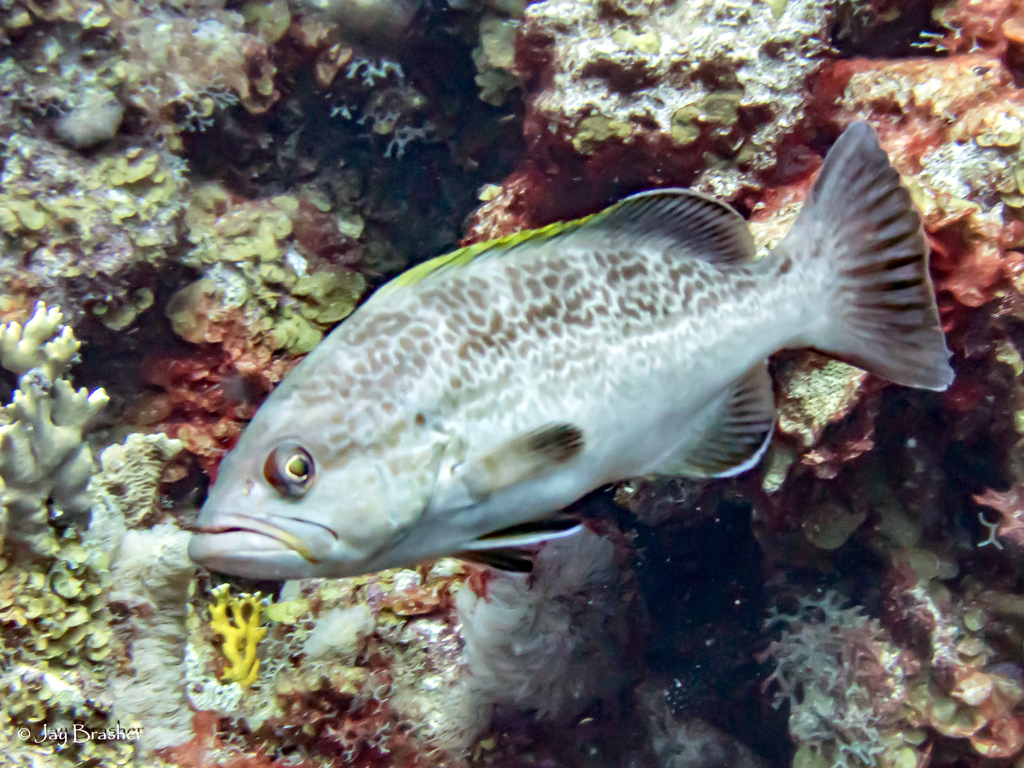
Yellowmouth Grouper
Mycteroperca interstitialis
The yellowmouth grouper (Mycteroperca interstitialis), also known as the crossband rockfish, grey mannock, hamlet, harlequin rockfish, princess rockfish, rockfish, salmon grouper, salmon rock fish or scamp, is a species of marine ray-finned fish, a grouper from the subfamily Epinephelinae which is part of the family Serranidae, which also includes the anthias and sea basses. It is found in the Caribbean and in the tropical waters of the Atlantic Ocean. It is also found in pockets in Brazil. It is a fairly large fish and it gets its name from the yellow around its mouth.
From the article Mycteroperca interstitialis on Wikipedia (CC BY-SA), quoted section by section
Description
Mycteropreca insterstitialis has an elongate, robust and compressed body which is no deeper at the origin of the dorsal fin than it as the origin of the anal fin. It standard length is 3.0 to 3.4 times its depth. The preopercle is angular and has an obvious lobe at its angle, this lobe has enlarged serrations, there is a clear incision in the preopercle above this lobe. The dorsal fin contains 11 spines and 16-18 soft rays while the anal fin contains 3 spines and 10-12 soft rays. The dorsal fin has a pointed rear margin while the anal fin has a pointed margin at its lower posterior edge in adults. The caudal fin is rounded. The adults are pale brownish-grey in background colour marked with closely set small brown spots on the dorsal half of the head and body. In some fish the body is marked with irregular dark bars. The margin of the spiny part of the dorsal fin and the inside of the mouth and along the outer margin of the rear part of the jaws is yellow. The pectoral fins have dark coloured rays with pale membranes between them and a whitish margin. There is a dark line above the rear of the upper jaw. Juveniles, and subadults, have the dorsal part of the head and body coloured dark brown, although this may be broken into wide dark bars or saddles, changing abruptly to white ventrally. …
Range & habitat
Mycteroperca interstitialis is found in the western Atlantic Ocean. Its distribution runs south along the coast of the United States from Cape Hatteras in North Carolina to the Bahamas, including Bermuda, and into the Gulf of Mexico, throughout the Caribbean Sea to Brazil. In Brazil it is found from Maranhão to Santa Catarina, including the islands of Trindade and Fernando de Noronha.
Wikipedia: “Distribution”
Where it lives
Recorded sightings
—
geo-referenced records in GBIF, from museums, herbaria and field observers.
Drag the globe to turn it. Dots are where records exist, not a range map; darker means more records.
In the stacks
Searching the stacks…
Every page naming Mycteroperca interstitialis in the Biodiversity Heritage Library →
This page is assembled live from iNaturalist, GBIF, Wikipedia, the Source Library and the Internet Archive. It is not yet part of the hand-edited codex. iNaturalist taxon 64466.