On eBird ↗
Saw-billed Hermit
Live sightings near you, the range map, bar charts of when it is seen, and Macaulay Library photos and recordings.
Saw-billed Hermit
Ramphodon naevius
The saw-billed hermit (Ramphodon naevius) is a hummingbird from southeastern Brazil, the only member of the genus Ramphodon. It is around 14–16 cm long and is one of the heaviest of the hermits; its straight bill has a hooked tip. It lives in humid forests, where it aggressively defends feeding routes ("trap-lines") from individuals of its own species as well as other hummingbirds. It is currently considered near-threatened, since it has a restricted range in threatened Atlantic...
From the article Saw-billed hermit on Wikipedia (CC BY-SA), quoted section by section
Description
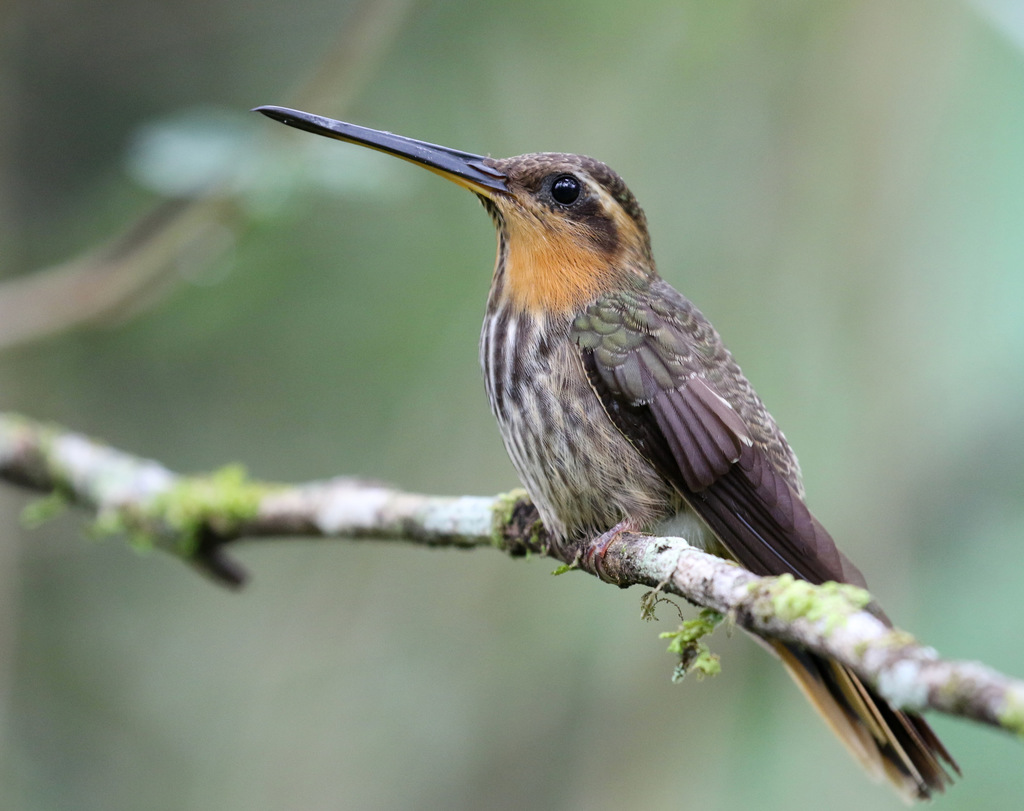
The saw-billed hermit is 14 to 16 cm (5.5 to 6.3 in) long and weighs 5.3 to 9 g (0.19 to 0.32 oz). It is one of the three heaviest hermits and the male is heavier than the female. Both sexes have saw-like serrations on the mandible and the male's bill has a hooked tip as well. (The unrelated tooth-billed hummingbird (Androdon aequatorialis) is the only other hummingbird that has a serrated bill.) Both sexes have scaly brown upperparts and dark and pale striped underparts. They have a reddish ochre throat, a dark patch through the eye, and a white supercilium. The upper side of the tail is purplish black while the underside has progressively more buff at the ends to the outer pair of feathers.
Range & habitat
The saw-billed hermit is found in a narrow band of southeastern Brazil from the states of Minas Gerais and Espírito Santo south to eastern Santa Catarina and northernmost Rio Grande do Sul. It inhabits the understory of the humid coastal Atlantic Forest up to an elevation of 500 m (1,640 ft).
Wikipedia: “Distribution and habitat”
What it does
The saw-billed hermit feeds on the nectar of a wide range of native and introduced flowering plants; most share the characteristic of tubular blossoms. It typically feeds within about 6 m (20 ft) of the ground but has been noted as high as 15 m (49 ft). Like other hermit hummingbirds it is a "trap-line" feeder, visiting a circuit of flowering plants. However, unlike many other trap-liners it defends its route by aggressive behavior towards conspecific and other hummingbirds. In addition to nectar, it feeds on small arthropods gleaned from vegetation.
Wikipedia: “Feeding”
Listen
Looking for field recordings…
Where it lives
Recorded sightings
—
geo-referenced records in GBIF, from museums, herbaria and field observers.
Drag the globe to turn it. Dots are where records exist, not a range map; darker means more records.
In the stacks
Searching the stacks…
Every page naming Ramphodon naevius in the Biodiversity Heritage Library →
This page is assembled live from iNaturalist, GBIF, Wikipedia, the Source Library and the Internet Archive. It is not yet part of the hand-edited codex. iNaturalist taxon 6487.