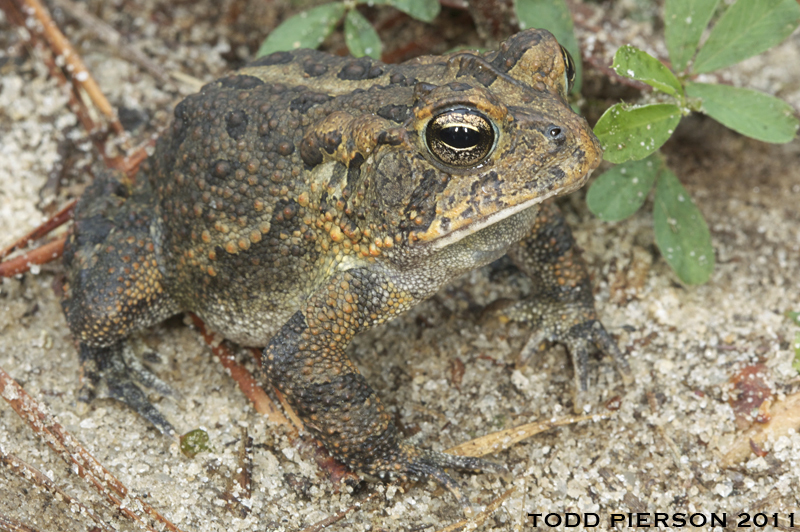
Southern Toad
Anaxyrus terrestris
The southern toad (Anaxyrus terrestris) is a true toad native to the southeastern United States, from eastern Louisiana and southeastern Virginia south to Florida, where it is the largest toad found in that range.It often lives in areas with sandy soils. It is nocturnal and spends the day in a burrow. Its coloring is usually brown but can be red, gray, or black. It is approximately 8 cm (3 inches) long.
From the article Southern toad on Wikipedia (CC BY-SA), quoted section by section
Description
The southern toad is a medium-sized, plump species with a snout-to-vent length of up to 92 mm (3.6 in) with females being slightly larger than males. The most obvious distinguishing features are the knobs on the head and the backward-pointing spurs that extend as far as the paratoid glands. The dorsal surface is covered with warts, some of which may be spiny. The color of the head, back and sides varies from brick red to mottled grey, brown and black while the underparts are pale, sometimes with dark spots on the chest.
Range & habitat
The southern toad is found on the coastal plain of the southeastern United States. Its range extends from southern Virginia to Florida and Louisiana and there are two isolated populations on the Piedmont plateau and the Blue Ridge Mountains in South Carolina. Southern toads are generalists when it comes to their habitats, since they can be found in many different areas, including fragmented landscapes, suburban areas, and many more.
Wikipedia: “Distribution”
What it does
The southern toad is nocturnal and lives in a burrow by day, or sometimes hides under a log or pile of debris. It occurs in woodland in cultivated land and gardens and sometimes stands beneath outdoor lights at night to pick up the attracted insects that fall to the ground. A 2006 study found that there was no difference in the number of toads found in wooded and clearcut area, but there was a difference in the survival rates which was much higher in wooded area. In winter it may become inactive and remain in its burrow for extended periods.
Wikipedia: “Behavior”
Listen
Looking for field recordings…
Where it lives
Recorded sightings
—
geo-referenced records in GBIF, from museums, herbaria and field observers.
Drag the globe to turn it. Dots are where records exist, not a range map; darker means more records.
In the stacks
Searching the stacks…
Every page naming Anaxyrus terrestris in the Biodiversity Heritage Library →
This page is assembled live from iNaturalist, GBIF, Wikipedia, the Source Library and the Internet Archive. It is not yet part of the hand-edited codex. iNaturalist taxon 64988.