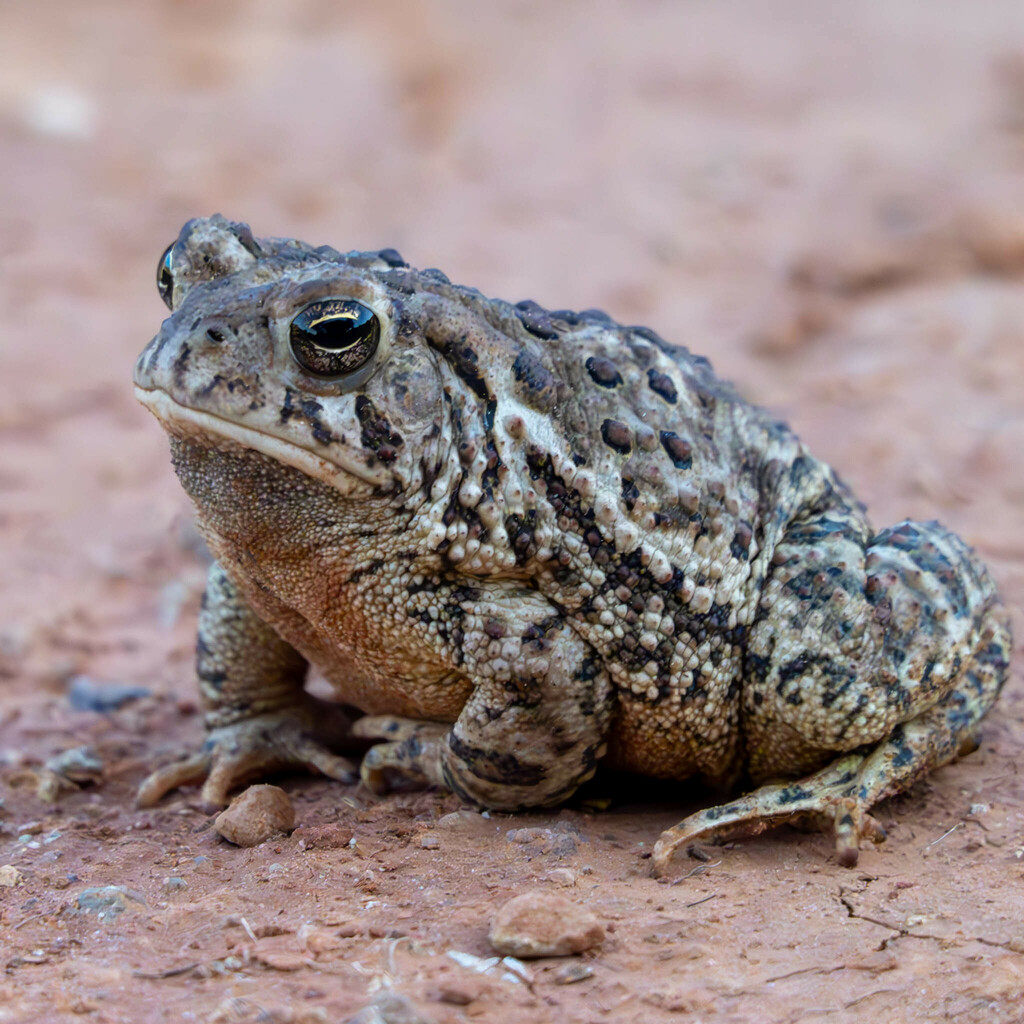
Woodhouse's Toad
Anaxyrus woodhousii
Woodhouse's toad (Anaxyrus woodhousii) is a medium-sized (4 inches or 10 centimetres) true toad native to the United States and Mexico. There are three recognized subspecies. A. woodhousii tends to hybridize with Anaxyrus americanus where their ranges overlap.
From the article Woodhouse's toad on Wikipedia (CC BY-SA), quoted section by section
Description
Woodhouse's toad is a robust amphibian and can grow to a maximum snout-vent length of 127 mm (5 in). The head has prominent cranial crests in front of and in between the eyes. The parotoid glands are long and large. The dorsal surface of this toad is grayish-brown or yellowish-brown and it is speckled with small dark spots. There is a narrow pale line running along the spine. The belly is rather paler and is usually unspotted. The male has a single vocal sac on his throat. His call resembles the bleat of a sheep and lasts from one to three seconds.
Range & habitat
Woodhouse's toad is found in North America at altitudes of up to 2,500 metres (8,200 ft). Its range extends from Mexico in the south to Washington in the north. In the United States it is found in Arizona, Arkansas, California, Colorado, Idaho, Kansas, Montana, Nebraska, Nevada, New Mexico, North Dakota, Oklahoma, Oregon, South Dakota, Texas, Utah, Washington, and Wyoming. In the western part of its range it is typically found in lowland riparian corridors, wooded land besides streams and rivers. At higher altitudes it inhabits wet meadows, ponds, reservoirs and lakes. It is also found in urban environments, canals, ponds and irrigated agricultural land.
Wikipedia: “Distribution and habitat”
What it does
Woodhouse's toad is nocturnal and feeds on insects and other small invertebrates. Near human habitations these toads may congregate underneath outside lights to feed on the insects they attract. Breeding takes place at different times of year in different parts of the range. The males call from in, or close to, standing water and the eggs are laid in gelatinous strings in still-water habitats such as ditches, ponds, pools, cattle tanks and lakes. The tadpoles typically take from five to eight weeks to reach metamorphosis.
Wikipedia: “Behavior”
Listen
Looking for field recordings…
Where it lives
Recorded sightings
—
geo-referenced records in GBIF, from museums, herbaria and field observers.
Drag the globe to turn it. Dots are where records exist, not a range map; darker means more records.
In the stacks
Searching the stacks…
Every page naming Anaxyrus woodhousii in the Biodiversity Heritage Library →
This page is assembled live from iNaturalist, GBIF, Wikipedia, the Source Library and the Internet Archive. It is not yet part of the hand-edited codex. iNaturalist taxon 64989.