- Animals
- ›Chordates
- ›Vertebrates
- ›Birds
- ›Swifts and Hummingbirds
- ›Hummingbirds
- ›Brilliants, Coquettes, and Allies
- ›Brilliants and Allies
- ›Hylonympha
On eBird ↗
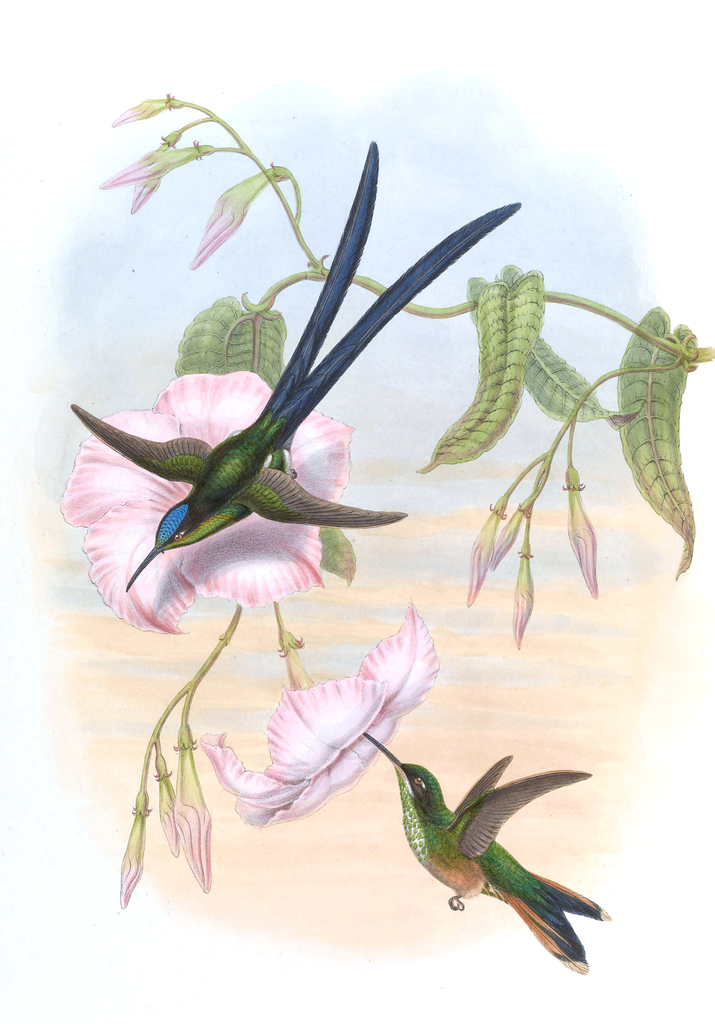
Scissor-tailed Hummingbird
Live sightings near you, the range map, bar charts of when it is seen, and Macaulay Library photos and recordings.
Scissor-tailed Hummingbird
Hylonympha macrocerca
The scissor-tailed hummingbird (Hylonympha macrocerca) is an Endangered species of hummingbird in the "mountain gems", tribe Lampornithini in subfamily Trochilinae. It is endemic to Venezuela.
From the article Scissor-tailed hummingbird on Wikipedia (CC BY-SA), quoted section by section
Description
The scissor-tailed hummingbird male is about 19 cm (7.5 in) long including its 9 to 10 cm (3.5 to 3.9 in) tail and weighs 7 to 7.5 g (0.25 to 0.26 oz). Females are 12 to 13 cm (4.7 to 5.1 in) long and weigh 6.5 to 8 g (0.23 to 0.28 oz). Both sexes have a long slightly decurved black bill. Males have a glittering violet forehead and center of the crown; the rest of the crown is a very dark green that is almost black. Their back is metallic grass green with a golden wash on the neck. The throat and breast are glittering emerald green and the rest of the underparts a duller and darker green that becomes blackish on the belly. The flanks have green spots. The blackish purple tail's outermost feathers are much longer and broader than the others. Females are dark glittering green above including the forehead and crown. Their throat and breast are white, spotted with green except in the center of the breast. The belly and undertail coverts are rufous chestnut. The tail is forked but not nearly as dramatically as the male's. Its central feathers are green at the base and steel blue at the end. The outer feathers are cinnamon with beige tips.
Range & habitat
The scissor-tailed hummingbird is found only on the Paria Peninsula of northeastern Venezuela. It primarily inhabits the interior of damp mature subtropical forest and cloudforest, and is also found at forest edges and in small clearings. In elevation it ranges from 500 to 1,200 m (1,600 to 3,900 ft).
Wikipedia: “Distribution and habitat”
What it does
The scissor-tailed hummingbird feeds on nectar, mainly from flowering bromeliads but also from flowers of genera Heliconia and Costus. Females might defend feeding territories. In addition to nectar, the species feeds on arthropods by gleaning from vegetation and by hawking from a perch.
Wikipedia: “Feeding”
Listen
Looking for field recordings…
Where it lives
Recorded sightings
—
geo-referenced records in GBIF, from museums, herbaria and field observers.
Drag the globe to turn it. Dots are where records exist, not a range map; darker means more records.
In the stacks
Searching the stacks…
Every page naming Hylonympha macrocerca in the Biodiversity Heritage Library →
This page is assembled live from iNaturalist, GBIF, Wikipedia, the Source Library and the Internet Archive. It is not yet part of the hand-edited codex. iNaturalist taxon 6514.