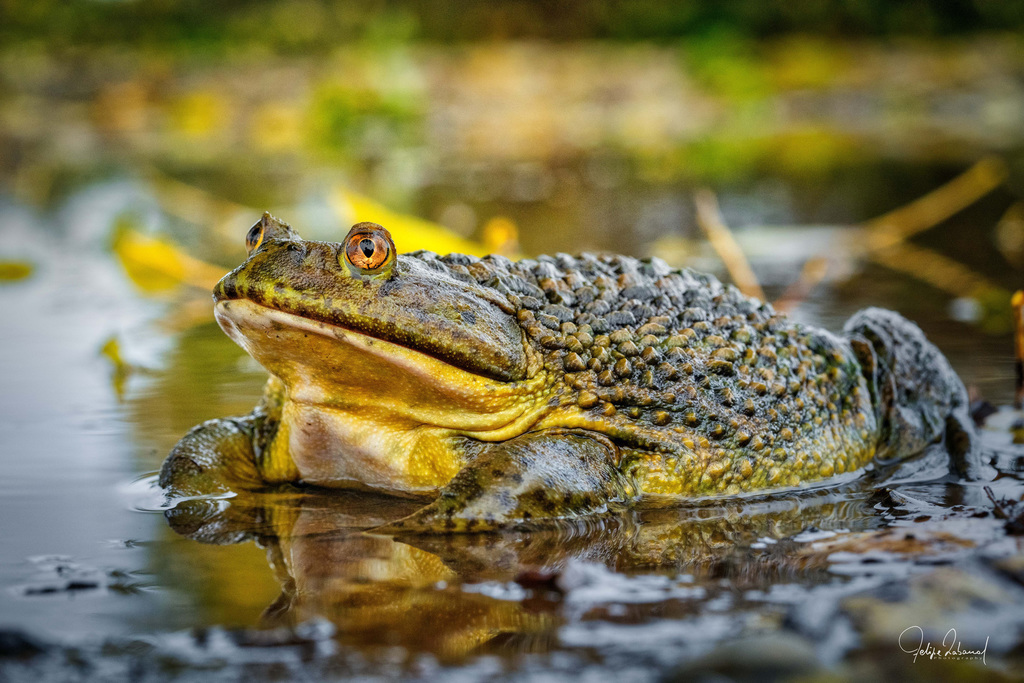
Chilean Helmeted Bullfrog
Calyptocephalella gayi
Calyptocephalella is a genus of frogs in the family Calyptocephalellidae. It is represented by a single living species, Calyptocephalella gayi, commonly known as the helmeted water toad, Chilean helmeted bull frog, or wide-mouthed toad. Additionally, there are a few extinct species that are only known from Late Cretaceous and Paleogene fossil remains from Patagonia in South America and the Antarctic Peninsula (at times when it was warmer and wetter). The helmeted water toad living today is aquatic to semi-aquatic, and found in deep ponds and reservoirs in central Chile and possibly adjacent west-central Argentina.
This very large frog
From the article Calyptocephalella on Wikipedia (CC BY-SA), quoted section by section
Description
The helmeted water toad is a robust species with a broad head and large mouth. It is very large, and can reach a snout–to–vent length of up to 15.5 cm (6.1 in) in males and 32 cm (12.6 in) in females. The typical maximum weight is 0.5–1 kg (1.1–2.2 lb), but exceptionally large individuals can reach 3 kg (6.6 lb). Such giants are essentially unheard of today, although there are recent records of several individuals weighing 1.2–1.3 kg (2.6–2.9 lb). It is the largest anuran (frogs and toads) of the Americas, surpassing other large species like the Blomberg's, cane, Colorado River, cururu and smooth-sided toads, and the American bull-, Lake Junin, mountain chicken and Titicaca water frogs. The maximum snout–to–vent is similar to that of the world's largest frog, the African goliath frog (Conraua goliath), which however can weigh more. Helmeted water toads are colored yellow, brown and green, with light green in mature specimens, while the oldest are gray, or have gray patches on a dark background. The olive-brown to dusky tadpoles also grow unusually large, typically exceeding lengths of 10 cm (3.9 in) and reaching up to 15 cm (5.9 in).
Wikipedia: “Characteristics”
What it does
The helmeted water toad breeds in the South Hemisphere spring (September–October) when males call. The female lays between 1,000 and 16,000 eggs in shallow, well-vegetated water. Although many eggs never hatch, captive studies have shown that a single spawning may result in more than 1,000 tadpoles. Typical larval (tadpole) life lasts five months to a year, but up to two years. After hatching, larval survival depends on the presence of vegetation as the existence of movements in the body of water maintain good oxygenation, but the presence of seasonal ponds with some degree of drainage is essential for hatching, as these sites contain fewer predators to the larvae. Then, the transport of larvae from ponds, to larger bodies of water during the rains, or transport of these among several bodies of water facilitates the survival and allows a good development of populations. The larvae prefer cooler areas of the body of water and protective aquatic vegetation, unlike toad larvae that occupy the same sites and have a higher degree of pigmentation that protects them from the solar rays. While the species is almost entirely aquatic, especially young helmeted water toads that are recently metamorphosed from the tadpole stage often can be seen on land. …
Wikipedia: “Reproduction and aggressive behavior”
Listen
Looking for field recordings…
Where it lives
Recorded sightings
—
geo-referenced records in GBIF, from museums, herbaria and field observers.
Drag the globe to turn it. Dots are where records exist, not a range map; darker means more records.
In the stacks
Searching the stacks…
Every page naming Calyptocephalella gayi in the Biodiversity Heritage Library →
This page is assembled live from iNaturalist, GBIF, Wikipedia, the Source Library and the Internet Archive. It is not yet part of the hand-edited codex. iNaturalist taxon 65148.