- Animals
- ›Chordates
- ›Vertebrates
- ›Birds
- ›Swifts and Hummingbirds
- ›Hummingbirds
- ›Bee Hummingbirds, Emeralds, Mountain-gems, and Allies
- ›Bee Hummingbirds and Allies
- ›Doricha
On eBird ↗
Mexican Sheartail
Live sightings near you, the range map, bar charts of when it is seen, and Macaulay Library photos and recordings.
Mexican Sheartail
Doricha eliza
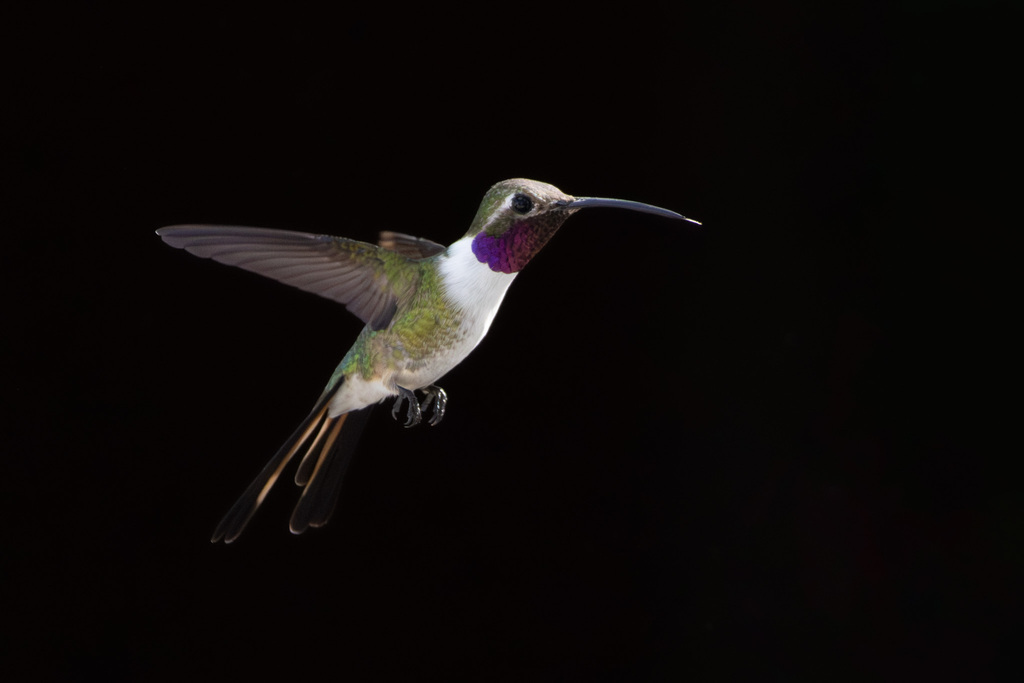
The Mexican sheartail (Doricha eliza) is a species of hummingbird in the family Trochilidae. It is endemic to Mexico.
From the article Mexican sheartail on Wikipedia (CC BY-SA), quoted section by section
Description
This is a tiny bird, weighing only 2.4 to 2.6 g (0.085 to 0.092 oz). All Mexican sheartails have a long, curved and black bill, a dull green crown and bronzy-green nape and upper parts. Males and females are sexually dimorphic. The male, which is 9 to 10 centimetres (3.5 to 3.9 in) long including the tail, has a white line behind the eye and a pink-purple throat with a white band below. His underparts are dull green, being clearer on median belly and feathers covering his undertail. The male's tail is long and deeply forked, usually held closed in repose. His inner tail are feathers green, the rest being black with cinnamon inner margins. Females, at 8.5 to 9 cm (3.3 to 3.5 in), have a whitish face with a blackish stripe behind the eye. Her throat, chest and belly are whitish with cinnamon tinges on the sides. The female has a shorter forked tail, the outer feathers of which are reddish with a subterminal black band and white tips. Immatures are similar to females. Females are also far more commonly seen than males, typically outnumbering the latter 5 to 1.
Range & habitat
It is found only in Mexico where it lives in two disjunct populations, one in the center of Veracruz and the other in the northern coastal area of the Yucatan Peninsula. Its natural habitats are subtropical or tropical dry forest, subtropical or tropical dry shrubland, mangroves, rural gardens and urban areas. A specific example of the mangrove habitat is the Petenes mangroves ecoregion in the Yucatán Peninsula. The species is threatened by habitat loss.
Wikipedia: “Distribution and habitat”
What it does
The Mexican sheartail feeds on nectar from flowers and has been seen visiting Ipomoea, Justicia and Helicteres guazumaefolia. It also sometimes consumes small arthropods. In Veracruz, breeding takes place from May onwards and in Yucatán, between August and April. The tiny cup-shaped nest is made of lichens, spiders webs and the seeds of daisy family plants. Two eggs are laid and newly fledged young have been reported from Yucatán in February and March.
Wikipedia: “Behaviour”
Listen
Looking for field recordings…
Where it lives
Recorded sightings
—
geo-referenced records in GBIF, from museums, herbaria and field observers.
Drag the globe to turn it. Dots are where records exist, not a range map; darker means more records.
In the stacks
Searching the stacks…
Every page naming Doricha eliza in the Biodiversity Heritage Library →
This page is assembled live from iNaturalist, GBIF, Wikipedia, the Source Library and the Internet Archive. It is not yet part of the hand-edited codex. iNaturalist taxon 6518.