- Animals
- ›Chordates
- ›Vertebrates
- ›Amphibians
- ›Frogs and Toads
- ›Terraranas
- ›Fleshbelly and Terrestrial-breeding Frogs
- ›Fleshbelly Frogs
- ›Craugastor
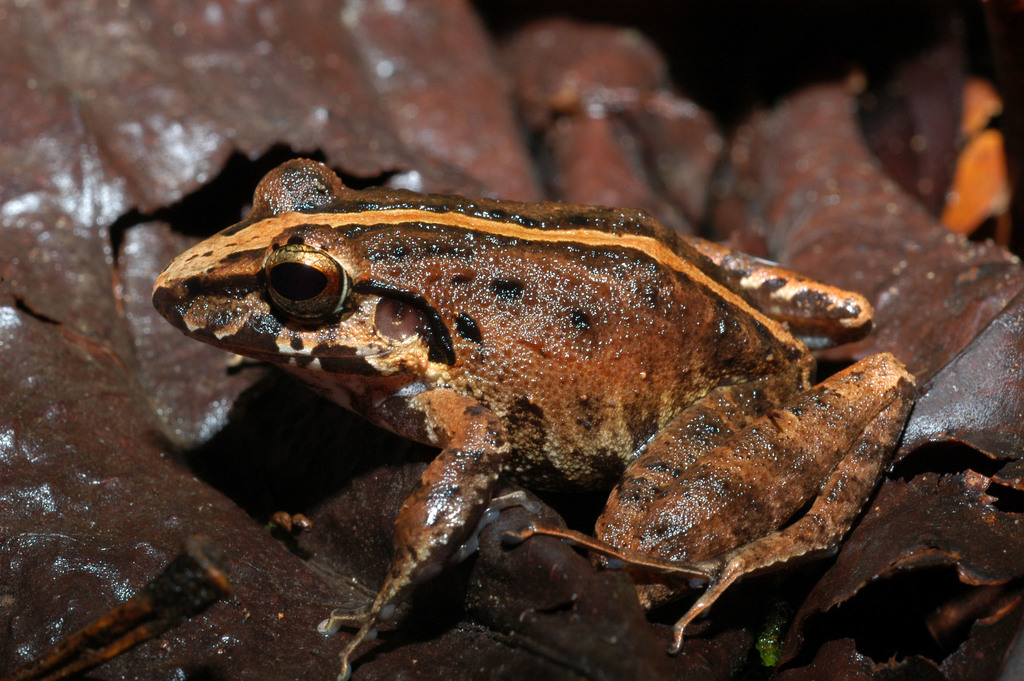
Fitzinger's Robber Frog
Craugastor fitzingeri
The Fitzinger's robber frog (Craugastor fitzingeri) is a species of frog in the family Craugastoridae. It is found in Colombia, Costa Rica, Honduras, Nicaragua, and Panama. Its natural habitats are subtropical or tropical dry forests, subtropical or tropical moist lowland forests, subtropical or tropical moist montane forests, and heavily degraded former forest.
From the article Craugastor fitzingeri on Wikipedia (CC BY-SA), quoted section by section
Description
Adult males measure 24–35 mm (0.9–1.4 in) and adult females 35–53 mm (1.4–2.1 in) in snout–vent length. The snout is subacuminate in dorsal view. The tympanum is prominent. The fingers and the toes bear discs; the toes are moderately webbed. Skin typically bears warts and ridges. The dorsal coloration varies from gray-brown to brown to orange-brown. Some individuals have a wide, light middorsal stripe. Most individuals have only some blackish spots and a vague, darker dorsal pattern. The throat is typically grey with a white line down the middle. The belly is pale white or yellow. The male advertisement call is a variable series of harsh chirps or clacks.
Range & habitat
Craugastor fitzingeri occurs in humid lowland and montane forests below 1,520 m (4,990 ft). It is often found in disturbed forest or forest edge, although it does not occur in secondary forest in the Colombian part of its range. In lowland dry forest areas, it is restricted to riparian gallery forest in the dry season, but ranges more widely in the wet season. By day these frogs are found on the forest floor, usually concealed in leaf litter, but they can also be active. At night, they often climb onto logs or into low vegetation. Males typically call at dusk from elevated positions on low herbs and in bushes, etc. This species can be locally abundant, but some populations have declined. No major threats to it have been identified. Its range overlaps with several protected areas.
== References ==
Wikipedia: “Habitat and conservation”
Listen
Looking for field recordings…
Where it lives
Recorded sightings
—
geo-referenced records in GBIF, from museums, herbaria and field observers.
Drag the globe to turn it. Dots are where records exist, not a range map; darker means more records.
In the stacks
Searching the stacks…
Every page naming Craugastor fitzingeri in the Biodiversity Heritage Library →
This page is assembled live from iNaturalist, GBIF, Wikipedia, the Source Library and the Internet Archive. It is not yet part of the hand-edited codex. iNaturalist taxon 65238.