- Animals
- ›Chordates
- ›Vertebrates
- ›Amphibians
- ›Frogs and Toads
- ›Terraranas
- ›Fleshbelly and Terrestrial-breeding Frogs
- ›Fleshbelly Frogs
- ›Craugastor
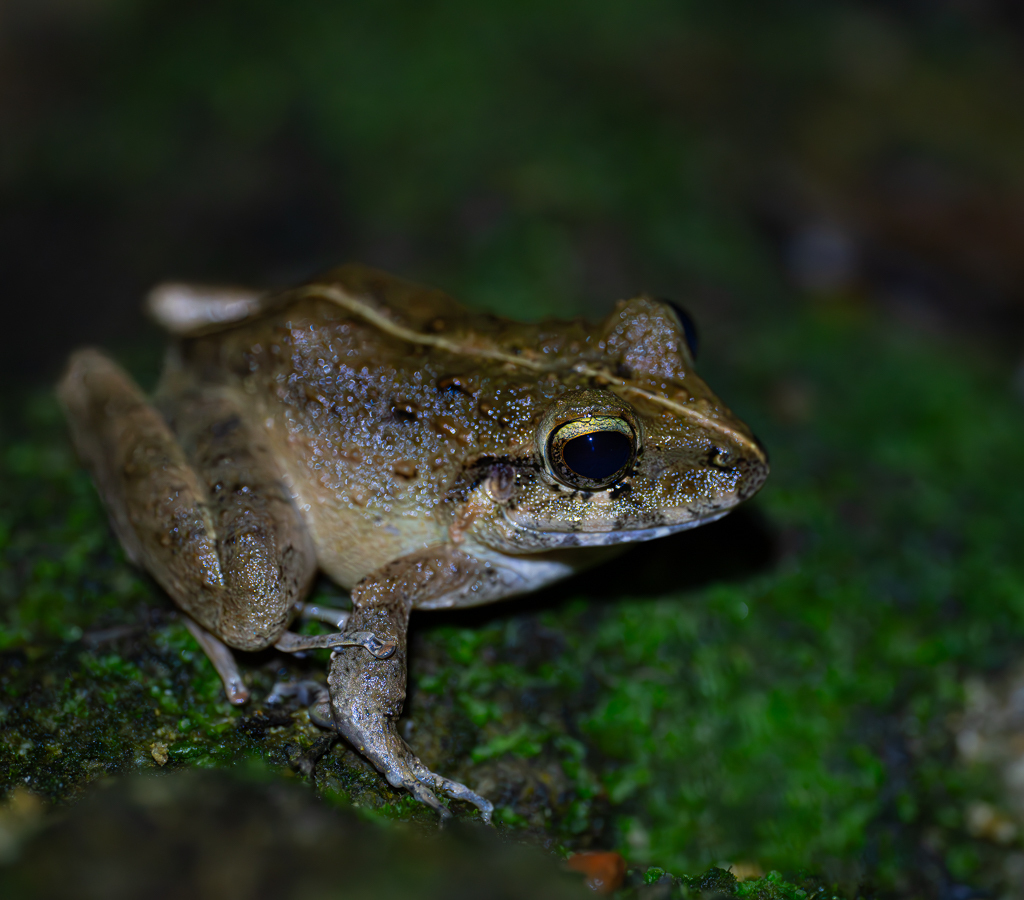
Long-Legged Streamfrog
Craugastor sabrinus
Craugastor sabrinus, also known as the long-legged streamfrog, is a species of frog in the family Craugastoridae. It is found in Belize and eastern Guatemala. The specific name sabrinus is derived from the Latin sabrina, meaning "river nymph", and alludes to the stream-side habitat of this species.
From the article Craugastor sabrinus on Wikipedia (CC BY-SA), quoted section by section
Description
Adult males measure 38–44 mm (1.5–1.7 in) and adult females 69–83 mm (2.7–3.3 in) in snout–vent length. The canthus rostralis is moderately sharp. The tympanum is distinct. Dorsal skin is smooth–granulate, with few scattered tubercles and weak parietal and supra-scapular ridges. The finger and toe discs are moderately developed, up to 1.5 times the digit width. The fingers and the toes have well-developed lateral keels or narrow flanges; the toes are moderately webbed. The dorsum is dark olive-brown, reddish brown, or tan. A yellow, orange, or tan vertebral line or stripe is sometimes present. A dark brown interorbital is present but is often ill-defined. The larger tubercles or folds are often tan or pale brown, with black edges. Limbs have darker brown bars that are not too conspicuous. The flanks are lighter. Males have whitish throat with dark mottling; the chest is whitish, grading to yellow on the belly. Females have less yellow on the belly.
Range & habitat
Craugastor sabrinus occurs in lowland and premontane wet and moist forests at elevations up to 900 m (3,000 ft) above sea level. It lives in and alongside pristine streams and does not occur in degraded forests, although it can be found in areas that have been farmed in the past. The eggs are laid on land and the development is direct (i.e., no free-living larval stage). This species has declined in Guatemala but is still common in Belize. It is threatened by habitat loss, which is principally caused by agricultural development, but also by logging, hydroelectric development, oil and mineral extraction, and expanding human population. It occurs in a number of protected areas.
== References ==
Wikipedia: “Habitat and conservation”
Listen
Looking for field recordings…
Where it lives
Recorded sightings
—
geo-referenced records in GBIF, from museums, herbaria and field observers.
Drag the globe to turn it. Dots are where records exist, not a range map; darker means more records.
In the stacks
Searching the stacks…
Every page naming Craugastor sabrinus in the Biodiversity Heritage Library →
This page is assembled live from iNaturalist, GBIF, Wikipedia, the Source Library and the Internet Archive. It is not yet part of the hand-edited codex. iNaturalist taxon 65295.