- Animals
- ›Chordates
- ›Vertebrates
- ›Amphibians
- ›Frogs and Toads
- ›Terraranas
- ›Fleshbelly and Terrestrial-breeding Frogs
- ›Fleshbelly Frogs
- ›Craugastor
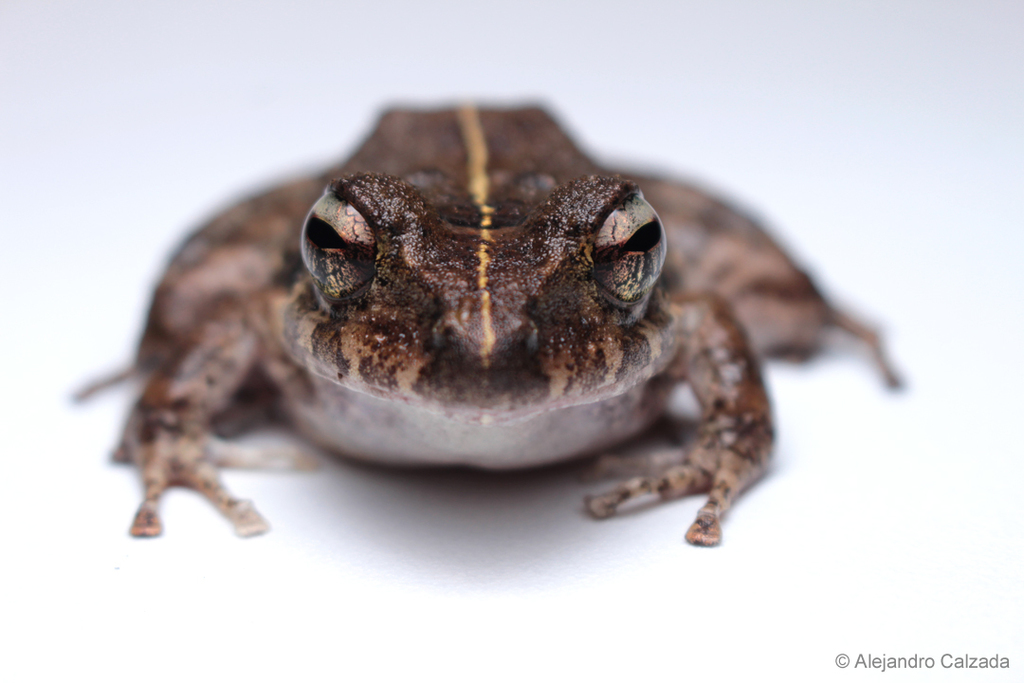
Volcan San Martin Rainfrog
Craugastor vulcani
Craugastor vulcani is a species of frog in the family Craugastoridae. It is endemic to the Sierra de los Tuxtlas range in southern Veracruz state, Mexico. Its name refers to its type locality on the San Martin Tuxtla volcano. Its natural habitats are premontane and lower montane wet forests where it occurs along streams. The species is likely impacted by habitat loss, and its distribution area is small, prompting classification as an endangered species.
From the article Craugastor vulcani on Wikipedia (CC BY-SA), quoted section by section
Description
Adult males measure 40–47 mm (1.6–1.9 in) in snout–vent length [although males as small 31 mm SVL had nuptial pads] and adult females 60–75 mm (2.4–3.0 in) SVL. The tympanum is distinct. The fingers and toes bear well-developed discs. The fingers have lateral keels while the toes have lateral flanges and are moderately webbed. The eyelids have numerous medium-sized, rounded tubercles. Skin of the dorsum is rugose with groups of tubercles and short glandular folds, and typically with well-defined parietal and suprascapular ridges. The dorsal coloration is variable: olive brown, reddish brown, or dark smokey gray, and either uniformly colored or with an irregular middorsal yellow or orange stripe; some individuals are mottled with dark brown. The sides are paler, usually pale yellow-brown or tan suffused with brown. The venter is cream to buff. Males have dark melanophores in their chest and belly while females have immaculate bellies. The iris is bronze.
Range & habitat
Craugastor vulcani occurs in premontane and lower montane wet forests at elevations up to 1,200 m (3,900 ft) above sea level. It occurs along streams. Development is direct (i.e., there is no free-living larval stage). The species is threatened by habitat loss (deforestation) and its distribution area is small, prompting classification as an endangered species. It occurs in the Los Tuxtlas Biosphere Reserve, but significant deforestation is occurring in this reserve.
== References ==
Wikipedia: “Habitat and conservation”
Listen
Looking for field recordings…
Where it lives
Recorded sightings
—
geo-referenced records in GBIF, from museums, herbaria and field observers.
Drag the globe to turn it. Dots are where records exist, not a range map; darker means more records.
In the stacks
Searching the stacks…
Every page naming Craugastor vulcani in the Biodiversity Heritage Library →
This page is assembled live from iNaturalist, GBIF, Wikipedia, the Source Library and the Internet Archive. It is not yet part of the hand-edited codex. iNaturalist taxon 65312.