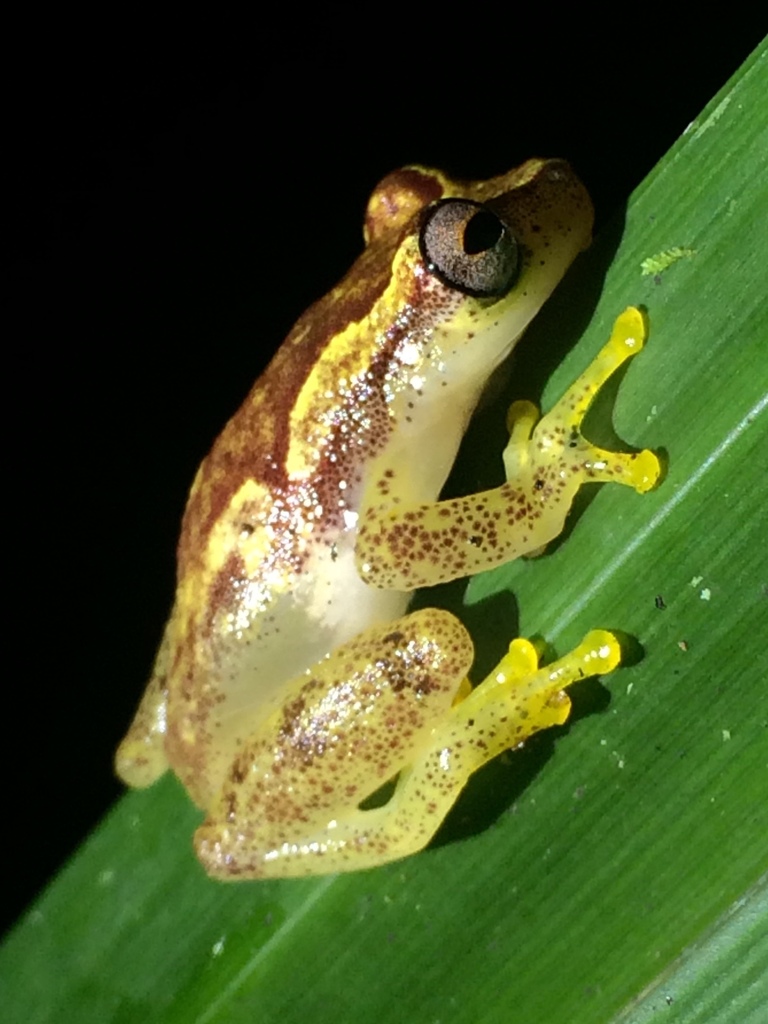
Haddad's Tree Frog
Dendropsophus haddadi
Dendropsophus haddadi is a species of frog in the family Hylidae. It is endemic to Brazil. Its natural habitats are subtropical or tropical moist lowland forests, subtropical or tropical moist shrubland, freshwater marshes, intermittent freshwater marshes, arable land, rural gardens, urban areas, heavily degraded former forest, and ponds.
From the article Dendropsophus haddadi on Wikipedia (CC BY-SA), quoted section by section
Description
Adult males measure 16–19 mm (0.6–0.7 in) and adult females 22–24 mm (0.9–0.9 in) in snout–vent length. The snout is short. The tympanum is distinct and relatively large. The canthus rostralis is distinct. The fingers and toes have rounded discs and are partially webbed. Dorsal coloration is variable, but most individuals are dark brown with white snout and stripes running laterally to the inguinal region.
Range & habitat
Dendropsophus haddadi occurs in coastal rainforest and in scrubby coastal "restinga" vegetation, as well as in gardens, farmland, and towns, at elevations below 650 m (2,130 ft). It breeds in permanent bonds and can be spotted on vegetation around these. It is a common and very adaptable species that is not facing any threats. It is present in many protected areas.
== References ==
Wikipedia: “Habitat and conservation”
Listen
Looking for field recordings…
Where it lives
Recorded sightings
—
geo-referenced records in GBIF, from museums, herbaria and field observers.
Drag the globe to turn it. Dots are where records exist, not a range map; darker means more records.
In the stacks
Searching the stacks…
Every page naming Dendropsophus haddadi in the Biodiversity Heritage Library →
This page is assembled live from iNaturalist, GBIF, Wikipedia, the Source Library and the Internet Archive. It is not yet part of the hand-edited codex. iNaturalist taxon 65357.