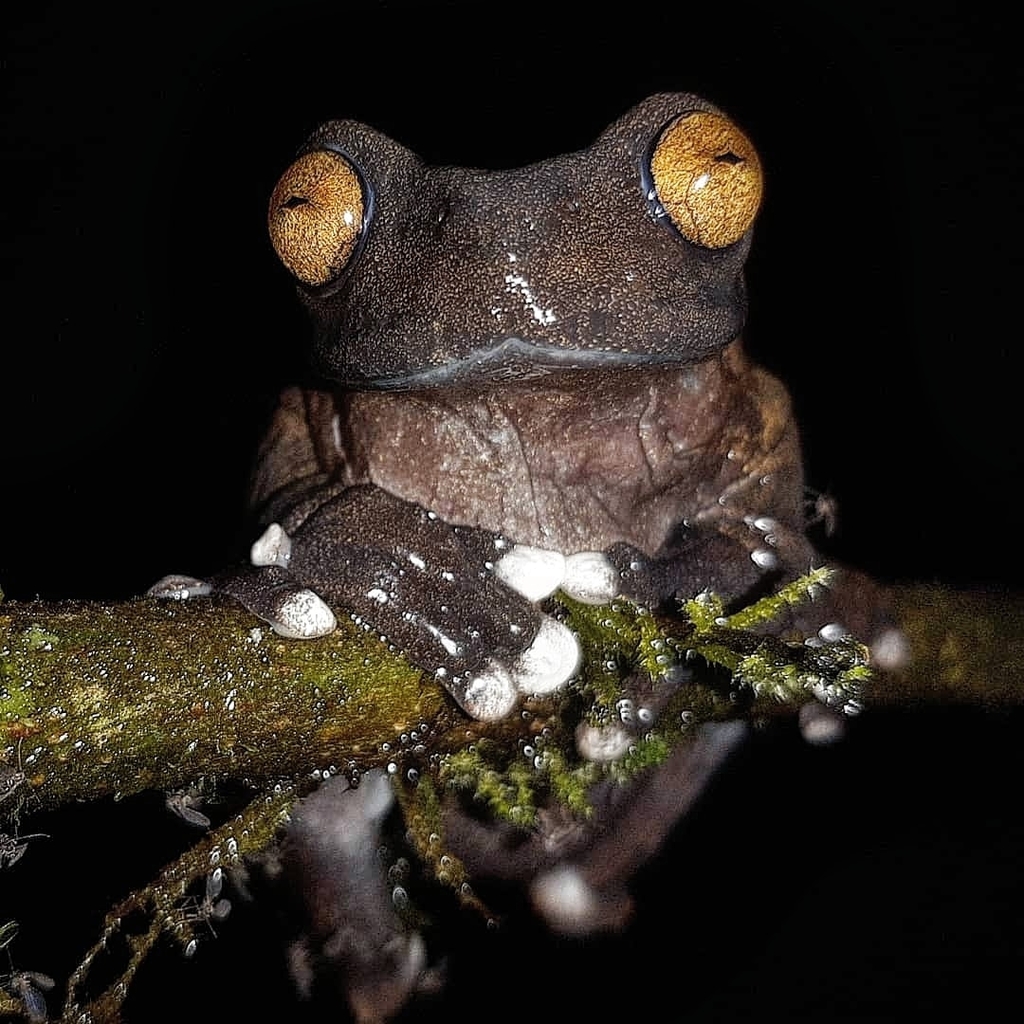
Tapichalaca Tree Frog
Hyloscirtus tapichalaca
Hyloscirtus tapichalaca is a species of frog in the family Hylidae. It is endemic to Ecuador and only known from the vicinity of its type locality in the Tapichalaca Biological Reserve, Zamora-Chinchipe Province. It is named after the type locality, which is a reserve owned by the Fundación de Conservación Jocotoco. Hyloscirtus tapichalaca belongs to the Hyloscirtus larinopygion group, although its placement with the group is uncertain; it may be the sister taxon of all other species in the group.
From the article Hyloscirtus tapichalaca on Wikipedia (CC BY-SA), quoted section by section
Description
Adult males measure 59–64 mm (2.3–2.5 in) and adult females 62–67 mm (2.4–2.6 in) in snout–vent length. The body and the limbs are robust. The snout is nearly truncate in lateral view. The tympanum is distinct, and the supratympanic fold is thick, obscuring its posterodorsal edge. The fingers, and the toes are broad, bear large discs, and have webbing. The dorsum is gray to pale brown, and the flanks are gray to gray brown. The digital discs, lateral and lower margins of vent, knees, elbows, and outer margin of forearms are white. The iris is yellow-gold. Males have a single subgular vocal sac.
Range & habitat
The type locality is a small cascading stream in montane cloud forest. There are records from elevations of 1,637 to 2,697 m (5,371 to 8,848 ft) above sea level. Males have been observed calling from branches by stream margins. Threats to this species are unknown. The type locality is a protected area. Habitat degradation likely occurs outside the reserve.
== References ==
Wikipedia: “Habitat and conservation”
What it does
The male advertisement call consists of a single, unpulsed note of variable duration (0.14–0.19 seconds). The calls are emitted at irregular time intervals (0.7–1.2 seconds apart), most of them clustered in bouts. Scars in the males suggest male-male combats. A 62-mm female contained 428 ovarian eggs some 3 mm (0.1 in) in diameter. The tadpoles probably develop in streams.
Wikipedia: “Reproduction”
Listen
Looking for field recordings…
Where it lives
Recorded sightings
—
geo-referenced records in GBIF, from museums, herbaria and field observers.
Drag the globe to turn it. Dots are where records exist, not a range map; darker means more records.
In the stacks
Searching the stacks…
Every page naming Hyloscirtus tapichalaca in the Biodiversity Heritage Library →
This page is assembled live from iNaturalist, GBIF, Wikipedia, the Source Library and the Internet Archive. It is not yet part of the hand-edited codex. iNaturalist taxon 65670.