- Animals
- ›Chordates
- ›Vertebrates
- ›Amphibians
- ›Frogs and Toads
- ›Poison Frogs
- ›Poison Dart Frogs
- ›Hyloxalinae
- ›Hyloxalus
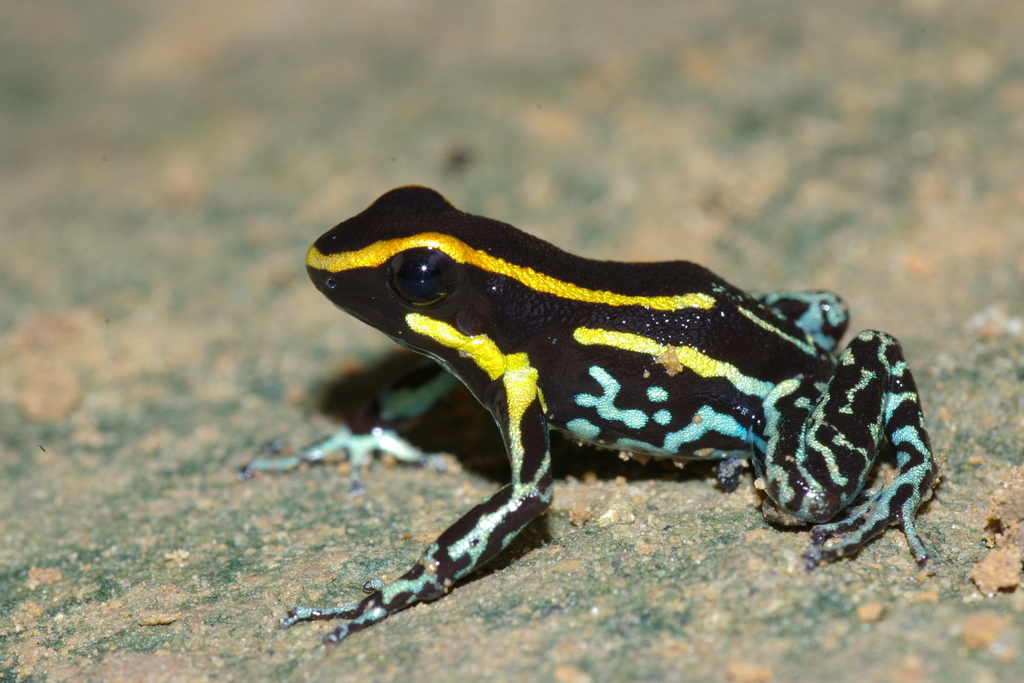
Sky Blue Rocket Frog
Hyloxalus azureiventris
The sky-blue poison frog (Hyloxalus azureiventris) is a species of poison dart frog. It is endemic to Peru and known from the lower eastern versant of the Andes in the upper Amazon basin of the San Martín Region.
From the article Sky-blue poison frog on Wikipedia (CC BY-SA), quoted section by section
Description
The adult frog measures about 27 mm long in snout-vent length. The frog's skin has a black base color with bright aposematic coloration. There are yellow stripes reaching from the nose over the eyes to the back legs. There are more yellow stripes from the nose to the front legs. The upper surfaces of the back, front legs, and back legs have blue-green marbling. The flanks are black in color, and all four legs have bright blue marks.
Range & habitat
The species habitat is primarily lowland tropical rainforests as well as inland wetlands of Peru. The adult frog seems to prefer caves and rock piles, but juvenile frogs have been observed in the leaf litter. Little is known about the species' adaptability to modified habitats. This frog has been observed between 200 and 1200 meters above sea level. This frog's range includes at least one protected park: Cordillera Escalera Regional Conservation Area.
Wikipedia: “Habitat and ecology”
What it does
People hear the male frogs calling to the female frogs at dusk. They perch on rocks or sit in crevices. The female frog lays 12–16 eggs in water in coconut shells, in hollows in the leaf litter, or in water in bromeliad plants. The male frogs guard the eggs during the two weeks they take to hatch. After that, the male frogs carry the tadpoles to water in streams, bromeliad plants, or even water-filled fallen palm leaves. The tadpoles can grow to 11.5 mm. The end of the tail is round. Each tadpole has five rows of teeth, two on top and three on the bottom. The tadpoles are dark gray in color.
Wikipedia: “Reproduction”
Listen
Looking for field recordings…
Where it lives
Recorded sightings
—
geo-referenced records in GBIF, from museums, herbaria and field observers.
Drag the globe to turn it. Dots are where records exist, not a range map; darker means more records.
In the stacks
Searching the stacks…
Every page naming Hyloxalus azureiventris in the Biodiversity Heritage Library →
This page is assembled live from iNaturalist, GBIF, Wikipedia, the Source Library and the Internet Archive. It is not yet part of the hand-edited codex. iNaturalist taxon 65676.