- Animals
- ›Chordates
- ›Vertebrates
- ›Amphibians
- ›Frogs and Toads
- ›Poison Frogs
- ›Poison Dart Frogs
- ›Hyloxalinae
- ›Hyloxalus
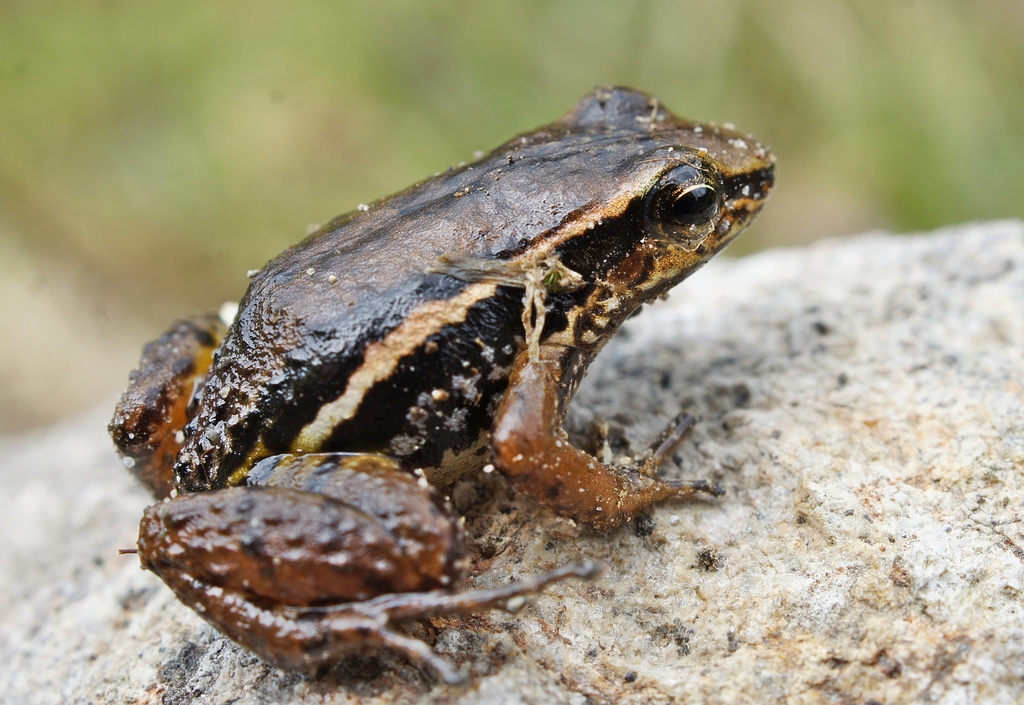
Lehmann's Rocket Frog
Hyloxalus lehmanni
Hyloxalus lehmanni is a species of frog in the family Dendrobatidae. It is found widely in Colombia from Antioquia southwards along the Cordillera Occidental and Cordillera Central to northern Ecuador (Cotopaxi Province).
From the article Hyloxalus lehmanni on Wikipedia (CC BY-SA), quoted section by section
Description
Males measure 15–20 mm (0.59–0.79 in) and females 17–23 mm (0.67–0.91 in) in snout–vent length. Abdomen is black in males but white or gray in females. An oblique lateral stripe that extends to eye is present.
Range & habitat
Its natural habitats are very humid montane forest, but it has also been found in open fields and very modified areas. It always occurs near streams. Its altitudinal range is 1,500–2,580 m (4,920–8,460 ft) in Colombia and 1,460–2,120 m (4,790–6,960 ft) in Ecuador. The frog's range includes several protected parks, including Parque Nacional Sumaco Napo-Galeras, Reserva Ecológica Cayambe-Coca, and Reserva Natural Comunitaria El Manantial Florencia. Hyloxalus lehmanni is common in Colombia, but has dramatically declined in Ecuador, possibly due to chytridiomycosis. Also habitat loss, introduction of alien predatory fish, and pollution are threats. Scientists also cite deforestation in favor of legal farms, illegal farms, timber harvesting, and sites for human habitation as threats. Spraying of illegal crops also creates pollution that affects this species.
== References ==
Wikipedia: “Habitat and conservation”
Listen
Looking for field recordings…
Where it lives
Recorded sightings
—
geo-referenced records in GBIF, from museums, herbaria and field observers.
Drag the globe to turn it. Dots are where records exist, not a range map; darker means more records.
In the stacks
Searching the stacks…
Every page naming Hyloxalus lehmanni in the Biodiversity Heritage Library →
This page is assembled live from iNaturalist, GBIF, Wikipedia, the Source Library and the Internet Archive. It is not yet part of the hand-edited codex. iNaturalist taxon 65695.