- Animals
- ›Chordates
- ›Vertebrates
- ›Amphibians
- ›Frogs and Toads
- ›Poison Frogs
- ›Poison Dart Frogs
- ›Hyloxalinae
- ›Hyloxalus
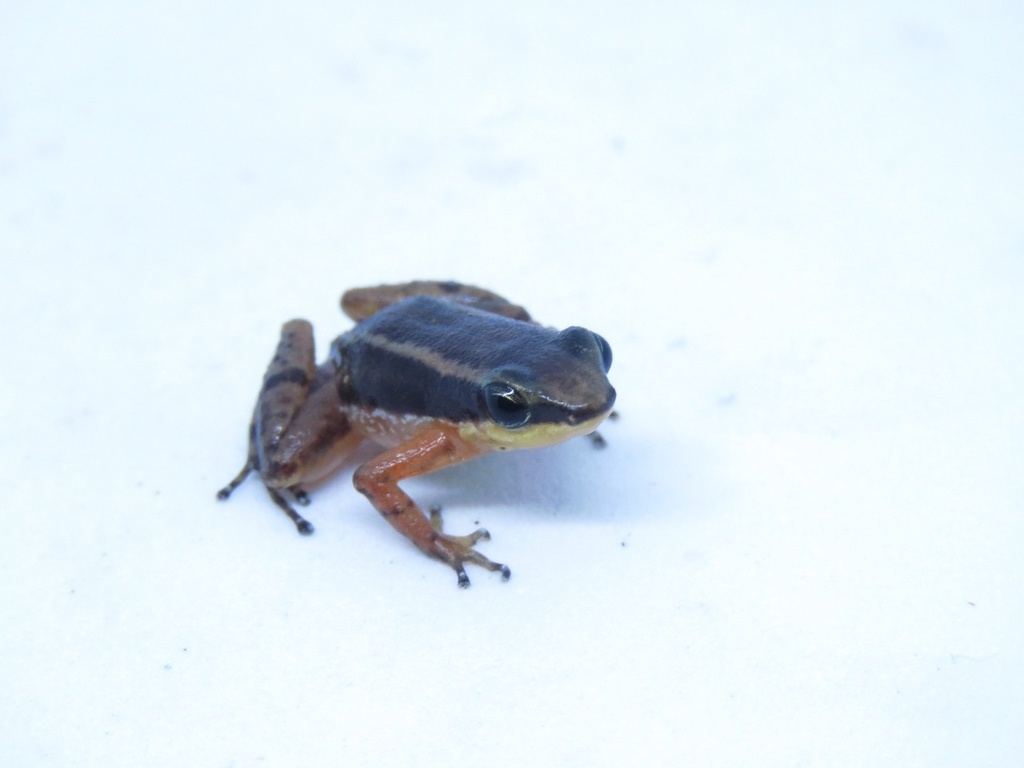
Santiago Rocket Frog
Hyloxalus shuar
Hyloxalus shuar is a species of frog in the family Dendrobatidae. It is endemic to Ecuador and Peru and is currently known from only two locations, though formerly widespread. The common English-language names Santiago rocket frog and Shuar rocket frog have been proposed for it.
From the article Hyloxalus shuar on Wikipedia (CC BY-SA), quoted section by section
Description
Males measure 24–31 mm (0.94–1.22 in) and females 25–32 mm (0.98–1.26 in) in snout–vent length. The frog has an uninterrupted lateral line down each side of its body. The male frog has a gray throat and white testicles.
Range & habitat
Its natural habitats are premontane and cloud forests at around 1270 to 2370 m above sea level. This frog was once more widespread, but scientists have only recently confirmed it in two places: One place in Santa Rosa in Peru and one place in Morona Santiago in Ecuador. Regarding the frog's habits, scientists caught one specimen under vegetation at night and others active on the forest floor during the day. The frog's range once included several protected parks, none of which are believed to host any as of 2023: Parque Nacional Sumaco Napo-Galeras, Parque Nacional Sangay, Parque Nacional Llanganates, the Reserva Ecológica Antisana, and the Reserva Ecológica Cayambe-Coca.
Wikipedia: “Habitat and conservation”
What it does
Scientists believe that the female frog lays eggs on the ground and the male frog carries the tadpoles to water after they hatch, but none have reported observing this.
Wikipedia: “Reproduction”
In human culture
Scientists named this frog after the Shuar indigenous people, also known as Jíbaros. A team of Shuar helped scientist John E. Edwards on his surveys through the Cordillera del Cóndor.
Wikipedia: “Etymology”
Listen
Looking for field recordings…
Where it lives
Recorded sightings
—
geo-referenced records in GBIF, from museums, herbaria and field observers.
Drag the globe to turn it. Dots are where records exist, not a range map; darker means more records.
In the stacks
Searching the stacks…
Every page naming Hyloxalus shuar in the Biodiversity Heritage Library →
This page is assembled live from iNaturalist, GBIF, Wikipedia, the Source Library and the Internet Archive. It is not yet part of the hand-edited codex. iNaturalist taxon 65714.