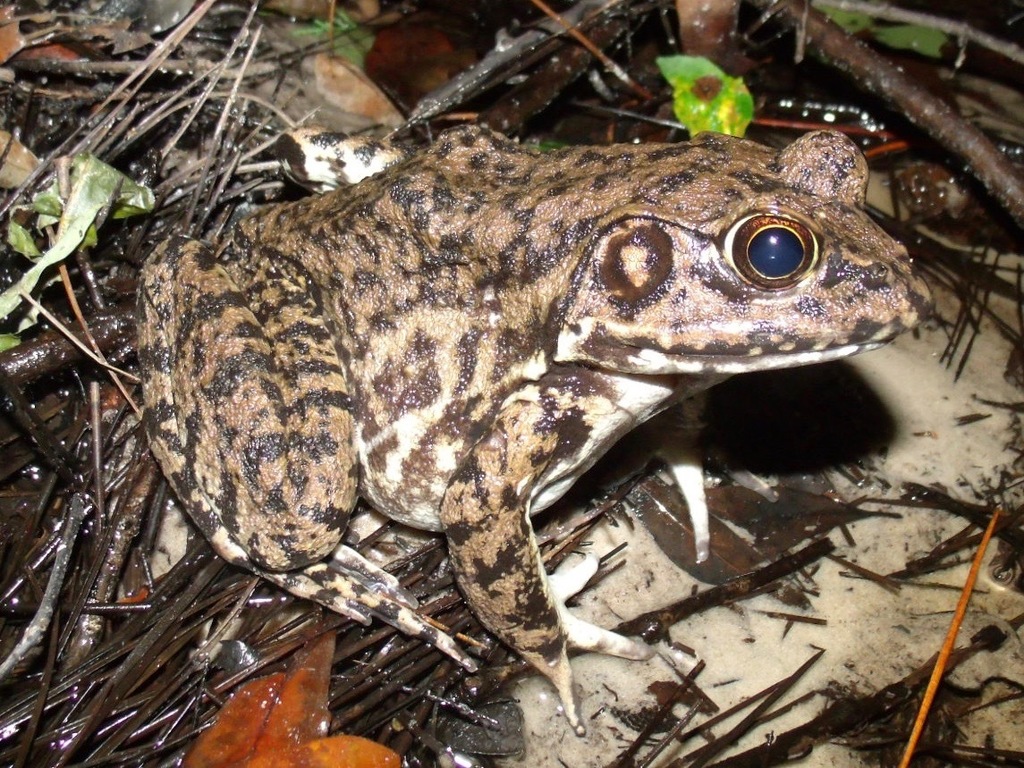
River Frog
Lithobates heckscheri
The river frog (Lithobates heckscheri) is a species of aquatic frog in the family Ranidae. It is endemic to the southeastern United States. Its natural habitats are temperate rivers, swamps, freshwater lakes and freshwater marshes. It is threatened by habitat loss.
From the article Lithobates heckscheri on Wikipedia (CC BY-SA), quoted section by section
Description
The river frog is a very large species with adults commonly between 7 and 13 cm (3 and 5 in) in length. The skin is rough and wrinkled but there are no dorso-lateral ridges as there are in the green frog (Lithobates clamitans). The back is some shade of dark green or blackish-green and the belly is dark grey, or blackish with pale wavy lines and specks. A distinctive characteristic is white spots on the lips, particularly on the lower lip, and this helps to distinguish this species from bullfrogs (Rana catesbeiana) and pig frogs (Rana grylio). Another distinguishing feature is a pale band outlining the groin. Males have a yellowish throat and their tympani (eardrums) are larger than their eyes while those of females are smaller.
Range & habitat
The river frog is endemic to the Atlantic and Gulf coastal plains of the southeastern United States. Its range at least formerly extended southwards from the southern part of North Carolina to southeastern Mississippi and northern Florida; it is now thought to have been extirpated from North Carolina due to habitat loss. Its typical habitat is marshes and other wet locations with emergent vegetation near streams, rivers, ponds and lakes.
Wikipedia: “Distribution and habitat”
Listen
Looking for field recordings…
Where it lives
Recorded sightings
—
geo-referenced records in GBIF, from museums, herbaria and field observers.
Drag the globe to turn it. Dots are where records exist, not a range map; darker means more records.
In the stacks
Searching the stacks…
Every page naming Lithobates heckscheri in the Biodiversity Heritage Library →
This page is assembled live from iNaturalist, GBIF, Wikipedia, the Source Library and the Internet Archive. It is not yet part of the hand-edited codex. iNaturalist taxon 65987.