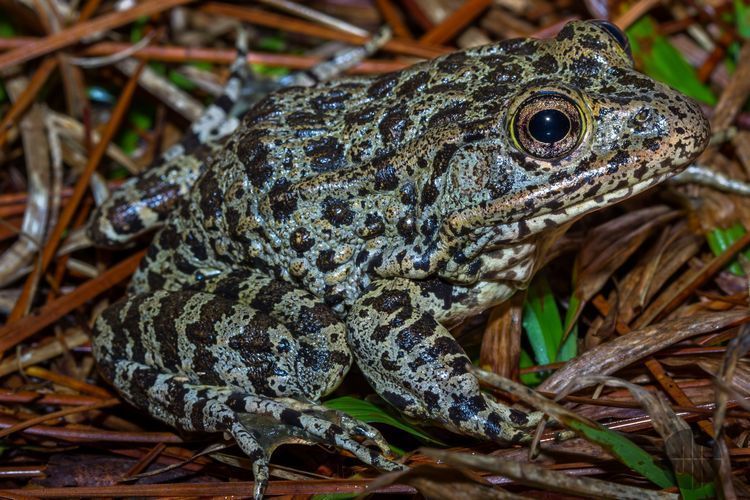
Dusky Gopher Frog
Lithobates sevosus
The Mississippi gopher frog (Lithobates sevosus), also known commonly as the dark gopher frog, the dusky gopher frog, and the St. Tammany gopher frog, is a critically endangered species of frog in the family Ranidae (true frogs). The species is endemic to the southern United States. Its natural habitats are temperate coastal forests and intermittent freshwater marshes. This secretive frog is on average 3 in (8 cm) long, with a dark brown or black dorsal surface covered in warts. It is a federally listed endangered species of the United States.
From the article Mississippi gopher frog on Wikipedia (CC BY-SA), quoted section by section
Description
The Mississippi gopher frog is a mid-sized, stocky, frog with a total body length of about 3 in (8 cm). The frog's back ranges in color from black to brown or gray and is covered with dark spots and warts. The male's call has been compared to the sound of human snoring. Another notable feature of this secretive frog is that, when exposed to bright light or threatened, the frog will put its hands in front of its face to shield its eyes. Other defense responses include inflating its body and excretion of a bitter, milky fluid from warty glands located on its back. Maximum longevity of the frog is six to 10 years. The diet of adult Mississippi gopher frogs probably includes frogs, toads, insects, spiders, and earthworms. Males reach sexual maturity at four to six months and females at two to three years. The fist-sized egg masses, containing 2,000 or more eggs, are typically attached to stems of emergent vegetation. Tadpoles average slightly over 1 in (3 cm) long and require 80 to 180 days to complete metamorphosis in the field. The Mississippi gopher frog possesses several defense mechanisms in its immune system that are unique to Lithobates sevous. The frog's innate immune system is adept at recognizing outside prokaryotic pathogens. Lithobates sevous reacts quickly to exterior pathogens, effectively limiting the extent of infections in the early hours after exposure. …
Wikipedia: “Characteristics”
Range & habitat
The Mississippi gopher frog was once abundant along the Gulf Coastal Plain in lower Louisiana, Mississippi, and Alabama – from east of the Mississippi River Delta to Mobile Bay. However, it has not been seen in Alabama since 1922 or in Louisiana since 1967. Presently, only two known populations exist, with about 100 frogs to be found in Glen's Pond, Harrison County, Mississippi. The other population is less dense and spread out through the surrounding wetlands, recently found to concentrate around Mike's Pond, Jackson County, Mississippi. Currently, the range of Lithobates sevosus is decreasing at a dramatic rate due to urban sprawl, deforestation, and even fire suppression that destroys the possibility of sunlight reaching down to the wetlands, critical for the growth of the frogs' immediate habitat. Currently, the two known populations of Lithobates sevosus are separated by only 32 km (20 mi).
Wikipedia: “Geographic range”
What it does
The Mississippi gopher frog was listed as endangered by the state of Mississippi in 1992 and by the US Fish and Wildlife Service in 2001. The only known remaining population of the Mississippi gopher frog consists of about 100 adult frogs from one site in Harrison County, Mississippi (Glen's Pond). Several possible sites are located in Jackson County, Mississippi. The Mississippi gopher frog is among rarest amphibians in North America, if not the rarest. There were two known places of the Mississippi gopher frog. They were Glen's Pond at Harrison County, Mississippi, and Mike's Pond at Jackson County, Mississippi. Scientists discovered a population of Mississippi gopher frogs at Mike's Pond in 2004. Due to conservation efforts, the frog's trajectory has turned around. While the species remains critically endangered and still relies on intensive interventions, its numbers have grown to around 600 adults, spread out over some 15 ponds and a handful of captive populations that now produce offspring. Population shifts in this species are mainly due to adult mortality, difference in ages at maturity, and a lack of adults returning to mate. …
Wikipedia: “Population and reproduction”
Listen
Looking for field recordings…
Where it lives
Recorded sightings
—
geo-referenced records in GBIF, from museums, herbaria and field observers.
Drag the globe to turn it. Dots are where records exist, not a range map; darker means more records.
In the stacks
Searching the stacks…
Every page naming Lithobates sevosus in the Biodiversity Heritage Library →
This page is assembled live from iNaturalist, GBIF, Wikipedia, the Source Library and the Internet Archive. It is not yet part of the hand-edited codex. iNaturalist taxon 66008.